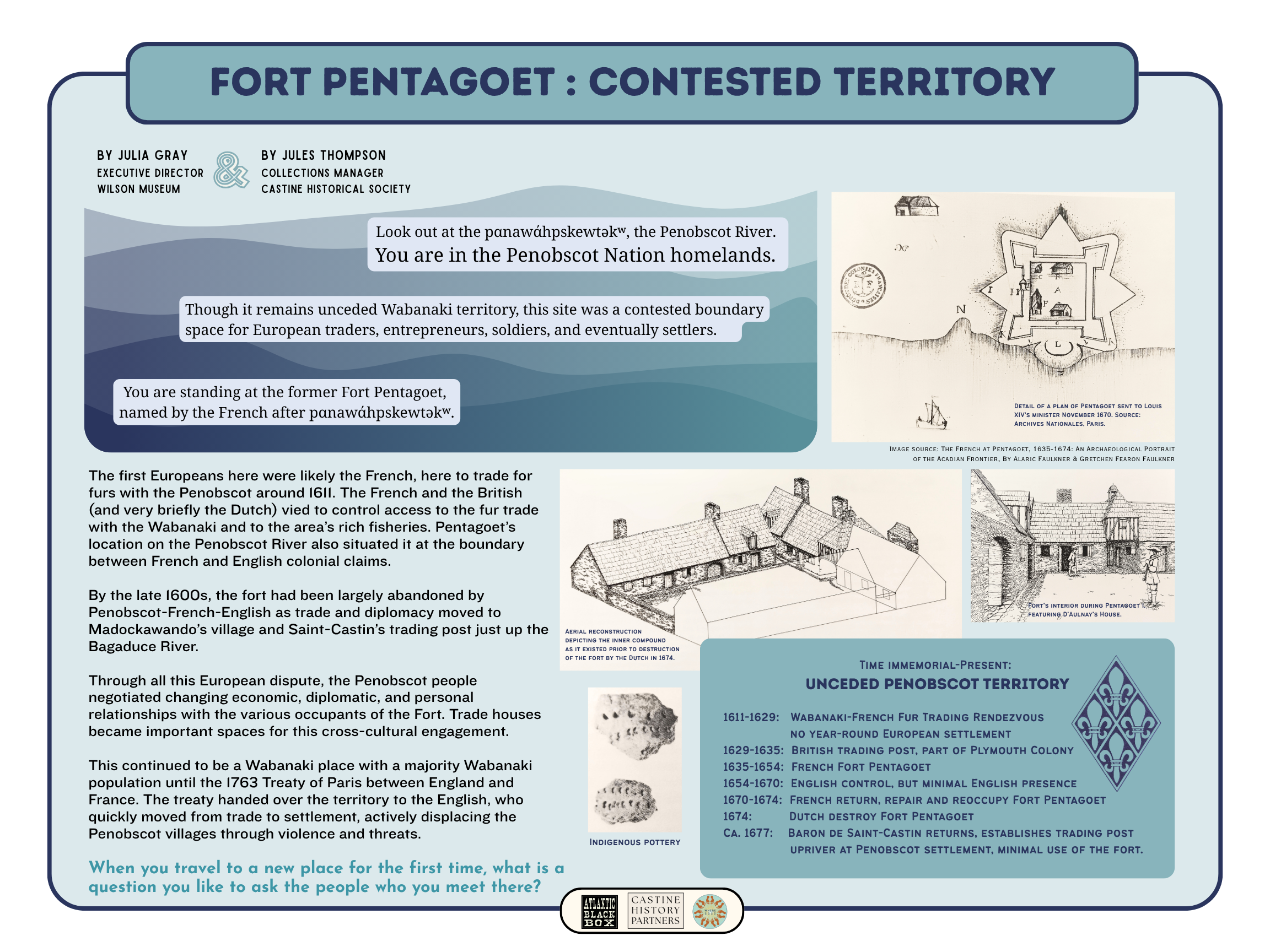
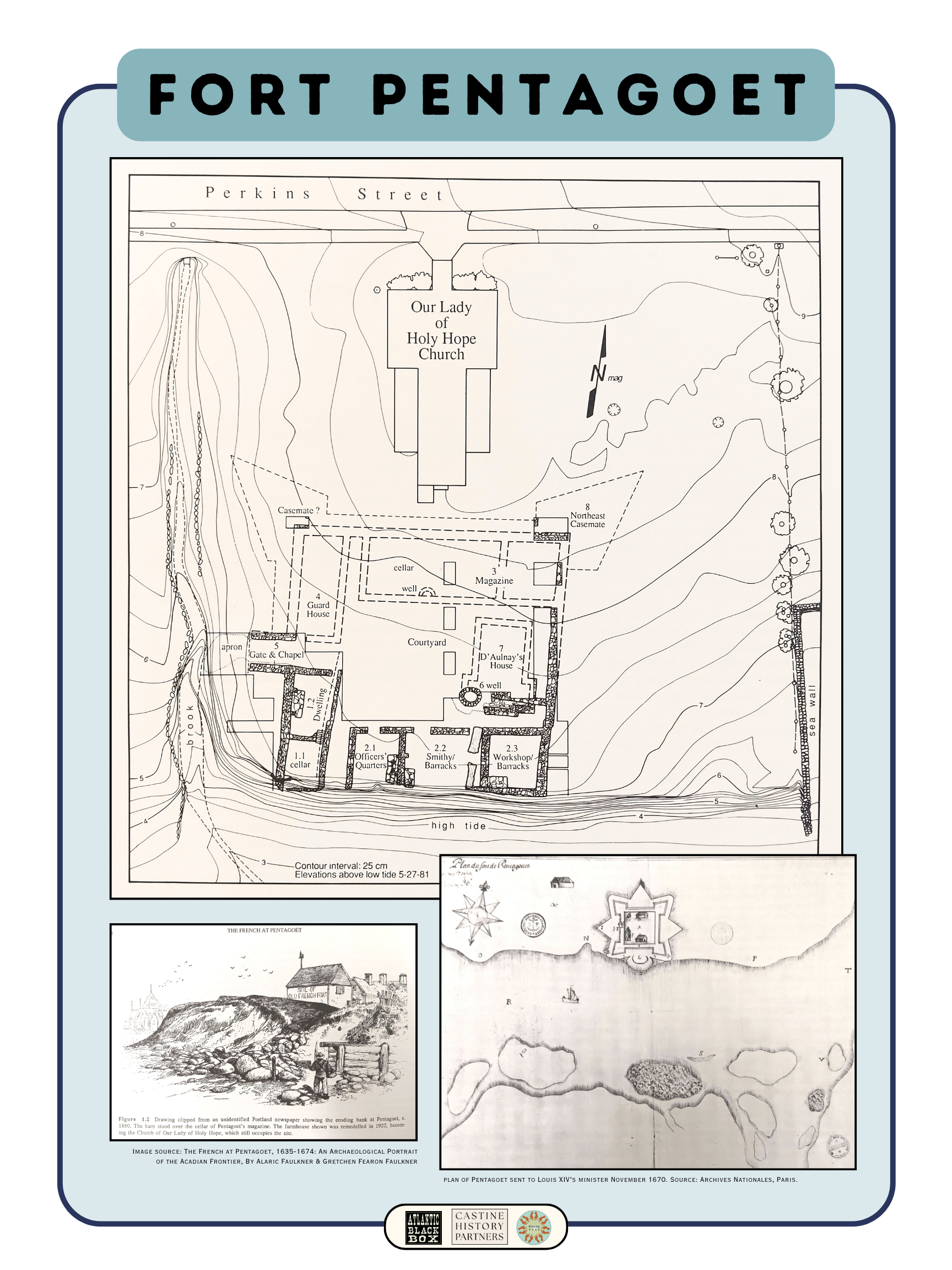
Fort Pentagoet : Contested territory
Look out at the pαnawάhpskewtəkʷ, the Penobscot River.
You are in the Penobscot Nation homelands.
Though it remains unceded Wabanaki territory, this site was a contested boundary space for European traders, entrepreneurs, soldiers, and eventually settlers.
You are standing at the former Fort Pentagoet, named by the French after pαnawάhpskewtəkʷ.
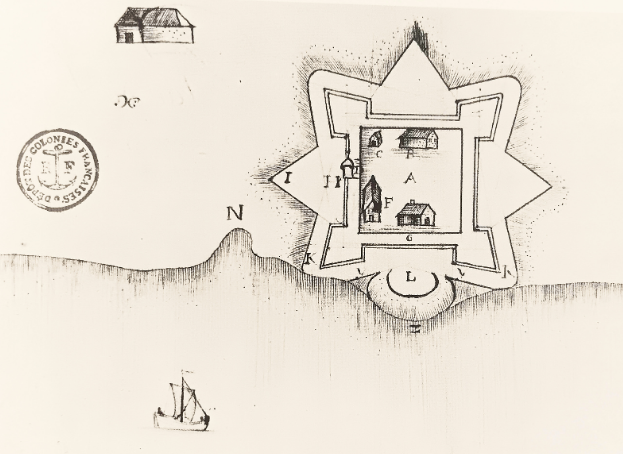
Detail of a plan of Pentagoet sent to Louis XIV’s minister November 1670. Source: Archives Nationales, Paris
Image source: The French at Pentagoet, 1635-1674: An Archaeological Portrait of the Acadian Frontier, by Alaric Faulkner & Gretchen Fearon Faulkner
The first Europeans here were likely the French, here to trade for furs with the Penobscot around 1611. The French and the British (and very briefly the Dutch) vied to control access to the fur trade with the Wabanaki and to the area’s rich fisheries. Pentagoet’s location on the Penobscot River also situated it at the boundary between French and English colonial claims.
By the late 1600s, the fort had been largely abandoned by Penobscot-French-English as trade and diplomacy moved to Madockawando’s village and Saint-Castin’s trading post just up the Bagaduce River.
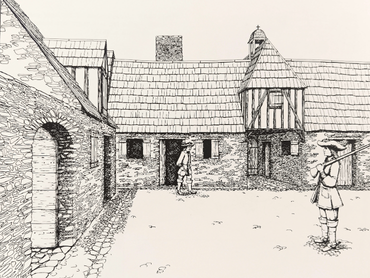
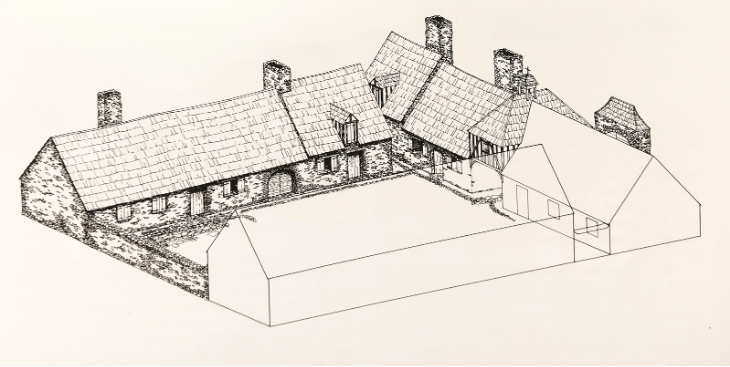
Through all this European dispute, the Penobscot people negotiated changing economic, diplomatic, and personal relationships with the various occupants of the Fort. Trade houses became important spaces for this cross-cultural engagement.
This continued to be a Wabanaki place with a majority Wabanaki population until the 1763 Treaty of Paris between England and France. The treaty handed over the territory to the English, who quickly moved from trade to settlement, actively displacing the Penobscot villages through violence and threats.
Time Immemorial-Present: Unceded Penobscot Territory
1611-1629 Wabanaki-French Fur Trading Rendezvousno year-round European settlement
1629-1635 British trading post, part of Plymouth Colony
1635-1654 French Fort Pentagoet
1654-1670 English control, but minimal English presence
1670-1674 French return, repair and reoccupy Fort Pentagoet
1674 Dutch destroy Fort Pentagoet
Ca. 1677 Baron de Saint-Castin returns, establishes trading post upriver at Penobscot settlement, minimal use of the fort.
This research was compiled as part of the Mači-pikʷátohsək: A Wayfinding Walk which took place in Castine on October 5, 2025. For more information about this walk, click here. For more research related to this area, click on the tags below. To download a hi-res version of the posters below for educational use, please contact where@atlanticblackbox.com.
This event was a collaboration between Castine History Partners (CHP) and the Walks for Historical & Ecological Recovery (WHERE), a series convened by Atlantic Black Box.
Castine History Partners is a collaboration originally established to create virtual history tours for Castine. CHP supports a variety of learning opportunities around the history of Castine. The partners include Castine Community Partners, Castine Historical Society, Castine Touring Company, Maine Coast Heritage Trust, Maine Maritime Academy, Wilson Museum, and Witherle Memorial Library.