Maine in the West Indies
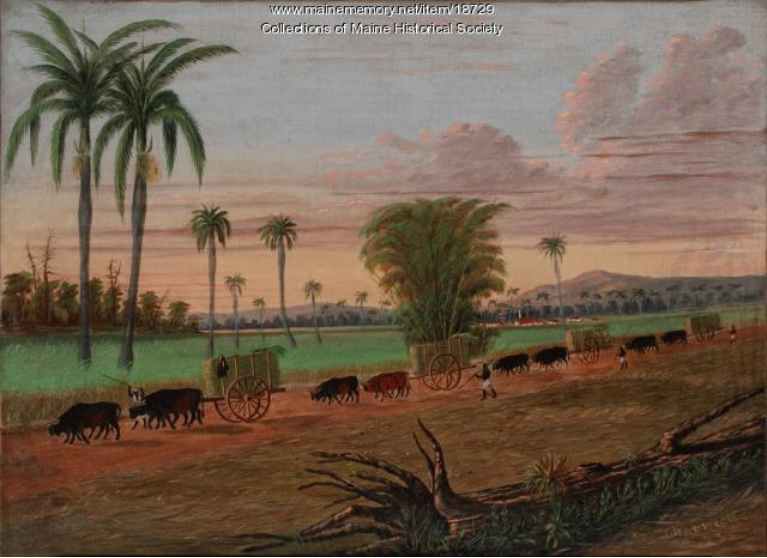
William F. Chadwick of Portland painted the scene to the left, depicting a sugar harvest in Cuba in 1873. He was the son of prominent merchant Samuel Chadwick. The family's Portland-based vessels traded for molasses in Guadeloupe and Cuba.
During the years Chadwick lived in Matanzas, Cuba (1870-1876), he would have witnessed the murderous conditions of the sugar cane fields and the exacting labor extracted from enslaved men, women, & children of African heritage.
But that is not what he chose to paint.
Though Britain and the U.S. abolished their slave trades in 1807 and 1808 respectively, Cuba remained one of the most common destinations for slaving vessels through the 1860s, an era during which the island produced nearly one-third of the world's sugar. Slavery continued legally in Cuba until 1886. Cuba was Portland’s no.1 trading partner for much of the 19th century.
(Text adapted from Maine Memory Network.)
Shown in their dooryard at 249 Congress Street, Portland, are, from left, Dr. George H. Chadwick and Samuel Chadwick. At the right is painter William F. Chadwick. The groom is identified only as “a native of Cuba.”
See more at Maine Memory Network
In exchange for the sugar, molasses, and rum that were shipped to Maine, merchants from this region provided a large variety of goods that were used to build and service plantations on the islands of the Caribbean. Maine vessels also exported food stuffs that fed enslaved Africans.
According to The Maritime History of Maine, written by William Rowe in 1948,
"Then also there were house frames all ready to put up, oxen and horses for the plow, the sugar and the treadmill, farm produce such as parsnips, potatoes, onions, and grain, beef, mutton, pork, pickled fish, soap, candles, and dried codfish in “drums” of from five to eight hundred pounds each….Lumber from the banks of Maine rivers which cost there $8.00 a thousand sold in Havana for $60.00. Beets and parsnips brought $16.00 a barrel in the French Islands…”
Remarkably, Rowe devotes an entire chapter of his book to the West Indies Trade without ever mentioning the enslaved Africans who labored in horrific conditions to produce luxury goods consumed in Maine.
This research was compiled as part of The Walk to Unsettle Portland, which took place in Portland on June 22, 2024. For more information about this walk, click here.
For more research related to this area, click on the tags below. To download a hi-res version of the posters below for educational use, please contact where@atlanticblackbox.com.
This walk was a collaboration with The Third Place, Maine Audubon, and Atlantic Black Box.