Native vs. Invasive
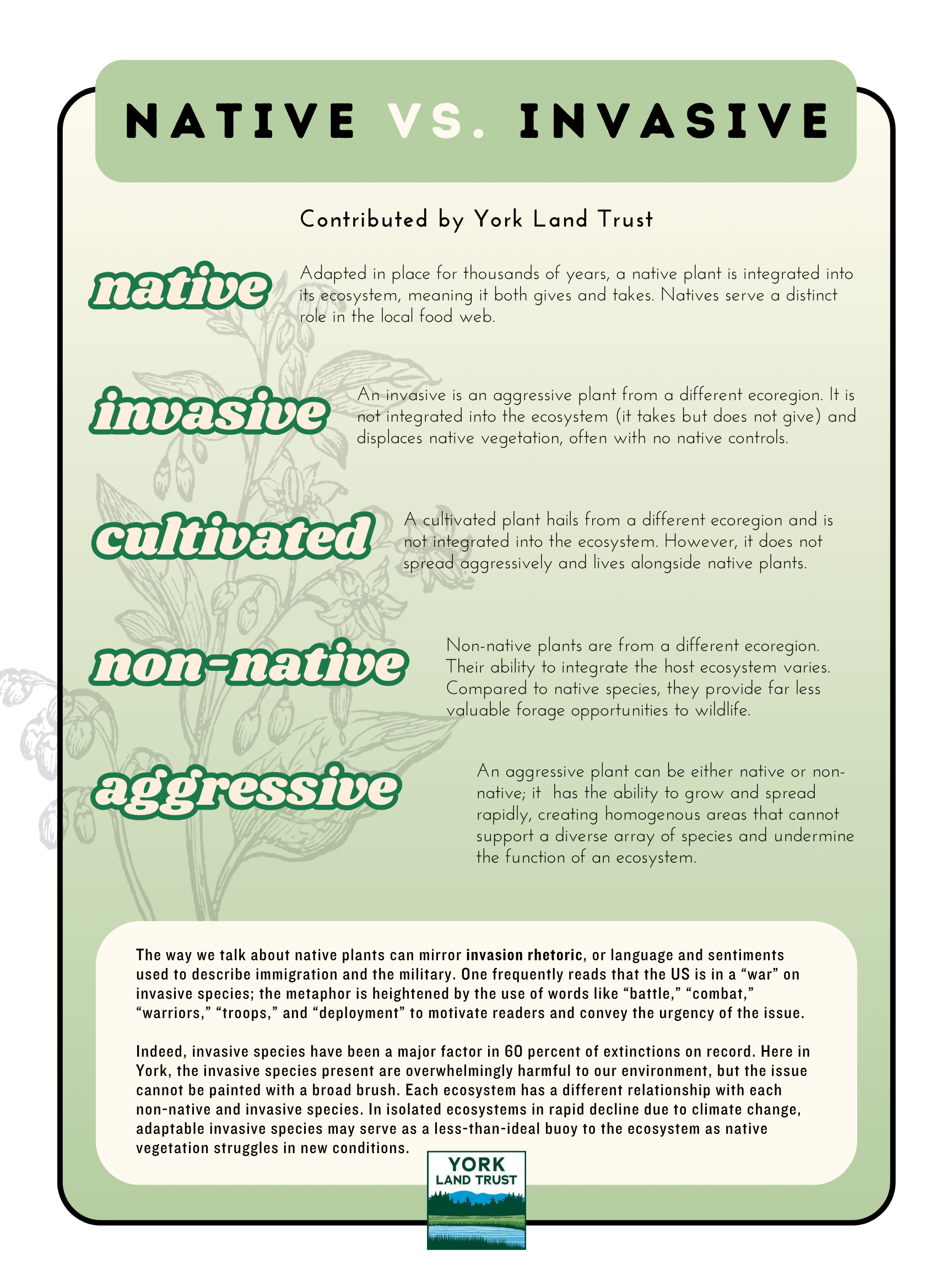
The way we talk about native plants can mirror invasion rhetoric, or language and sentiments used to describe immigration and the military. One frequently reads that the US is in a “war” on invasive species; the metaphor is heightened by the use of words like “battle,” “combat,” “warriors,” “troops,” and “deployment” to motivate readers and convey the urgency of the issue.
Indeed, invasive species have been a major factor in 60 percent of extinctions on record. Here in York, the invasive species present are overwhelmingly harmful to our environment, but the issue cannot be painted with a broad brush. Each ecosystem has a different relationship with each non-native and invasive species. In isolated ecosystems in rapid decline due to climate change, adaptable invasive species may serve as a less-than-ideal buoy to the ecosystem as native vegetation struggles in new conditions.
Native - Adapted in place for thousands of years, a native plant is integrated into its ecosystem, meaning it both gives and takes. Natives serve a distinct role in the local food web.
Invasive - An invasive is an aggressive plant from a different ecoregion. It is not integrated into the ecosystem (it takes but does not give) and displaces native vegetation, often with no native controls.
Cultivated - A cultivated plant hails from a different ecoregion and is not integrated into the ecosystem. However, it does not spread aggressively and lives alongside native plants.
Non-native - Non-native plants are from a different ecoregion. Their ability to integrate the host ecosystem varies. Compared to native species, they provide far less valuable forage opportunities to wildlife.
Aggressive - An aggressive plant can be either native or non-native; it has the ability to grow and spread rapidly, creating homogenous areas that cannot support a diverse array of species and undermine the function of an ecosystem.
This research was compiled as part of The Descendants Walk, which took place in York on November 16, 2024. For more information about this walk, click here.
For more research related to this area, click on the tags below. To download a hi-res version of the posters below for educational use, please contact where@atlanticblackbox.com.
This walk was a collaboration between Historic New England, York Diversity Forum, York History Partners, York Land Trust, and Atlantic Black Box.