Veterans’ Plaza
Memorials help us remember important people and events, but they can also obscure others.
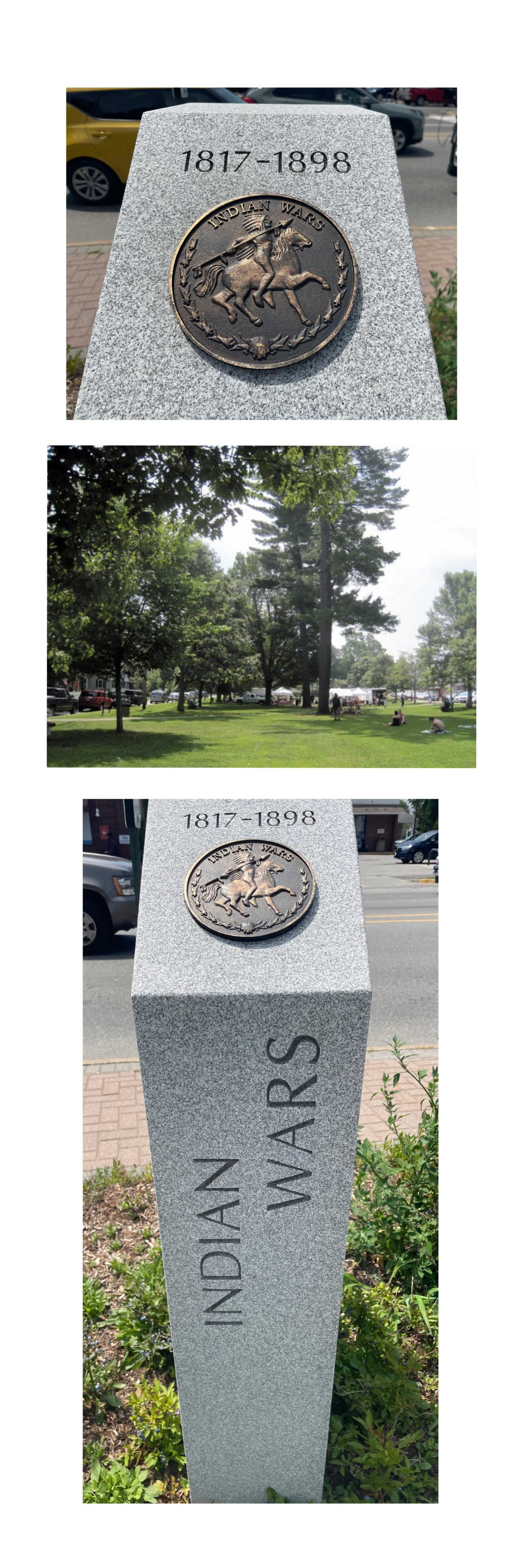
The Veterans’ Plaza on the Town Mall in Brunswick honors the veterans who have protected our country. One portion of the plaza honors veterans of “Indian Wars.” This term refers to wars during the 1800s between the US military and Indigenous peoples, and it raises difficult questions. For example, how should people remember the Native American veterans who defended their nations against colonization?
Wabanaki have struggled for centuries to protect their homelands from European colonizers. In 1755, during a time of war between Britain and France, Penobscots and other Wabanaki wanted to remain neutral. However, the Massachusetts Bay Lieutenant Governor Spencer Phips demanded that they side with the British. When the Penobscots refused, he issued a proclamation that declared them to be enemies of the British. The proclamation promised to pay colonists for every Penobscot man, woman, or child that they captured or killed.
This was the latest of many scalp bounties, which provided some colonists with money and even land for the work of hunting Wabanaki families, even those families who were not at war with the English. Wabanaki have not forgotten these conflicts. Their struggles for independence continue.
Sometimes Wabanaki have protected their homes by fighting alongside colonizers. In 1775, at the very start of the United States’s War for Independence, the Passamaquoddy and Penobscot were the first nations to make treaties to support independence. Since that first alliance, Wabanaki and other Native American peoples from across the country have served in the US military in far greater proportions than any other ethnic group.
In light of this history, the inclusion of the “Indian Wars” in the Veteran's Plaza provides a collective opportunity to think about who and what becomes memorialized.
The National Native American Veterans’ Memorial at the National Museum of the American Indian in Washington, D.C., provides one thoughtful approach. It recognizes how members of many Native nations have served in the US armed forces. It does so in part by honoring the distinct cultural traditions of those nations.
This research was compiled as part of the Pejepscot Portage Walk, which took place in Brunswick on October 6, 2024. For more information about this walk, click here.
For more research related to this area, click on the tags below. To download a hi-res version of the posters below for educational use, please contact where@atlanticblackbox.com.
This walk was a collaboration between the Pejepscot Portage Mapping Project and Atlantic Black Box.