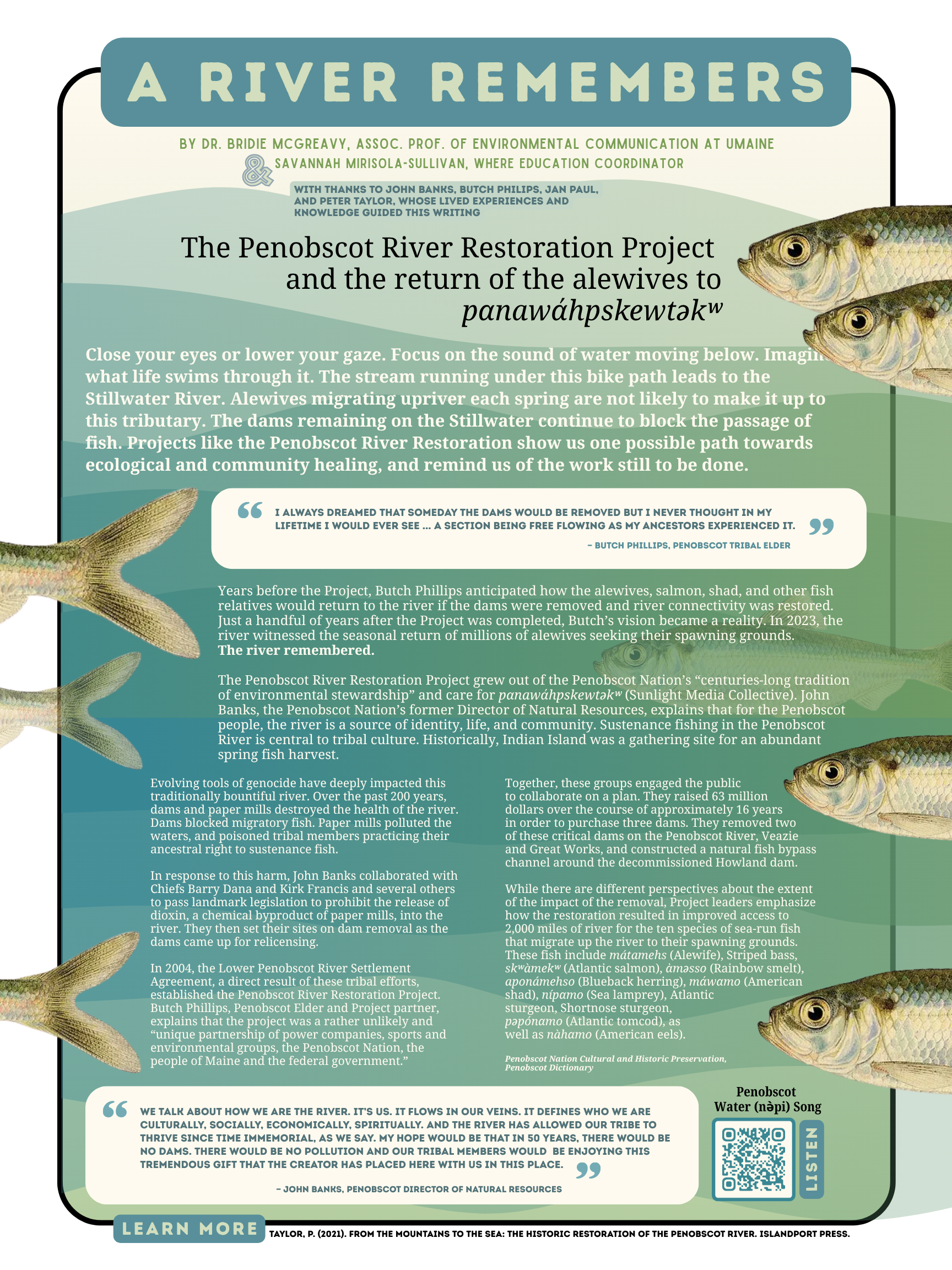
A River Remembers
The Penobscot River Restoration Project and the return of the alewives to pαnawάhpskewtəkʷ
With thanks to John Banks, Butch Philips, Jan Paul, and Peter Taylor, whose lived experiences and knowledge guided this writing
Close your eyes or lower your gaze. Focus on the sound of water moving below. Imagine what life swims through it. The stream running under this bike path leads to the Stillwater River. Alewives migrating upriver each spring are not likely to make it up to this tributary. The dams remaining on the Stillwater continue to block the passage of fish. Projects like the Penobscot River Restoration show us one possible path towards ecological and community healing, and remind us of the work still to be done.
“I always dreamed that someday the dams would be removed but I never thought in my lifetime I would ever see ... a section being free flowing as my ancestors experienced it.”
Years before the Project, Butch Phillips anticipated how the alewives, salmon, shad, and other fish relatives would return to the river if the dams were removed and river connectivity was restored.
Just a handful of years after the Project was completed, Butch’s vision became a reality. In 2023, the river witnessed the seasonal return of millions of alewives seeking their spawning grounds.
The river remembered.
The Penobscot River Restoration Project grew out of the Penobscot Nation’s “centuries-long tradition of environmental stewardship” and care for pαnawάhpskewtəkʷ (Sunlight Media Collective). John Banks, the Penobscot Nation’s former Director of Natural Resources, explains that for the Penobscot people, the river is a source of identity, life, and community. Sustenance fishing in the Penobscot River is central to tribal culture. Historically, Indian Island was a gathering site for an abundant spring fish harvest.
Evolving tools of genocide have deeply impacted this traditionally bountiful river. Over the past 200 years, dams and paper mills destroyed the health of the river. Dams blocked migratory fish. Paper mills polluted the waters, and poisoned tribal members practicing their ancestral right to sustenance fish.
In response to this harm, John Banks collaborated with Chiefs Barry Dana and Kirk Francis and several others to pass landmark legislation to prohibit the release of dioxin, a chemical byproduct of paper mills, into the river. They then set their sites on dam removal as the dams came up for relicensing.
“We talk about how we are the river. It’s us. It flows in our veins. It defines who we are culturally, socially, economically, spiritually. And the river has allowed our tribe to thrive since time immemorial, as we say. My hope would be that in 50 years, there would be no dams. There would be no pollution and our tribal members would be enjoying this tremendous gift that the creator has placed here with us in this place. ”
In 2004, the Lower Penobscot River Settlement Agreement, a direct result of these tribal efforts, established the Penobscot River Restoration Project. Butch Phillips, Penobscot Elder and Project partner, explains that the project was a rather unlikely and “unique partnership of power companies, sports and environmental groups, the Penobscot Nation, the people of Maine and the federal government.”
Together, these groups engaged the public to collaborate on a plan. They raised 63 million dollars over the course of approximately 16 years in order to purchase three dams. They removed two of these critical dams on the Penobscot River, Veazie and Great Works, and constructed a natural fish bypass channel around the decommissioned Howland dam.
While there are different perspectives about the extent of the impact of the removal, Project leaders emphasize how the restoration resulted in improved access to 2,000 miles of river for the ten species of sea-run fish that migrate up the river to their spawning grounds. These fish include mátamehs (Alewife), Striped bass, skʷàmekʷ (Atlantic salmon), ὰməsso (Rainbow smelt), aponámehso (Blueback herring), mάwαmo (American shad), nípαmo (Sea lamprey), Atlantic sturgeon, Shortnose sturgeon, pəpónαmo (Atlantic tomcod), as well as nàhαmo (American eels).
Penobscot Nation Cultural and Historic Preservation, Penobscot Dictionary
This research was compiled as part of the Walk to Honor Wabanaki Veterans, which took place in Orono on June 21, 2025. For more information about this walk, click here.
For more research related to this area, click on the tags below. To download a hi-res version of the posters below for educational use, please contact where@atlanticblackbox.com.
This event was part of the Walk for Historical and Ecological Recovery (WHERE), a series convened by Atlantic Black Box devoted to grassroots truth-seeking and transformation. It was organized under the leadership of James Eric Francis, Sr. in collaboration with the Penobscot Nation Cultural & Historic Preservation Department, the Town of Orono, the City of Old Town, the UMaine Wabanaki Center, Bangor Public Library, Orono Public Library, RSU 26, The Wabanaki Alliance, The Abbe Museum, Wabanaki Public Health & Wellness, The Wilson Center, The Church of Universal Fellowship, Ça C’est Bon, and Orono Arts Fest.