Alder Swamp
Before being drained and filled in 1826, the Maine Street Mall was an alder swamp. It was fed by a seep near what is now "Spring" Street, and it drained through a brook that ran where there is now a bridge on Federal Street. Colonists avoided the area as a swampy wasteland and source of disease. For Wabanaki, however, this area was a medicine field, a source of edible and medicinal plants, hunting, and refuge.
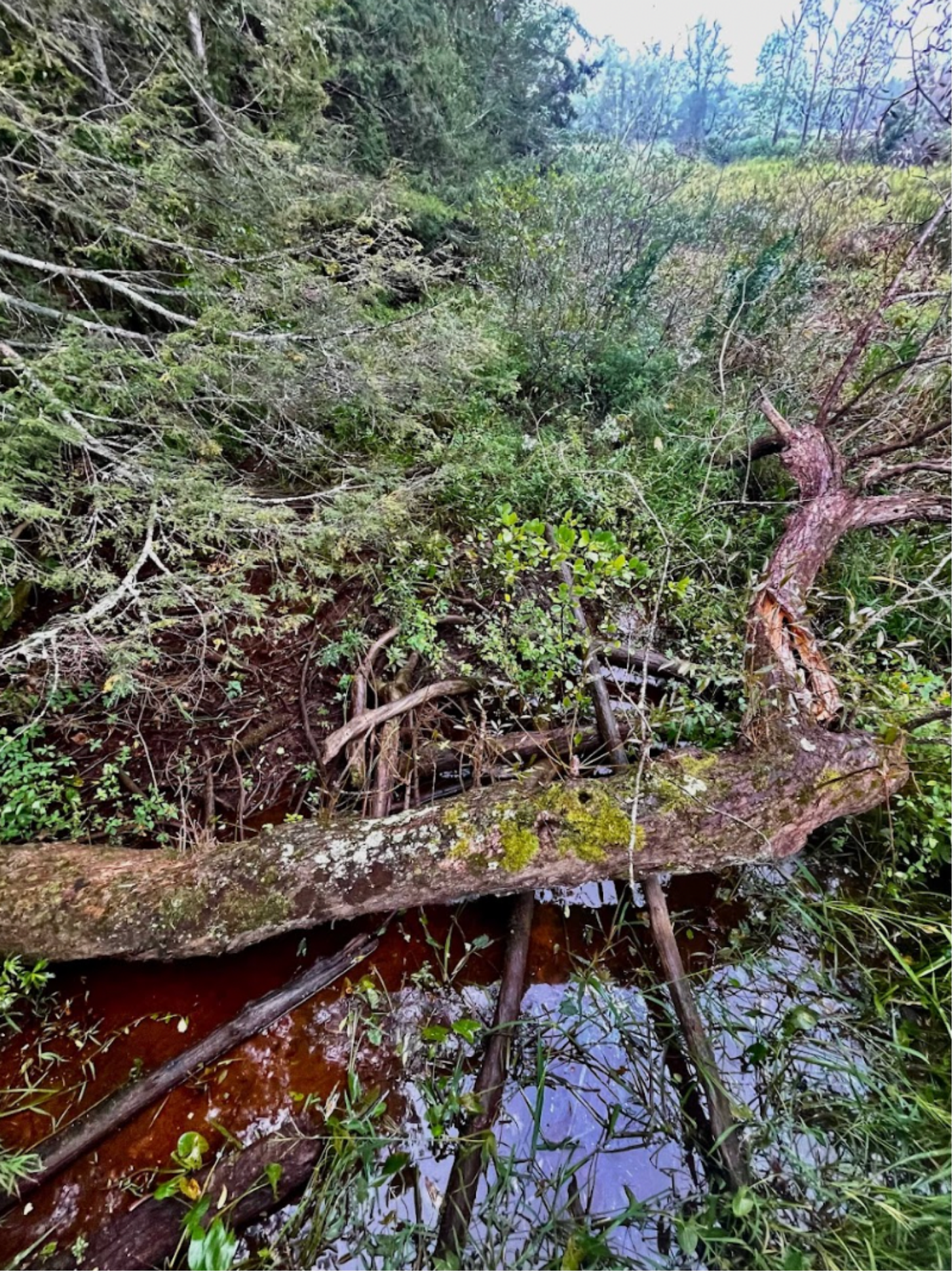
photo by Mia Beale
Alder swamps are plentiful in Maine. They form in places that flood frequently or that have shallow pools of water for long periods. Alder shrubs, blackberries, highbush cranberries, grasses, ferns, sedges, and mosses grow well in these swamps. They are important habitats for songbirds, frogs, salamanders, and turtles.
Wetlands like these have sustained Wabanaki in many ways. Cattails, or “bakwaaskw” in the Abenaki language, are particularly important. Their lower stems and roots are edible, their leaves can be woven to make mats or bags, and the down from their seed pods can wrap infants for warmth. Fiddleheads, which are the spring shoots of ostrich ferns, provide food at the end of long winters. When colonists drained and filled this wetland, they created a new park, but they deprived Wabanaki of an important place for food, medicine, and fibers.
Wabanaki organizations like the Bomazeen Land Trust and Niweskok are rebuilding Wabanaki relationships among plants, animals, and people. Wabanaki who live in and near Brunswick are cultivating community gardens here and in other nearby towns.
The rich alder swamp has become a beautiful park. It may not make sense to undo this transformation, but perhaps there are other ways to support Wabanaki spaces of community and wellness.
This research was compiled as part of the Pejepscot Portage Walk, which took place in Brunswick on October 6, 2024. For more information about this walk, click here.
For more research related to this area, click on the tags below. To download a hi-res version of the posters below for educational use, please contact where@atlanticblackbox.com.
This walk was a collaboration between the Pejepscot Portage Mapping Project and Atlantic Black Box.