Brig Baron de Castine and the Slave Trade
This piece was written by Kate McMahon and Jules Thompson from the Castine Historical Society as part of Interco(a)stal: Reading Between the Ribs of Maine’s Maritime History.
Castine, Maine is not a community one would normally associate with the broader story of global slavery during the nineteenth century. This bucolic community, with its historic homes and elm-lined streets, feels far away from the horrors of chattel slavery and the plantations that dotted the American South, the Caribbean, and South America. Yet Castine’s investment in global slavery grew exponentially alongside its growth as an important port in the early nineteenth century. Castiners were not only involved in the shipping of American goods, including hay, lumber, livestock, and food to plantations of the Caribbean, but also the trafficking of enslaved Africans and African Americans.
One such vessel was the brig Baron de Castine, built in Castine in 1851 and launched in 1852 at the Jarvis shipyard, owned and operated by the prominent Jarvis family one of the two most prominent merchant families in town. The brig’s early career began with regular involvement in the trade to Cuba and other sites in the Caribbean and South America. It carried American merchant goods, advertising its cargo in the papers of its ports of call. It returned to Maine laden with sugar and molasses.
In March 1854, the vessel was advertised as having “fine accommodations for Slave or Steerage passengers” in a newspaper in Charleston. Whether the Baron de Castine carried enslaved African Americans along the domestic slave trade from the upper South to the lower South is currently unknown, though this advertisement foreshadowed things to come.
Like many merchants during the nineteenth century, the owners and captains of the vessel grew their relationships with merchants in Cuba as they continued to go back and forth between the United States and cities like Cienfuegos, Remedios, and Havana. In 1857, the vessel again traveled to Cuba, and was consigned (or leased) to a notorious slave trader, José Mazorra. Mazorra became one of the most prominent slave traders in nineteenth century Cuba, who grew to immense wealth and power by not only trading enslaved Africans, but also running his own plantations. He amassed this wealth through the illegal slave trade by finding American vessels to illegally traffic Africans to Cuba, due to the protections of the American flag at sea. Given this, this 1857 journey was almost certainly a successful slave trading journey, with an unknown number of enslaved Africans being landed somewhere in Cuba.
The subsequent years immediately following this, the vessel continued to regularly travel between Cuba and the U.S. In 1860, its captain Henry Lufkin of Deer Isle, Maine, took the vessel across the Atlantic again, this time to Badagry, Nigeria, one of the largest ports for the embarkation of enslaved people in West Africa, particularly during the period of the illegal slave trade after 1808.
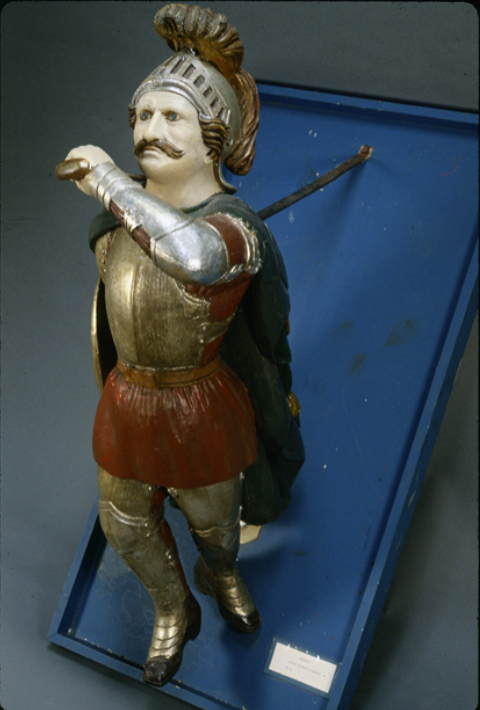
Baron de Castine Figurehead
This figurehead that was once on the bow of the Baron de Castine shows the Baron, who was one of the first European colonizers of what is now Castine. It was recovered from the wreck of the vessel, which sank in French waters in 1864, after it had been captured by the Confederates in 1862 and used to attack Union ships during the American Civil War.
Image courtesy of Mariners Museum and Park
From all accounts, the nature of the charter party followed similar patterns from other illegal slave trading vessels, particularly the long duration of the charter at more than fourteen months. In Africa, the crew began to become deeply restless with the uncertain length of the voyage, and the “sailors, on the very day of the expiration of the fourteen months revolted, and threatened either to have their wages or the captain’s life. He refused, and laid his complaint before the first Commandant he saw, who sided with the sailors and said they must be paid or he would detain the ship’s register – he would stand no nonsense with Yankees, for they were slave dealers and murderers.” Captain Lufkin did die on the coast of Africa in Ghana, though there is no mention as to whether this was from violence or illness. These unknown lengths of journeys were a common tactic utilized by slave traders to effectually trap American crews into making multiple trips between Africa and Cuba, forcing them into staying with the vessels or risk being marooned in Africa. This back and forth allowed them to circumvent the need to travel back to the U.S. and risk exposure of their crimes to American and British authorities.
The Baron de Castine returned to Boston in October of 1860 carrying hundreds of elephant tusks, palm oil, and sugar. Funds generated by this trade–the “legitimate trade” and their likely engagement in the slave trade to Cuba–came back to New England. Advertisements in the papers in Boston and Portland noted 378 packages of palm oil 321 tusks for sale on the docks of Boston.
Castine’s entanglement and investment in global slavery coincided with its rise as an important port town. The town’s prolonged investment in global slavery through the trade of plantation goods, the enslavement of African Americans both locally and in the South, and the direct participation in the trade of enslaved Africans became a building block of the town’s economic expansion during the early and mid-nineteenth century. This dependence and entanglement with slavery is hiding in plain sight on Main Street, with its opulent homes built and owned by these same merchants and shipbuilders. Ongoing research continues to expand our knowledge and understanding of just how important slavery was to the economic expansion of this town in the nineteenth century, and the ways this history still shapes the town today.
About the Author(s)

Kate McMahon, Executive Director, Castine Historical Society
Kate McMahon, Ph.D. is the Executive Director of the Castine Historical Society. She also serves on the Operational Committee of SlaveVoyages.org and is a co-founder and board member of Atlantic Black Box. She received her B.A. in Art History and M.A. in American and New England Studies from the University of Southern Maine. She completed her Ph.D. in History at Howard University in 2017. Her current research explores New England’s connections to and complicity in the illegal slave trade and colonialism, 1809-1900.
Jules Thompson, Collections Manager, Castine Historical Society
Jules Thompson is the Collections Manager at the Castine Historical Society. She holds advanced degrees in Mediaeval History and Archeology from the Universities of St Andrews and Oxford, UK, and a MLIS from Simmons University in Boston. In 2013 she completed a traineeship in digitization and digital archives with the National Archives UK, and went on to work for 4 years as Digital Access Officer with The Record Office for Leicestershire, Leicester and Rutland. Back in the U.S., she worked from 2017-2022 with the Congregational Library & Archives in Boston, first in a CLIR grant-funded role publishing collections for the “New England’s Hidden Histories” digital humanities project, and later as the Library’s Associate Archivist.