Captain Frederick Allen, Maine Sea Captain
This piece was written by Anna Durand as part of Interco(a)stal: Reading Between the Ribs of Maine’s Maritime History.
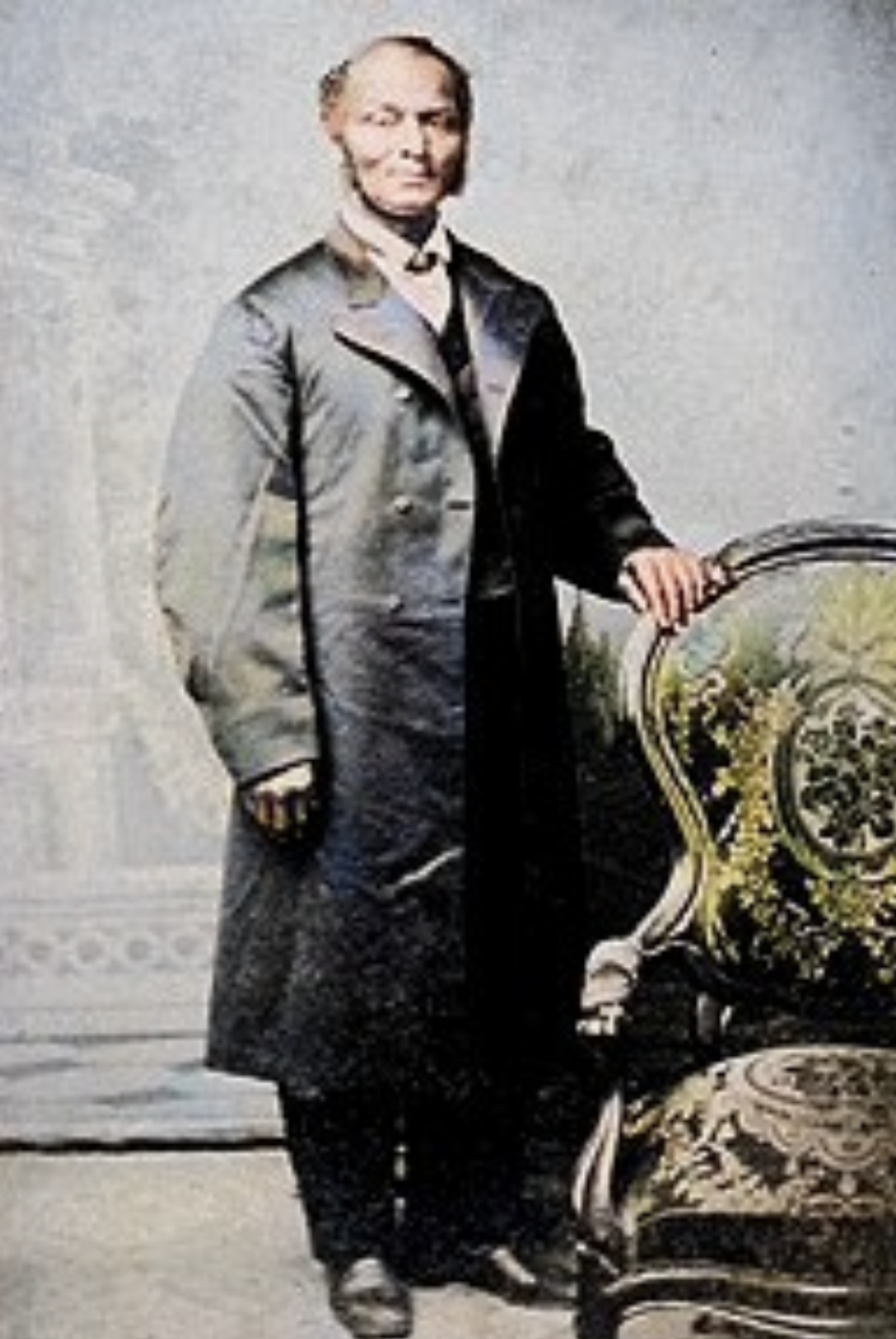
Captain Frederick Allen of West Eden, Maine, was a highly successful Black seafarer during the Age of Sail. Earning the titles of Master Mariner and then Sea Captain, this father of twelve taught his five sons his trade and at least two of them also rose to the title of Captain. Shoreside, he married Climenia Higgins who was a daughter of one of the first European settler families on Mount Desert Island, bought and sold over two hundred acres of land on MDI, and built a family farm along the shore of the Western Bay. Captain Allen was one of the many expert Black mariners working and building wealth in the nineteenth century coasting trade. His command of multiple schooners and his ties to the local seafaring community place him securely in the storied MDI maritime chronicle.
Here is an 1887 map showing “Negro Point” in the northwest corner of Mount Desert Island, with “F. Allen” marking the house of Captain Allen.

1887 map of MDI and adjacent islands
Here is an 1887 map showing “Negro Point” in the northwest corner of Mount Desert Island, with “F. Allen” marking the house of Captain Frederick Allen.
In his book Black Jacks: African American Seamen in the Age of Sail, scholar and author W. Jeffery Bolster describes the lives of Black mariners sailing in the colonial era, during the American Revolution, and throughout the Age of Sail. Seafaring was one of the few industries in which Black workers could build a career, even as their personal safety was threatened by the possibility of being kidnapped into slavery in the course of their work. Free Black seamen worked in all major American seaports from Philadelphia north to Boston, and along the trading rivers as well. Enslaved mariners were also experts in their industry. According to Bolster, as many as one fifth of free mariners employed in the nineteenth century sailing trade were Black, working as Sea Captains, Master Mariners, able-bodied seamen, stewards, and cooks as well as shoreside on the docks. Both free and enslaved Black sailors were an integral part of the maritime “Underground Railroad,” the sea-based route to freedom used by many people liberating themselves from slavery.
Under the Fugitive Slave Acts of 1793 and 1850, enslavers were legally allowed and even required to “return” self-emancipated people to their enslavers, and many free people of color were abducted and sold into slavery including free Black mariners.
Below is a document called a Seaman’s Protection Paper, issued in Philadelphia for a Black Portland, Maine mariner named Thomas Ashton. These papers were required across the south but were invented in South Carolina in 1822 with the passing of the “Negro Seamen’s Acts.” These laws were passed in direct response to a famous revolt by enslaved people under the leadership of Denmark Vesey, a formerly enslaved person who had bought his freedom. Mr. Vesey was executed for his role in the planning of the uprising, which was given away before it began. His plan included getting help from free Black sailors. White lawmakers believed that free Black mariners posed a risk of “contaminating” the minds of enslaved Black sailors in the south and so required all free Black sailors arriving on ships to spend the duration of their ship’s stay in jail, with the cost to be borne by the captains. Captains might leave without their jailed crew members or refuse to pay, in which case it was legal for the jailed crew members to be sold into slavery. Free Black sailors were issued these protection certificates to prove their freedom, and they were also used along the maritime underground railroad, with sailors lending them to others who were leaving enslavement.
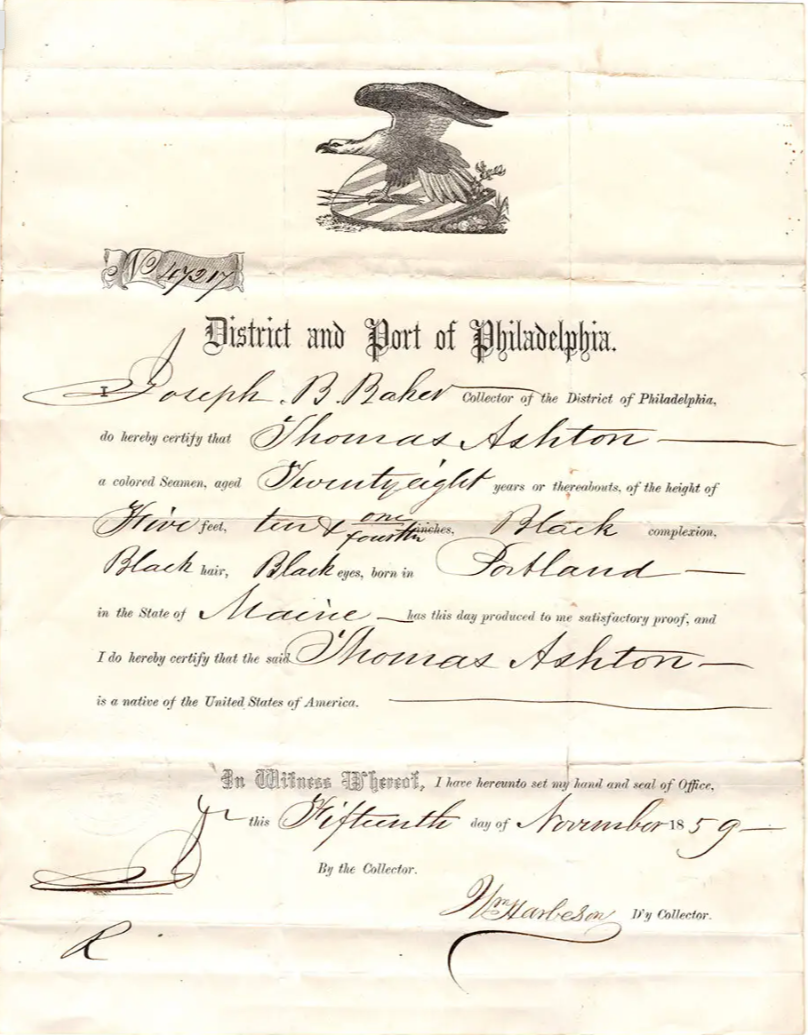
Free Black sailors were issued seamen’s protection certificates (such as this one belonging to Thomas Ashton of Portland) to prove their freedom. They were also used along the maritime underground railroad, with sailors lending them to others who were leaving enslavement.
Captain Allen arrived on Mount Desert Island in the early nineteenth century. He settled in what was then called West Eden. Eden was the name of the town which became Bar Harbor in 1918, having been “set off” from the town of Mt. Desert in 1796.
Born in Pennsylvania, he is first shown on the Mt. Desert, Maine census in 1840, below, second from bottom in both images. This record is enigmatic; where later censuses record his race as Black, this document not only does not record him as a “Free Colored Person” or even “Male” but also has an odd little zero marked in the column for “Total Number of Persons.” Other single heads of households are shown with a “1.” By 1840 Allen had already bought land on MDI, so his status as Free, Black, Male, and Head of Family should have been unimpeachable.
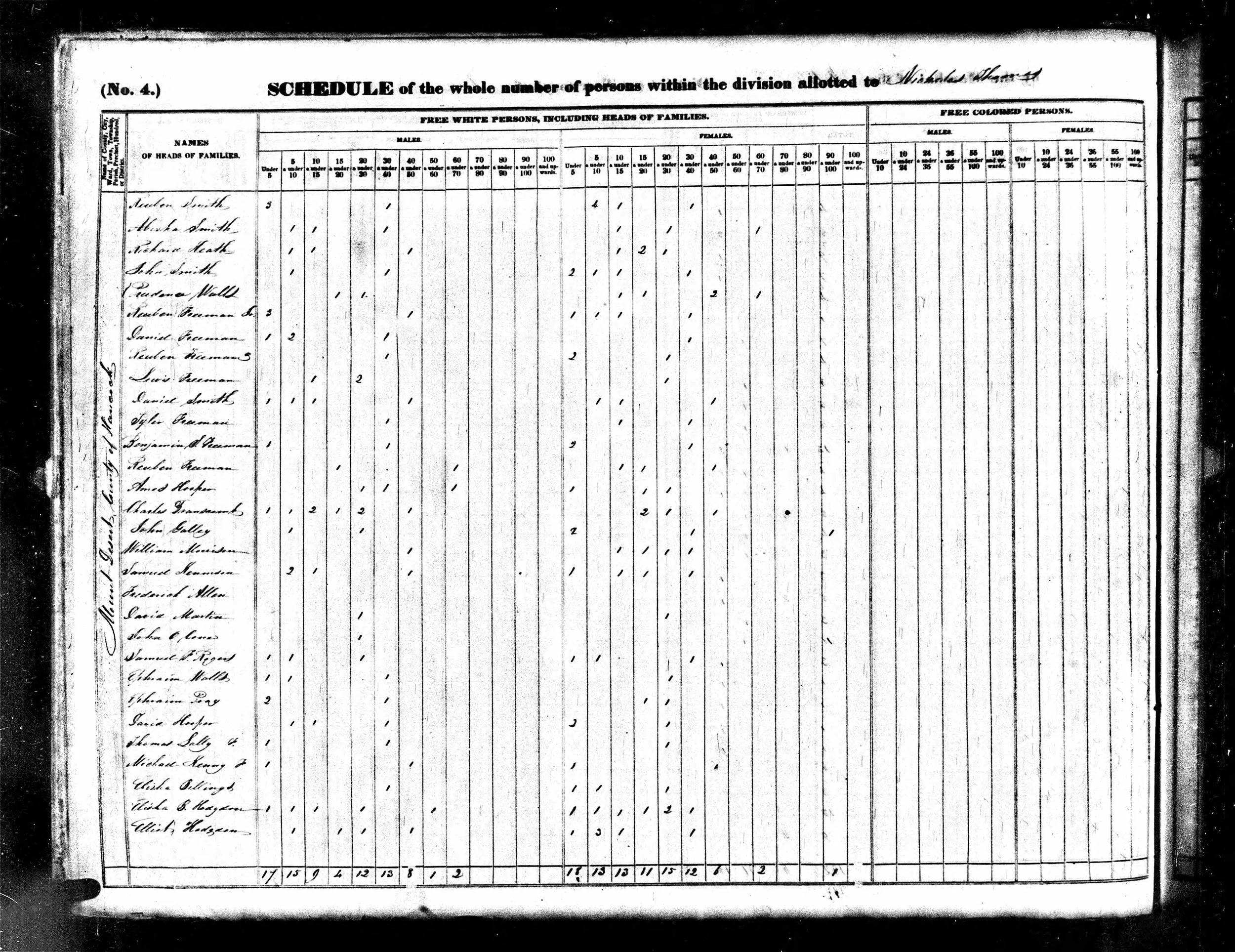
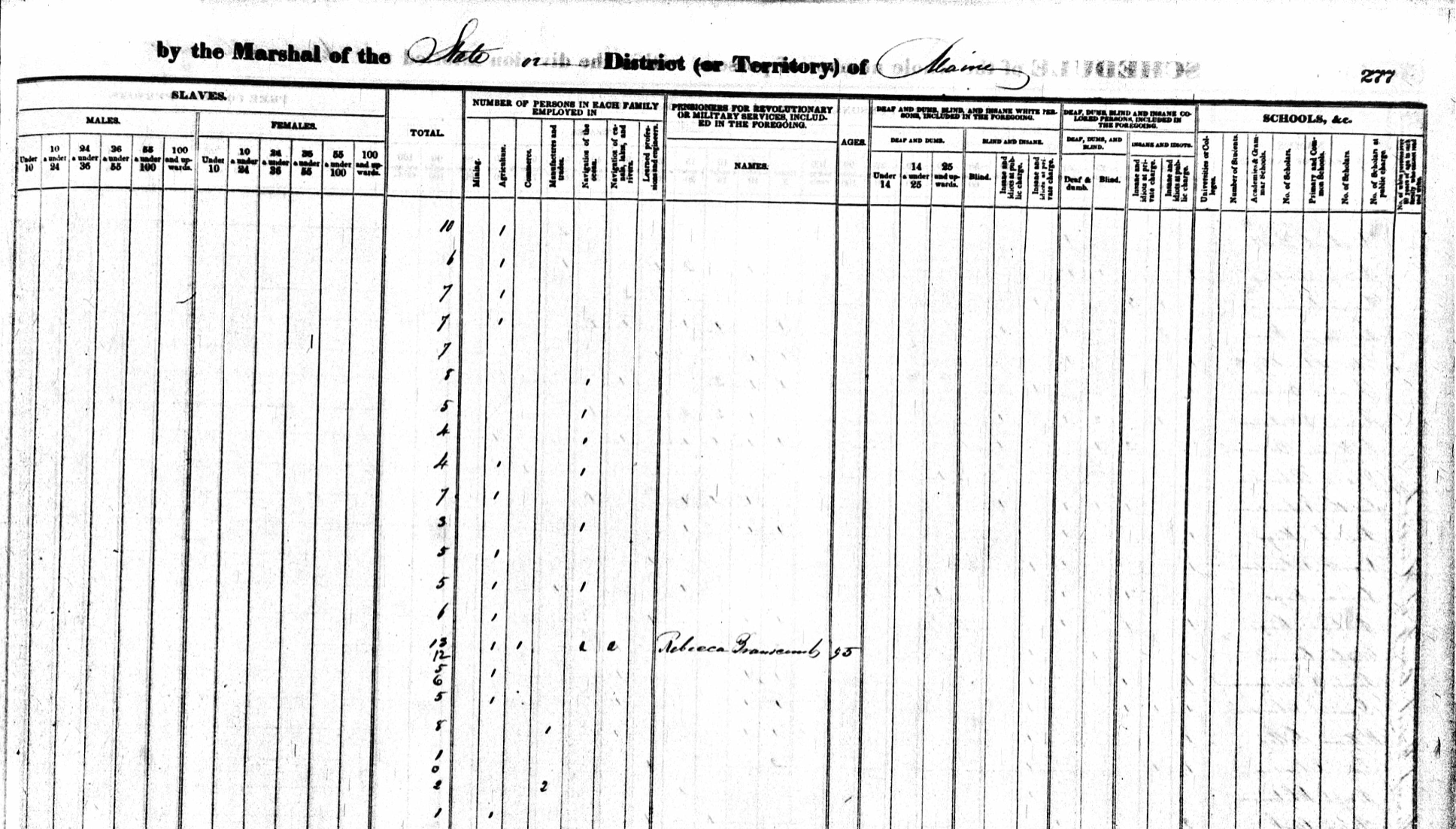
Even before the 1840 US Census, Allen had already begun to set down roots in the town of West Eden. Allen’s first real estate investment on Mt. Desert Island was ten acres of land bought from Eastman Hutchings on August 2nd, 1839. Three days later, his second land deed records fifty acres bought from Reuben and Joseph Higgins. Three weeks later, he bought another fifty acres, and another fifty-two acres within the following year. Most of this land was along the shore of Western Bay, off the northwest tip of Mount Desert Island, although he also bought ten acres along Great Pond (now called Long Pond.) These handwritten deeds included various caveats such as allowing the sellers to take some of the lumber off one parcel, and also designating a right-of-way to a “watering place,” presumably a spring on adjoining land. One deed allowed Allen to create and maintain a road from his house to the County Road, and this right-of-way still exists today, called Right of Way Rd in the village of Town Hill, Maine.
These early deeds refer to Frederick Allen as both a merchant and a trader; later, his occupation on the censuses is listed as Master Mariner and then Sea Captain. There are two documents recorded at the Hancock County Registry of Deeds which point to an earlier career or perhaps just a few trades in which he lost a court case and was forced to relinquish some of his land. The court case was brought by Joel Fay, a trader in Boston, possibly representing Moody White which was a Boston shipping and trading company.
Below is an 1838 letter to Joel Fay from Joshua Dillingham of Camden, requesting molasses, nails, raisins, and sugar be sent to him by Captain Pendleton, which would have been similar to correspondence between Joel Fay and Captain Allen.
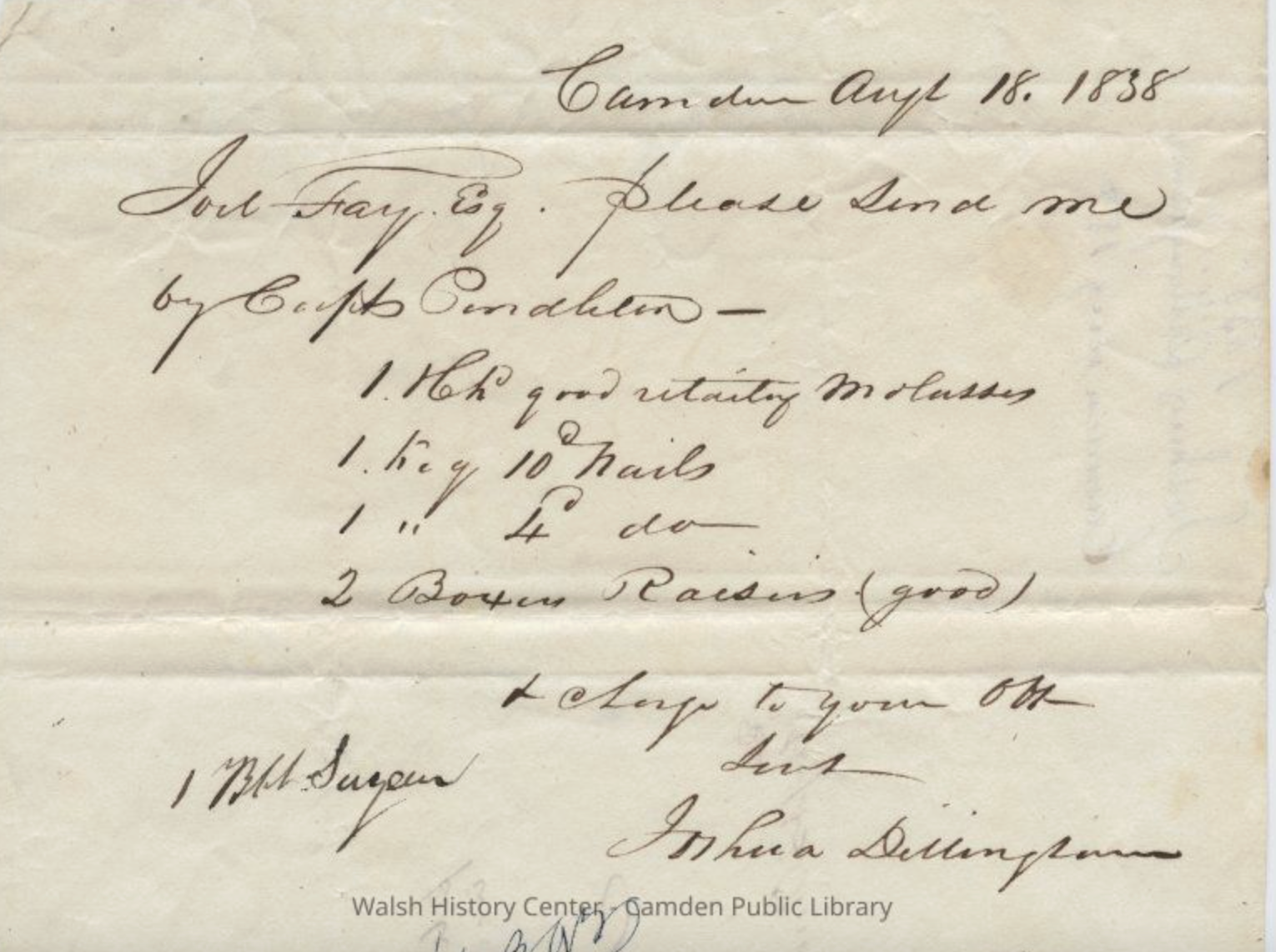
1838 letter to Joel Fay from Joshua Dillingham of Camden, requesting molasses, nails, raisins, and sugar be sent to him by Captain Pendleton, which would have been similar to correspondence between Joel Fay and Captain Allen.
Captain Allen was likely another ship’s captain tasked by Joel Fay with procuring these types of store goods for a local merchant. Moody White was a company in Boston in this same era that hired captains to trade for goods. Moody White owned multiple ships and sold liquor from Foster’s Wharf in Boston, both legally and illegally. The company lost several ships in bankruptcy proceedings in the early 1840s.
One year before their bankruptcy proceedings, Moody White was listed as a creditor seeking a debt from Frederick Allen, and we have the deeds showing that the Hancock County sheriff Richard Tinker served papers to Allen demanding he give up some of his land to satisfy this debt. Allen’s land was then sold by Sheriff Tinker to George Beckwith, a local developer. But Allen held on to at least one hundred and twelve acres following this court case, and eventually was able to add another ninety-two acres for a total of 204 acres.
On April 20th, 1841, Frederick Allen bought land from John Higgins, and the deed was witnessed by Higgins’ two white children: Wyatt and Climenia. Frederick Allen and Climenia Higgins soon became husband and wife but were not legally allowed to marry as Maine law outlawed interracial marriage from 1821 to 1883. Nevertheless, on October 16th, 1842, Climenia gave birth to the couple’s first child, Edward W. Allen. Eleven more children followed over the next twenty-eight years, and miraculously all lived to adulthood.
The names and birth years of Frederick and Climenia’s children were as follows:
Edward W., 1842
Emily Francis, 1844
Elvira E., 1846
Annette C., 1848
George D., 1850
Delmon W., 1853
Frederick A., 1855
Mary H., 1857
Ivory W., 1859
Harvey T., 1861
Cora G., 1863
Charles D., 1866
Diphtheria and other epidemics cut short the lives of many young children across Mount Desert Island during this time but Climenia and Frederick kept their family safe at home on their shoreland farm. Here, they likely raised crops for food and medicinals, as well as feed for livestock. They would very likely have kept chickens for eggs and meat as well as sheep and cattle for fiber, milk, and meat. The Town of Eden Vital Records describes F. Allen’s mark for sheep and cattle as “a swallow’s tail in the left ear.”

According to the Town of Eden Vital Records, Captain Frederick Allen’s sheep and cattle were marked with “a swallow’s tail in the left ear.”
In addition to raising crops and livestock, The Allen family had valuable shoreland from which to fish, dig clams, and harvest oysters. Captain Frederick’s successful coasting career would have allowed them to trade for and purchase store goods as well, which might have included coffee and tea, textiles, ribbons, and shoes, molasses, rum, books, and newspapers.
With his growing family settled, surrounded by various Higgins family kin, Captain Frederick continued seafaring. The 1850 census shows Climenia’s brother Wyatt living in their household along with their five oldest children.
By the 1860 census, Allen’s occupation was listed as “Master Mariner.” Nine children were living at home, along with Climenia’s mother, Margaret Flynn Higgins. Wyatt had moved out to his own house. For the first time, the census records Allen’s birthplace as Pennsylvania. His real property was valued at $1,000.00 and his personal property at $250.00. While Allen’s race is always listed in the census as “B” for Black, his children were listed as “M” for Mulatto; in this year, Climenia’s race is not recorded.
In 1870, the census records Captain Allen’s occupation as “Sea Captain.” His twelve children are recorded as working variously as sailors, working in a bake shop, at school, and at home.
At this point, Captain Allen had been a sea captain for many years. He had charge of a number of Mount Desert Island ships as well as Ellsworth vessels. We can trace his career through clippings in the shipping news from newspapers in Boston, New York, and Portland, Maine. He commanded the schooners Penniah and Josephine, Henrietta, Bellona, Grace, George Washington, Olive Branch, Sailor Boy, Volant, and Elizabeth sailing to and from Eden, Mt. Desert, and Ellsworth by way of Boston, New York, Portland, Providence, Newport, and Philadelphia. Although several of these ships can be seen making journeys to southern U.S. ports and to the Caribbean under other captains, Captain Allen wisely avoided these areas and their dangers for Black seafarers.
Below we can see the journeys of three ships built on Mount Desert Island, captained by Frederick Allen. These vessels likely carried lumber and dried cod from Ellsworth, returning with store goods such as cloth, sugar, molasses, and rum from ports along the Eastern seaboard.
This 1850 NY Evening Post shipping news clipping shows Captain Allen at the helm of the Penniah and Josephine, leaving Newport for Providence. This schooner was owned by Edward and Otis Brewer and Richard Higgins, and built by Edward and Otis Brewer in Hulls Cove in 1845.

The schooner Olive Branch made many trips all across the Caribbean trading for sugar, molasses, and rum. Captain Allen made the journey from Ellsworth to Boston in this 1859 shipping news clipping from the Boston Evening Transcript:
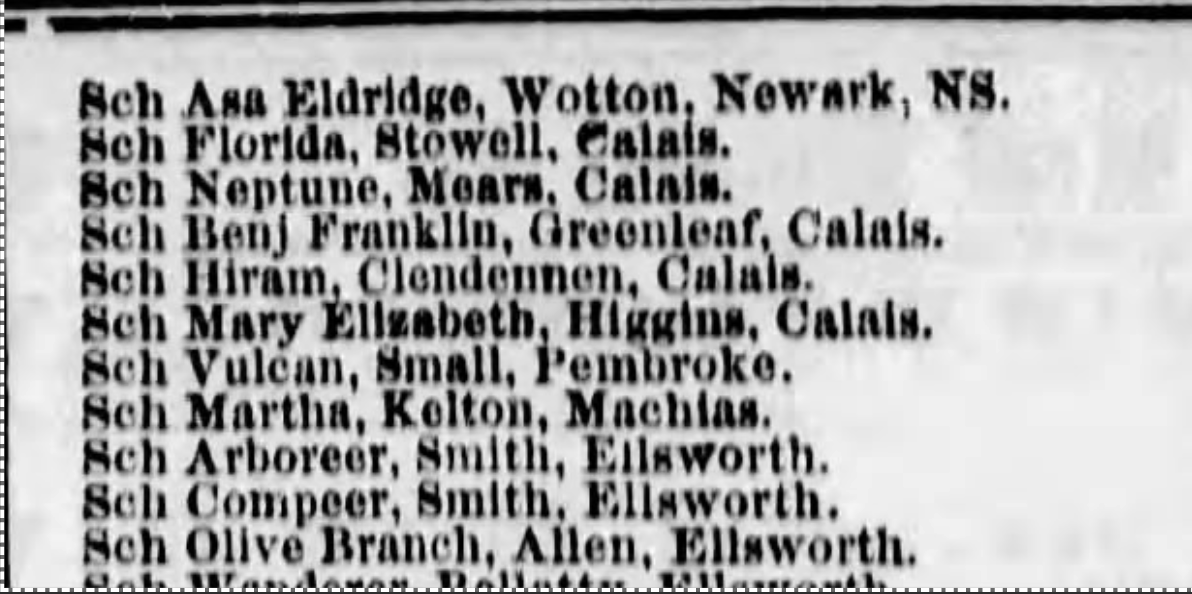
Olive Branch was built by Climenia’s cousins Amasa, Luther, and Jacob Higgins near her family home and her future home with Frederick, on Clark Cove, in 1829.
Henrietta was a schooner built on Thompson’s Island, the small island that lies between Trenton and Mount Desert Island, in 1848, and was owned by William Thompson. Here Henrietta has arrived in Providence from Ellsworth.

As Captain Allen was farming and coasting, his sons followed him to sea. All of his sons became mariners, with Edward and George both achieving the status of Captain. Ivory worked as a ship’s cook, and Harvey was a seaman. Tragically, his son Delmon, also a mariner, was lost at sea in Cuba at age 22. His daughters Mary and Cora worked at a cotton mill and a grist mill, respectively, while Emily and Elvira worked in a bake shop and a millinery. Annette kept house with her mother until she married and had children of her own.
In their later years, Frederick and Climenia sold two small parcels of land to their daughter Mary and son Frederick, Jr. including the original parcel bought from Climenia’s father John Higgins. The 1880 census showed for the first time that while Frederick had been born in Pennsylvania, his father was born in Sweden, and his mother’s birthplace was listed as “not known.”
Captain Frederick Allen died in 1885, his wife Climenia in 1897. They were buried together in the Mountain View Cemetery, in what was then known as West Eden, now Town Hill, Maine. His legacies of seafaring and farming live on with his descendants still living in the area and in the traces of his family’s land we can still see today: the old well at his homestead site and the remaining right-of-way he created more than one hundred and eighty years ago.
About the Author

Anna Durand, Independent Researcher
Anna Durand lives in Hulls Cove and is a dedicated student of local history. Her research focuses on nineteenth-century shipbuilding, seafaring, and the connections between Mount Desert Island and the slavery-based economies of the Caribbean. Her recent research has centered on Captain Frederick Allen, a prominent Black mariner who commanded schooners along the Eastern Seaboard, built a farm and raised a large family on Mount Desert Island, and navigated the dangers faced by free Black seamen in the decades before the Civil War. Through Allen’s story, Durand explores both the lives of Black mariners in nineteenth-century Maine and the ways their presence can be obscured or erased from the historical record.