Shipwright Willis Pinder: Going Beyond Enumerating Maine’s Black Maritime Laborforce
This piece was written by Kelly Page and Sophia Richter from the Maine Maritime Museum as part of Interco(a)stal: Reading Between the Ribs of Maine’s Maritime History. To reach Kelly and Sophia, contact: library@maritimeme.org
On October 15, 1901, the Bath Daily Times published a small announcement that “Willis Pinder, who has been working at Percy & Small’s yard left here for his home in Cambridge, MD., tonight. He used to work in this city fifteen years ago and came north this summer to see how this place prospered. Mr. Pinder is one of a few colored men who had worked in Bath shipyards. He is a good man with an axe, and was well liked by the men in the yard. He went home on account of his dislike of the cold weather.”[1]
To date, no archival collections have been located that directly reference Mr. Pinder, but newspapers announcing his arrivals and departures between Bath and the Mid-Atlantic such as this exist throughout the years of 1901-1909 . If it weren’t for this first article referring directly to his racial identity, it may have been much more difficult to perceive his presence in the historical record. In fact, there is an appendix in A Shipyard in Maine: Percy & Small and the Great Schooners which lists known workers from the shipyard. Compiled from newspapers, directories, interviews, and other sources, it contains several hundred names linked to details such as injuries, occupations, and residences. Yet Willis Pinder is the only individual who is explicitly identified as a person of color.
By tracing this one man’s life through the archive, it becomes apparent that there is much more to uncover about Maine’s Black shipbuilders. Going beyond enumeration, the story of Willis Pinder does more than illuminate the racial diversity within Maine’s shipbuilding trades. More specifically, it highlights how the Reconstruction period and Jim Crow may have shaped Maine’s shipyard labor.
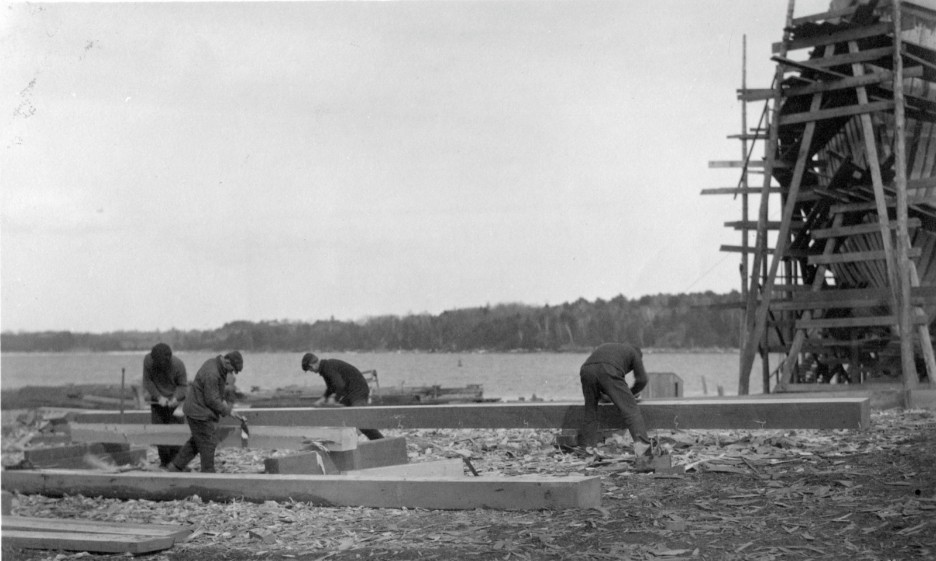
Ship carpenters at work
Carpenters rough-shape supporting timbers with a broadaxe, a task Willis Pinder would have regularly performed at Percy & Small. Exposed to the elements year-round, over 200 employees and subcontractors earned a living at the yard during peak production, laboring six days a week for up to 10 hours a day. He earned $2-$3 per day.
I. D. Clough, photographer
Willis Pinder was born in 1846 in Dorchester County, located in Maryland’s eastern shore. While we do not know for sure, it is possible that he was born to free Black parents. Even so, he would have entered a world with intimate proximity to slavery. At least one of every two Black residents of Dorchester County were enslaved in the 1840s and 1850s. Famously, abolitionist and statesman Frederick Douglass escaped his own enslavement in Talbot County, just south of where Willis was born. Not long after Douglass’ self-emancipation, Harriet ‘Moses’ Tubman, born Araminta Ross, first fled enslavement from Dorchester in 1849.
While information about his childhood hasn’t been uncovered, it is possible that he served in the Civil War during the 1860s. He would have been just under 18 when the war broke out. Studies of aggregate enlistment records suggest that at least 10 percent of soldiers who fought in the war were under the age of eighteen.[2]
Evidence of Pinder’s previous employment in Maine is presented in the 1870 U.S. Census, where he is listed as residing in Thomaston and living under the same roof as a man named James Cornish.[3] Both were noted as having come from Maryland. Willis’ occupation was listed as “ship carpenter” while James was noted as being a Teamster, a role frequently contracted by shipyards. Did they travel to Maine together? While we cannot name the precise shipyard that employed him, we do know that there were six active shipyards in Thomaston at that time.[4]
After spending what may have been his first year working in Maine’s shipbuilding industry, Willis returned home to Dorchester County and married Mariah E. Denby (sometimes spelled Marie or Mary) in 1872. They raised a family of four children on a remote farm in the Drawbridge district of Dorchester County, MD. The 1880 census notes that Willis Pinder’s occupation was a farmer.[5] In 1889, their marriage was cut short when Mariah died. In her will, she bequeathed the farm land to her husband Willis, and to her four children, “one red cow and one calf each red with white back”.[6]
Willis returned to work in Maine’s shipbuilding industry after nearly twenty years. During the following decade, Willis traveled seasonally up to Bath in the summers to work at the Percy & Small shipyard as a carpenter, the largest group of employees at the yard.[7] Thus, he may have participated in a number of stages of ship construction. Carpenters worked in temporary “gangs” oriented around specific tasks such as setting up the keel, assembling and erecting the frames, framing the stern, installing deck beams, and planking and ceiling the vessels. The average pay for men in his trade in 1908 was between $2 to $3 per day.[8] The typical work week for Pinder was over 50 hours spent laboring in the elements.
During the winter, Willis returned south to cut railroad ties in Maryland or cut frames in Virginia. Because carpenters typically supplied their own tools, stored in large wooden chests, Willis likely hauled his with him. His last documented year (appearing in Bath newspaper announcements) was 1909. Having departed just weeks before its launching, it is likely he would have contributed to building Wyoming. The last address listed in Bath’s City Directory for Willis was at 519 Washington St. in Bath. He died in 1916 at the age of 70, having spent his final years living with his daughter Bertha and her family.[9]
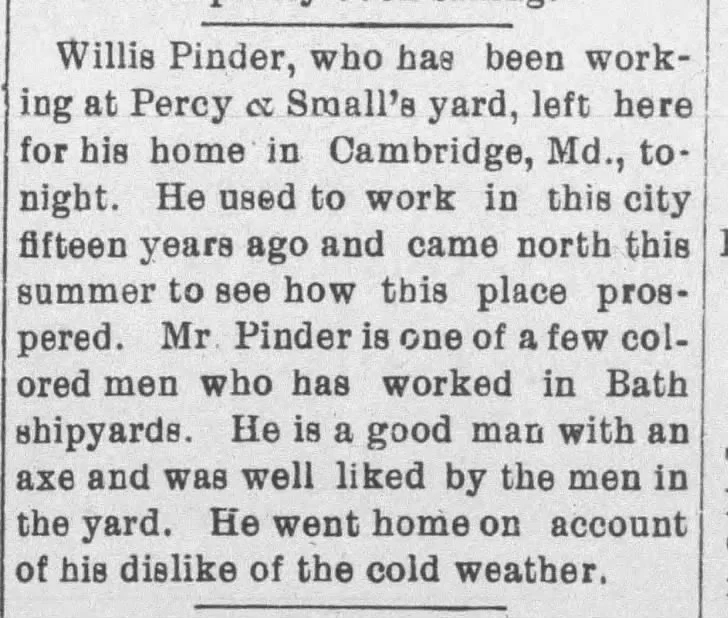
Announcement in the Bath Daily Times, October 15, 1901
The first of many semiannual announcements of Pinder's seasonal travels documented in the Bath Daily Times, this 1901 notice identified his race and hometown and also that he had worked in Maine years earlier. Subsequent accounts shared that he spent winters in Maryland cutting railroad ties or in Virginia cutting ship frames. His last known departure in 1909 was just two months before Wyoming’s launch.
Farmer; laborer; carpenter; shipbuilder; these are the terms used over the years to describe Mr. Pinder’s occupations. While Baltimore had one of the largest populations of free Black people in the country during the 1830s-late1840s, free and enslaved men looked to the city’s docks and ships for work. In particular, the caulking trade was nearly monopolized by Black workers.[10] Going into the shipbuilding trade would likely have been the most profitable occupation for a Black man.
By 1860, this would change. In 1858 and 1859, Baltimore Black shipyard workers endured a series of violent attacks by members of a white gang called the Tigers, leading to job-busting across the industry.[11] After the riots, it was difficult for young Black men in Maryland to get jobs as ship carpenters. Between 1850 and 1860, the percentage of Black ships carpenters under the age of 20 dropped from 71 percent.[12] Historian Frank Towers determined that the results of the riots were that “local white men outside the [shipbuilding] industry gained access to work at yards that had no jobs to offer, and they did so at the expense of black workers.”
It is possible that this was one of the reasons Willis looked to Maine for work in his 20s. Did he learn the trade before 1870, or was it in Thomaston, ME where he began his craft? Did he move to Baltimore and work with the shipbuilders there? What would the racial dynamics and social networks in the yards have looked like for a young Black man during this time?
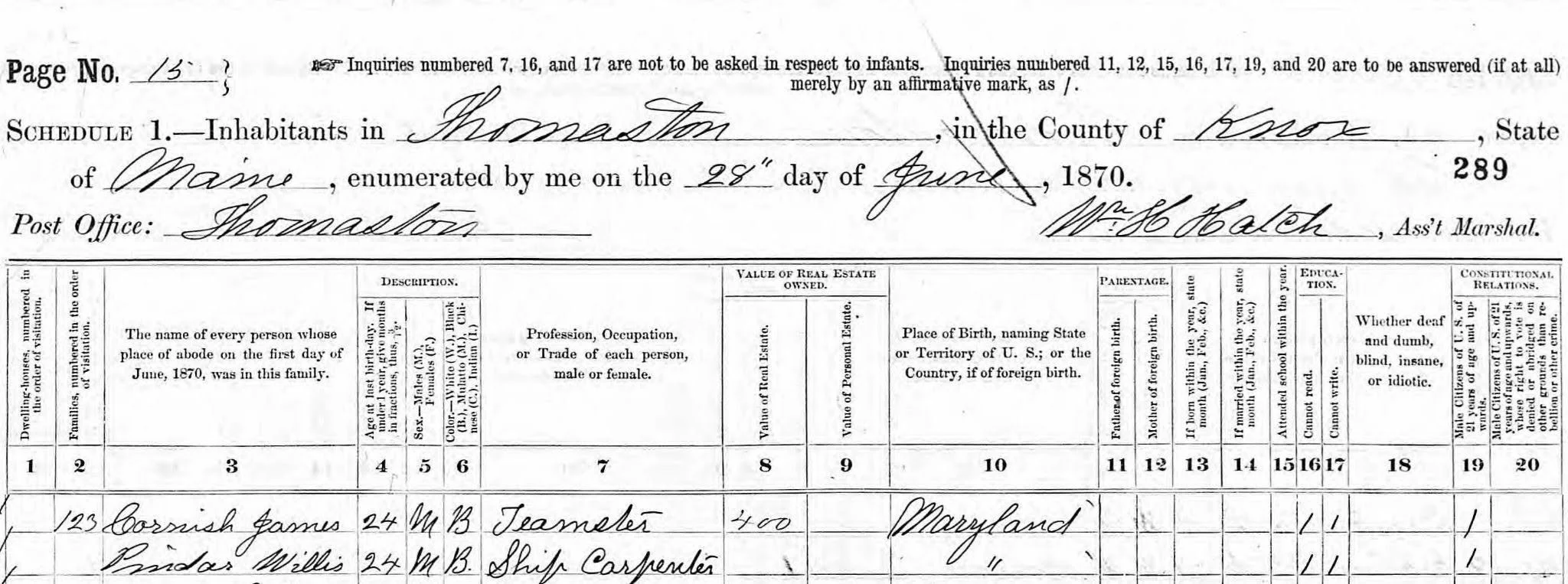
U.S. Federal Census for 1870, Thomaston, ME
The census population schedule for 1870 proves Pinder’s previous shipbuilding experience in Maine. Whether he learned his trade back home, or in one of Thomaston’s six active shipyards remains unknown.
During his time in Maine, Willis Pinder also navigated a complicated labor landscape, braving potential exclusion from labor organizations due to his race as well as negative sentiments toward migrant workers. It is unknown if Pinder was a union member while working in Maine, but union membership was common in the early 1900s. In fact, Bath was known for its early, and trendsetting, shipyard labor organizing. In the 1840s, workers successfully leveraged adoption of a 10-hour maximum work day. This was a significant improvement on work conditions. The previous, the sun-up to sun-down schedule meant up to 16-hour work days. As one of the most prolific centers of shipbuilding in the state, other communities fell in line following Bath’s adoption of this practice.
An extensive survey performed by the Bureau of Industrial and Labor Statistics for the State of Maine in 1889 showed that most shipbuilders identified themselves as being members in union. Membership, as well the number of unions, steadily increased into the 20th century, however, Pinder may not have been allowed to join a union, solely based on his race. While regions with large Black populations were able to establish their own unions, it wasn’t until World War II that the government stepped in to force unions to admit Black workers. This push was not for reasons of equality, but was done to fill roles related to war industries.
The surveyed shipyard workers in 1889 also noted negative sentiments toward migrant workers.[13] While this attitude was largely aimed at French-Canadians, it leads to the question of where the line of “otherness” was drawn for Mainers. Was Pinder, a Black man from much further away than Quebec, viewed as a threat to the prosperity of locals? Maine’s annual labor statistics for the year 1908 acknowledged a general labor shortage: “It is becoming a serious question in Bath and vicinity as to where competent … laborers … may be obtained. Employment at good wages can easily be found by temperate, industrious and capable help, and any movement to supply the deficiency will meet with hearty approval and co-operation.”[14] The Bath Daily Times noting that Pinder was “well-liked” seems to indicate that there is truth to this statement. However, we may likely never know his perspective.
Willis Pinder’s story demonstrates both the possibilities and limitations of historical research. His presence in the archive survives only through scattered records, the fragmentary nature of this evidence underscoring how easily Black workers can disappear from historical narratives. Archival preservation has favored some experiences over others, but there is also the simple fact that most records do not explicitly contain racial identifiers. Pinder’s visibility highlights the likelihood that other Black shipbuilders labored in Maine’s yards without leaving similarly identifiable traces. In fact, three more Black men have recently been identified as employees at Percy & Small during the yard’s final years.
By situating Pinder’s life within the broader contexts of slavery’s legacy on Maryland’s Eastern Shore, the exclusion of Black workers from segments of the shipbuilding industry, and the evolving labor landscape of Maine’s shipyards, a more complex picture emerges of northern industrial labor at the turn of the 20th century. His seasonal migrations between Maine and the Mid-Atlantic illustrate the interconnected nature of American labor markets and reveal how Black craftsmen navigated opportunities and limitations across regional boundaries. Although many questions about his life remain unanswered, those gaps are themselves meaningful. They point to the silences embedded within the archive and the work that remains to be done to recover the experiences of Black shipbuilders. Ultimately, Willis Pinder’s story is valuable not only for what it tells us about one man, but also for what it suggests about the many workers whose contributions helped build Maine’s maritime economy yet remain obscured in the historical record.
Footnotes
[1] Bath Daily Times, 15 October 1901, page 1.
[2] Frances M. Clarke and Rebecca Jo Plant, “Introduction,” in Of Age: Boy Soldiers and Military Power in the Civil WAr Era, (Oxford University Press, 2023): 1-24; Kathleen Shaw, “‘Johnny Has Gone for a Soldier’: Youth Enlistment in a Northern Country,” Pennsylvania Magazine of History and Biography, vol. 135, no. 4 (October 2011): 419-446.
[3] 1870 U.S. census, Knox County, Maine, population schedule, Town of Thomaston, p. 15 (written), family 123, Willis Pinder.
[4] Edmund S. Hoyt, Maine State Year-Book and Annual Register for the Year 1871, 233
[5] 1880 U.S. Census. Vienna, Dorchester County, Maryland. Digital image (NARA) “Willis Pinder.” FamilySearch.
[6] Mariah E. Pinder, “Last Will and Testament”, Probate Records, 16 January 1889.
[7] Ralph Linwood Snow and Captain Douglas K. Lee, A Shipyard in Maine: Percy and Small and the Great Schooners (Gardiner: Tilbury House Publishers, 1999), 136.
[8] Maine Bureau of Industrial and Labor Statistics. Twenty-Second Annual Report of the Bureau of Industrial and Labor Statistics for the State of Maine.(Augusta, ME: 1890), 234.
[9] 1910 U.S. Census. Drawbridge, Dorchester County, Maryland. Digital image (NARA T 624 roll 564) “George W. Chase.” FamilySearch.
[10] Frank Towers, “Job Busting at Baltimore Shipyards: Racial Violence in the Civil War-era South,” The Journal of Southern History ( ): 225.
[11] Frank Towers, “Job Busting at Baltimore Shipyards: Racial Violence in the Civil War-era South,” The Journal of Southern History (): 226-227.
[12] Frank Towers, “Job Busting at Baltimore Shipyards: Racial Violence in the Civil War-era South,” The Journal of Southern History (): 227-230.
[13] Maine Bureau of Industrial and Labor Statistics. Third Annual Report of the Bureau of Industrial and Labor Statistics for the State of Maine.(Augusta, ME: 1890).
[14] Maine Bureau of Industrial and Labor Statistics. Twenty-Second Annual Report of the Bureau of Industrial and Labor Statistics for the State of Maine.(Augusta, ME: 1890), 234
About the Author(s)
Kelly Page, Curator of Collections, Maine Maritime Museum
Kelly Page is the Curator of Collections at Maine Maritime Museum, where she has served in various roles since joining the institution, including Library Assistant, Registrar, and Collections & Library Services Manager. In her current role, she oversees collections stewardship, historic preservation, and public access initiatives while contributing to interpretive research and content development across the museum's diverse exhibitions and programs. Before joining Maine Maritime Museum, Page worked at Bowdoin College's Hawthorne-Longfellow Library, the Pejepscot History Center, and the Maine State Archives. She holds a Bachelor of Arts in History and International Politics from Wheaton College in Massachusetts.
Sophia Richter, Collections Manager, Maine Maritime Museum
Sophia Richter is Collections Manager at the Maine Maritime Museum, where she oversees the stewardship, preservation, and accessibility of the museum's collections in support of research, exhibitions, and public engagement. Her interests lie at the intersection of history, archives, public memory, and community engagement. Before joining the museum, Sophia completed an M.A. at Concordia University, where her research focused on environmental history, fisheries, and deindustrialization. She has published on the political economy of fisheries and environmental change and brings a collaborative, interdisciplinary approach to connecting historical collections with contemporary audiences and conversations.