Held Taught: Ten Enslaved Lives—and the Tension Within a Maine Family’s Legacy
The following was researched and written by Kate Tremblay with support from Jill Whitchurch Dixon from Vaughan Woods & Historic Homestead, as part of Interco(a)stal: Reading Between the Ribs of Maine’s Maritime History.
Junto. Clarissa Congo. Clarissa Ebo. Sprightly. Mercury. Joe. Martin. Eliza. Cato. Cyrus.
The names of these ten enslaved people survive in the records of the Vaughan family’s Jamaican plantations, along with more than 700 others. They appear in valuations, correspondence, and government registers—records created to manage slavery, not to preserve the lives of the people caught within it.
Ages were estimated. Places of birth were recorded. Mothers were named because children inherited their legal status from them. People were categorized as “African,” meaning born in Africa and forcibly transported to Jamaica, or “Creole,” meaning born in the colonies. Some were also assigned ethnic designations such as “Congo” and “Ebo.” In plantation valuations, enslaved people were assigned monetary values alongside livestock, buildings, and equipment.
Read closely, though, the entries begin to take on human shape. Mothers raised children. Families stretched across generations. People developed skills, escaped, were captured, were sold, and sometimes secured their freedom.
These records are incomplete, but the lives behind them were not.
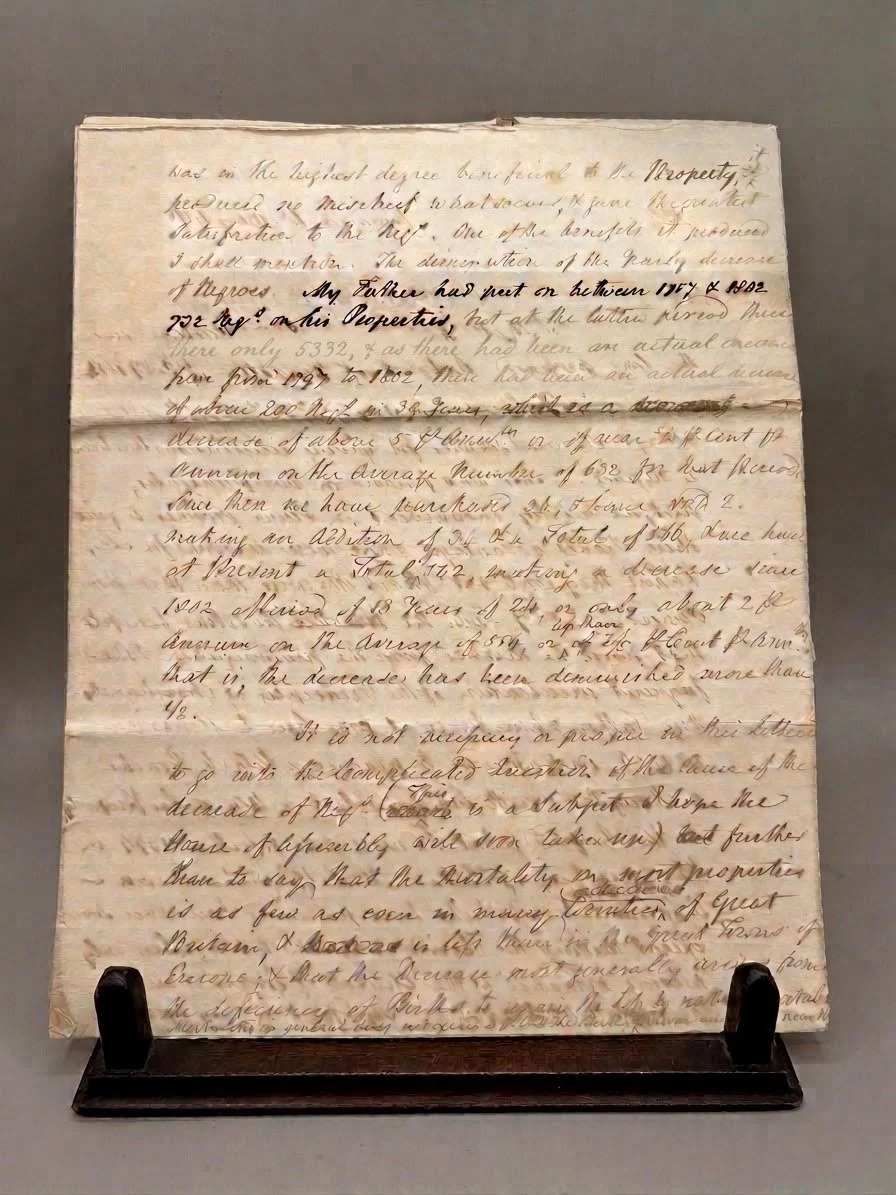
Samuel Vaughan Jr. Letter, 1815
Written in May 1815 by Samuel Vaughan Jr., this letter explicitly documents the exact number of individuals his family enslaved between 1757 and 1802—732. In addition to detailing these figures, Vaughan argues that religion does not condemn the institution of slavery.
Junto (~1736-1827)
Born in 1736, Junto lived to the extraordinary age of ninety-one. In the 1817 register, she is an eighty-one-year-old enslaved woman described as a “French Creole.” She was the mother of at least three children who survived to adulthood—Louis, Monday, and Deliah.
Her origins remain uncertain. Perhaps she had been transported from the nearby French colony on St. Domingue? What the records reveal is a woman who lived through nearly a century of Caribbean history while remaining enslaved, raising children who also remained within the system.
Clarissa Congo (~1757-1832) & Clarissa Ebo (b.~1749)
Both women were born in Africa and forcibly transported to Jamaica. “Congo” and “Ebo” were not surnames but ethnic designations imposed by enslavers and colonial officials.
Clarissa Ebo, born around 1749, was the mother of four Jamaica-born children. By 1826, one daughter had a child of her own.
Clarissa Congo, born around 1757, was also the mother of four children. Her daughter Lilly had a daughter named Statira, who had a daughter named Eliza Anna—making Clarissa Congo a great-grandmother. The records span four generations of one family—all enslaved by the Vaughans.
Sprightly (b. ~1778)
Born around 1778, Sprightly was the mother of five children. In 1832, all five were recorded as “losses” on the Vaughan slave register, sold along with the Vaughansfield plantation land, buildings, and other property.
Sprightly herself disappears from the surviving records. We do not know whether she remained with the Vaughans, was sold elsewhere, or died.
Her story makes the violence of the system painfully obvious—the children she raised were also property that could be taken from her.
Mercury (b.~1779)
Born in Africa around 1779, Mercury was assigned the highest monetary value of anyone enslaved at Vaughansfield in 1802.
An 1815 letter from Samuel Vaughan Jr. describes a highly skilled enslaved man as a “most valuable carpenter and millwright,” manager of the carpenters’ gang, and someone Vaughan was reluctant to part with. The man may have been Mercury, although the evidence does not allow us to say so with certainty.
If it was Mercury, the value listed on the slave census was assigned because of his knowledge and skill. While that expertise may have increased his monetary value to the enslavers and given him privileges other enslaved people may not have had, it did not change his legal status. His labor—and, under the law, his person—still belonged to someone else.
Joe (b.~1791)
In 1802, Joe was about eleven years old and already valued at £120—roughly the value assigned to many adult men.
By 1817, he was twenty-six, a Jamaica-born “Creole” man. His mother, Betty, and siblings are also named.
Then Joe disappeared from the plantation. In 1826, the register records that he had been sold out of the Westmoreland Workhouse as a runaway. We do not know where Joe went or whether he ever saw his family again. But we know that he ran toward freedom.
Martin (b. ~1806)
Martin was only eleven when he escaped from Vaughansfield. The 1817 register records that he had been captured, carried to the United States, and was expected to be recovered.
At some point, Martin tried to return to Jamaica and was captured again.
The register eventually marks him as “struck off,” but his life was not an account to be closed. Somewhere between the child who escaped and the young man who tried to return was a person making choices about where he belonged and what kind of life he wanted.
Eliza (b. ~1807)
Eliza was the daughter of Lucia and granddaughter of Chloe, connecting three generations of women. Chloe was African-born; Lucia and Eliza were born into slavery in Jamaica.
In 1817, Eliza was ten years old. By 1829, she was twenty-two and had a son of her own. And in that year, one word in the record changes the course of her story—“manumitted.” Eliza and her infant son had been legally freed.
We know little about what happened afterward, but her story spans three generations—from an African-born grandmother to a daughter born into slavery to a granddaughter who stepped out of slavery and into freedom.
Cato (d.1796)
Cato’s story is different. In the 1790s, conflict arose between the British and the community of the formerly enslaved and indigenous people known in Jamaica as the Maroons. Vaughansfield became a British military outpost and Samuel Vaughan Jr. used Cato to provide information about the movements of the nearby Trelawny Town Maroons.
Cato occupied a dangerous space between enslavers, colonial authorities, and people resisting British rule. He was eventually captured and killed by the Maroons. The Jamaican Assembly later granted annuities to his sons in recognition of their father’s service.
His story reminds us that enslaved people did not always have the freedom to choose their circumstances or affiliations. Survival could mean navigating relationships with many competing forces.
Cyrus (1811-1832)
Cyrus was born around 1811 on Vaughansfield Plantation, the son of Lucia and grandson of Chloe. The 1817 Vaughan slave register identifies him as a six-year-old Creole child, meaning he was born in the colonies. His family included his sister Eliza, who was later freed in 1829. Cyrus remained enslaved as Jamaica’s sugar plantations continued to depend on the forced labor of hundreds of thousands of people. His life was shaped by generations of bondage, and by the possibilities—and limits—of freedom within his own family.
In December 1831, rebellion swept across Jamaica in what became known as the Christmas Rebellion. The Vaughans’ plantations at Vaughansfield and Flamstead were burned, and the rebellion was followed by a brutal campaign of arrests, trials, and executions. In 1832 he appeared in the post-rebellion court records and was sentenced to death and executed for his role in the rebellion. More than 180 years later, Jamaica formally overturned Cyrus’s conviction under the 2017 National Heroes and Other Freedom Fighters Act, recognizing him not as a criminal, but as one of more than 600 people who resisted slavery. His name was joined by three others enslaved by the Vaughans—Robin, Francois, and Prince—whose lives, like Cyrus’s, were caught in the struggle to end slavery.
The Limits of the Record
Taken together, these lives reveal families, skills, escape, capture, sale, separation, and freedom.
But we cannot know what Junto thought as she grew old. We cannot know what Sprightly felt when her children were sold, where Joe went after his sale, or what Martin experienced during his years away from Jamaica. We know nothing of Eliza’s life after manumission. The silence is not evidence that these things did not matter. It is evidence of who created the archive.
The Vaughan Family Behind the Records
The records of these ten people were created by the Vaughan family and the colonial system that enslaved them. To understand those records, it helps to understand the family behind them.
At the center was Samuel Vaughan Sr., who built a fortune through Jamaican plantations and Atlantic trade. His five sons carried that wealth and those connections into lives in Britain, Philadelphia, Hallowell, and Jamaica.
One of those sons was Benjamin Vaughan, who eventually settled in Hallowell. Benjamin’s sons William Oliver Vaughan and Petty Vaughan became merchant traders, and continued the family’s commercial connections, linking Maine to the same Atlantic economy.
Across these generations, the family’s lives were intertwined with an economy in which Maine timber, Caribbean sugar and rum, natural resources like timber, and enslaved labor were intertwined.
The Vaughans also left behind another legacy: political activism, philanthropy, intellectual achievement, and advocacy for religious and political freedom.
That is the tension at the heart of their story.
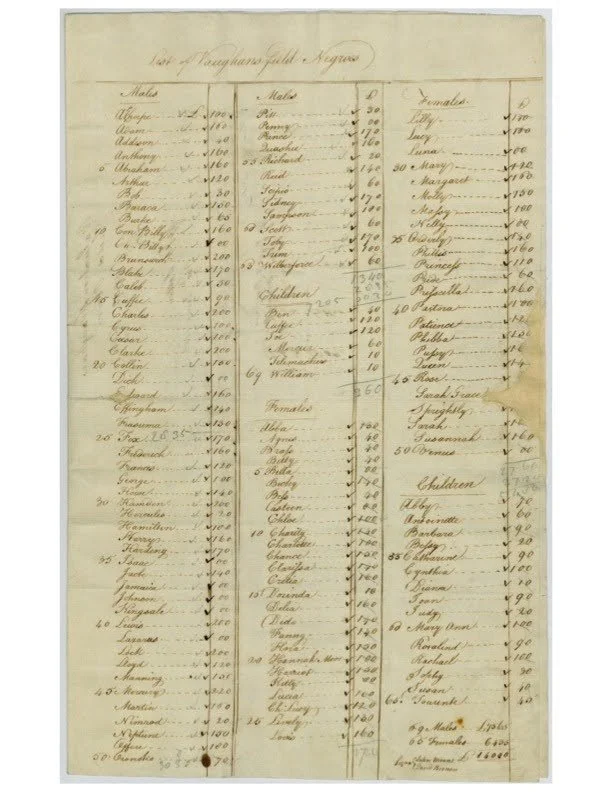
Vaughanfield Plantation Slave Census, 1802
When Samuel Vaughan died in 1802, his estate was valued to include land, buildings, equipment, livestock—and the people he enslaved. This list records the enslaved people living and laboring at Vaughansfield, one of the family’s three principal Jamaican plantations. Vaughansfield was destroyed during the Christmas Rebellion in 1831. Emancipation came to Jamaica in 1838.
Samuel Vaughan Sr.
British merchant Samuel Vaughan built the family fortune in Jamaica through sugar, coffee, land, trade, and enslaved labor. He developed business connections with Benjamin Hallowell, a Boston Shipbuilder and Maine landowner, whose daughter Vaughan eventually married. Through Vaughan’s Caribbean connections and Hallowell’s ships and access to Maine resources, sugar and rum moved north while ships and lumber moved south.
Vaughan was also a Unitarian, political radical, supporter of the American Revolution, and friend of Benjamin Franklin. He believed in reason, liberty, and human progress.
When he died in 1802, his estate included property in Britain, America, and Jamaica—including the people he enslaved.
The Five Vaughan Brothers
Samuel Vaughan Sr.’s five sons inherited more than property. They inherited a network of businesses, plantations, commercial relationships, and wealth that stretched across the Atlantic—as well as the Enlightenment-era values that shaped their family and a determination to put those ideals into action.
Each followed a different path, but their paths were driven by shared purposes: to strengthen the family’s business interests and to advance ideas about liberty, education, reform, and human progress. William expanded the family’s commercial reach in London; John built a life of commerce and philanthropy in Philadelphia; Benjamin pursued politics, diplomacy, and reform before settling in Hallowell; Charles managed land and promoted civic development in Maine; and Samuel Jr. remained in Jamaica, managing the family plantations.
Their lives reveal both the reach of those ideals and the limits of applying them within a family whose wealth remained deeply connected to slavery.
William Vaughan (1752-1850)
Based in London, William helped expand the family’s commercial reach through shipping, waterways, and the development of the West India Docks.
He was also a philanthropist and reformer, advocating for prison reform, public health, and education.
His life reflects a pattern that runs throughout the family: efforts to improve society alongside participation in an economy built on slavery.
John Vaughan (1756-1841)
John made his home in Philadelphia, where he remained connected to his brothers and the family business. He became deeply involved in the American Philosophical Society, the heart of American Enlightenment, and supported education and a school for the blind.
His philanthropy was made possible in part by a fortune inherited from a family whose wealth was rooted in Jamaican plantations.
Benjamin Vaughan (1751-1835)
A British physician, diplomat, and political thinker, Benjamin Vaughan worked alongside figures including Benjamin Franklin and other American dignitaries like John Adams and John Jay, and helped negotiate the 1783 Treaty of Paris that ended the American Revolution. He championed reason, liberty, and free trade and initially supported abolition of the slave trade. Then he went to Jamaica.
In 1792, he spoke in Parliament against abolition, arguing that enslaved people were not prepared for freedom. Two years later, he supported abolition of the trade. His position had changed, but his financial and family connections to the West India trade remained.
Benjamin eventually settled in Hallowell, Maine, on land that had once belonged to his maternal grandfather. He became known as a physician, farmer, intellectual, and civic leader. He corresponded with the first six presidents of the United States and designed Maine’s state seal in 1820.
Charles Vaughan (1759-1839)
Charles was the first Vaughan brother to settle permanently in Hallowell where he served as a land agent for the Kennebec Proprietors, managing property claims that sometimes put him at odds with local settlers.
He also promoted agriculture, education, and civic improvement.
From Hallowell, Charles managed the family’s Maine lands and resources that tied them to a trading network that stretched to the Caribbean.
Samuel Vaughan JR. (1762-1827)
Samuel Jr. was the only Vaughan brother to make Jamaica his permanent home. For nearly three decades, he managed the family’s plantations near Montego Bay and became a prominent agricultural and civic figure.
He supported education, infrastructure, and Christian instruction for the people he enslaved. Some of his peers considered him a model of enlightened plantation management.
But Samuel Jr. did not believe religious instruction required freedom. In an 1815 letter, he defended slavery as permitted by Scripture.
His story exposes one of the central contradictions of “enlightened” slaveholding: a person could promote education, religion, and moral improvement while still defending the institution that denied other people their freedom.
William Oliver (1783-1826) & Petty Vaughan (1788-1854)
The family’s Atlantic connections continued into the next generation through Benjamin’s sons, William and Petty.
William Oliver became a farmer and West India merchant in Hallowell. His correspondence shows the movement of Maine timber and staves south to the Caribbean, with sugar and rum returning north. Petty later worked with his uncle William in England, keeping a ledger that records the same Atlantic exchange.
These can look like ordinary business records—cargoes, quantities, prices, destinations. Read beside the plantation records, they reveal the link—Maine timber entered an economy sustained by enslaved labor, while the sugar and rum arriving in Maine were products of that same system.
Held Taut
The Vaughans left behind ideas, institutions, businesses, philanthropy, and a community legacy that continues to shape how they are remembered.
But their story cannot be separated from the people whose labor helped make that legacy possible.
Across three generations, the Vaughan family’s wealth, relationships, and ambitions stretched across the Atlantic. The records they left behind preserve fragments of the people who lived within that world—but rarely on their own terms.
The ten lives traced here remind us what those records can reveal when we look beyond names, numbers, and valuations.
They also remind us what they cannot.
The archive was created by a system that treated people as property. Yet within those records are mothers and children, skilled workers, people who ran, people who were captured, and people who found a path to freedom.
Their lives are not a footnote to the Vaughan story. They are the foundation of the story.
About the Author(s)
Kate Tremblay, Executive Director, Vaughan Woods and Historic Homestead
Kate Tremblay, M.Ed., is the Executive Director of Vaughan Woods & Historic Homestead in Hallowell, Maine. She holds a Master of Education from Lesley University and has spent her career creating engaging educational experiences that connect people with nature, history, and place. Before joining Vaughan Woods & Historic Homestead, she was a Registered Maine Guide and Director of Chewonki's Outdoor Classroom for Schools in Wiscasset. Today, she leads efforts to preserve and interpret the historic homestead and nature preserve with a recent emphasis on expanding public understanding of the Vaughan family's ties to slavery through exhibitions and archival research. She lives in Hallowell with her husband, two teenage children, and their old English Sheepdog.
Jill Whitchurch Dixon, Lead Interpreter, Vaughan Woods and Historic Homestead
In her work at Vaughan Woods and Historic Homestead, Jill enjoys the multiple roles required by a small house museum; researcher, gardener, archivist, curator, trail walker, pear picker, event hostess, educator, and crafter. In 2019 Jill earned a Master’s in American History from Norwich University where she focused on studying women and their work in order to make sense of gender inequality and the lack of recognition of the work done by half of our population throughout history, leading up to present day realities for women. Her continued hope through historical research and writing is to dig up forgotten stories that still need to be told. Jill also enjoys working and volunteering in the local schools and if she is not at a lake, ocean, or pool, she is wishing she were.