The Civilian Conservation Corps & WWII Prisoner of War Camp
Across the road from the Passamaquoddy Cultural Heritage Museum is the former WWII Prisoner of War Camp, which at one point housed 350 German prisoners. Previously, the site had served as a Depression-era work farm. Two buildings from the camp remain standing today.
“The Great Depression hit the Indian people harder than any other people in the State of Maine. There is practically no sales for their baskets and novelties which they manufacture and it is impossible for them to obtain work of any kind. If I, as their agent, ask a contractor for work which they are capable of doing, the answer is: ‘when we hire a man, it is a tax payer, and you will have to take care of the Indians as they are wards of the State, and we are not employing that class of laborers.’”
New Deal-era Conservation Corps Camp
In 1933, during the Great Depression, the U.S. government established the Civilian Conservation Corps (CCC) to provide work for unemployed men, mostly youths between 18 and 24. One such camp, designated as Company 192, was located in Motahkomikuk (Indian Township), near Princeton. This camp, often referred to as the "Far East" camp, was under the supervision of the Maine Forest Service from June 1933 to June 1941. The primary focus of the Princeton camp was on forest logging, road construction, and maintenance. It offered no work for tribal members.
Conversion to WWII Prisoner of War Camp
In the spring of 1944, the federal government repurposed the camp to house German prisoners of war (POWs) as part of a broader effort to utilize POW labor for essential wartime industries. The POW camp located in Indian Township was part of a network of similar facilities across Maine, including camps in Houlton, Seboomook, and Spencer Lake, which collectively housed thousands of German POWs. A 6-foot electric barbed wire fence was installed around the entire camp and outside the electric fence were two more fences.
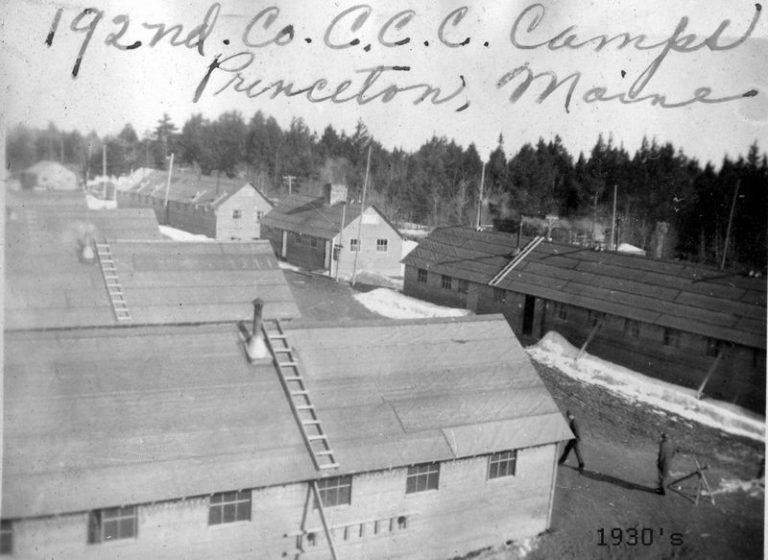
The first group of approximately 286 German soldiers arrived in Princeton on May 9, 1944. The prisoners were primarily from Rommel’s Afrika Korps or U-boat crews. Some had previously been held in Louisiana and made to pick cotton before being transferred to Maine, where they were primarily engaged in cutting pulpwood for local paper mills.
Interactions between the POWs and the local community were said to be generally cordial by local residents. Some prisoners even exchanged goods like butter and meat with locals, which were scarce in the community but supplied to the camp under the Geneva Convention.
Repurchasing Stolen Land
After the war, the lands near Lewey Lake and the former CCC/POW camp had passed into private hands. Following passage of the 1980 Settlement Act, the Passamaquoddy tribe used settlement funds to repurchase lands in Indian Township from private landowners, including the POW Camp. Beginning in 2013, the site was used for residential purposes, as a watershed, and for wildlife habitat along Lewey Lake.
This research was compiled as part of the Mihqitahatom: The “I Remember” Walk at Motahkomikuk/Indian Township, which took place on August 17, 2025. For more research related to this area, click on the tags below. To download a hi-res version of the posters below for educational use, please contact where@atlanticblackbox.com.
This walk was a collaboration between the Passamaquoddy Tribe at Motahkomikuk (Indian Township), First Light, and the Walks for Historical & Ecological Recovery (WHERE), a series convened by Atlantic Black Box, following the actions and determination of the community and leadership from elders.