The Jackson Family Homesite
An Invisible Landmark in Castine’s African and African American History
Mary Tyler Jackson, a free African American woman, owned a house that stood on the land in front of you from 1865-1877.
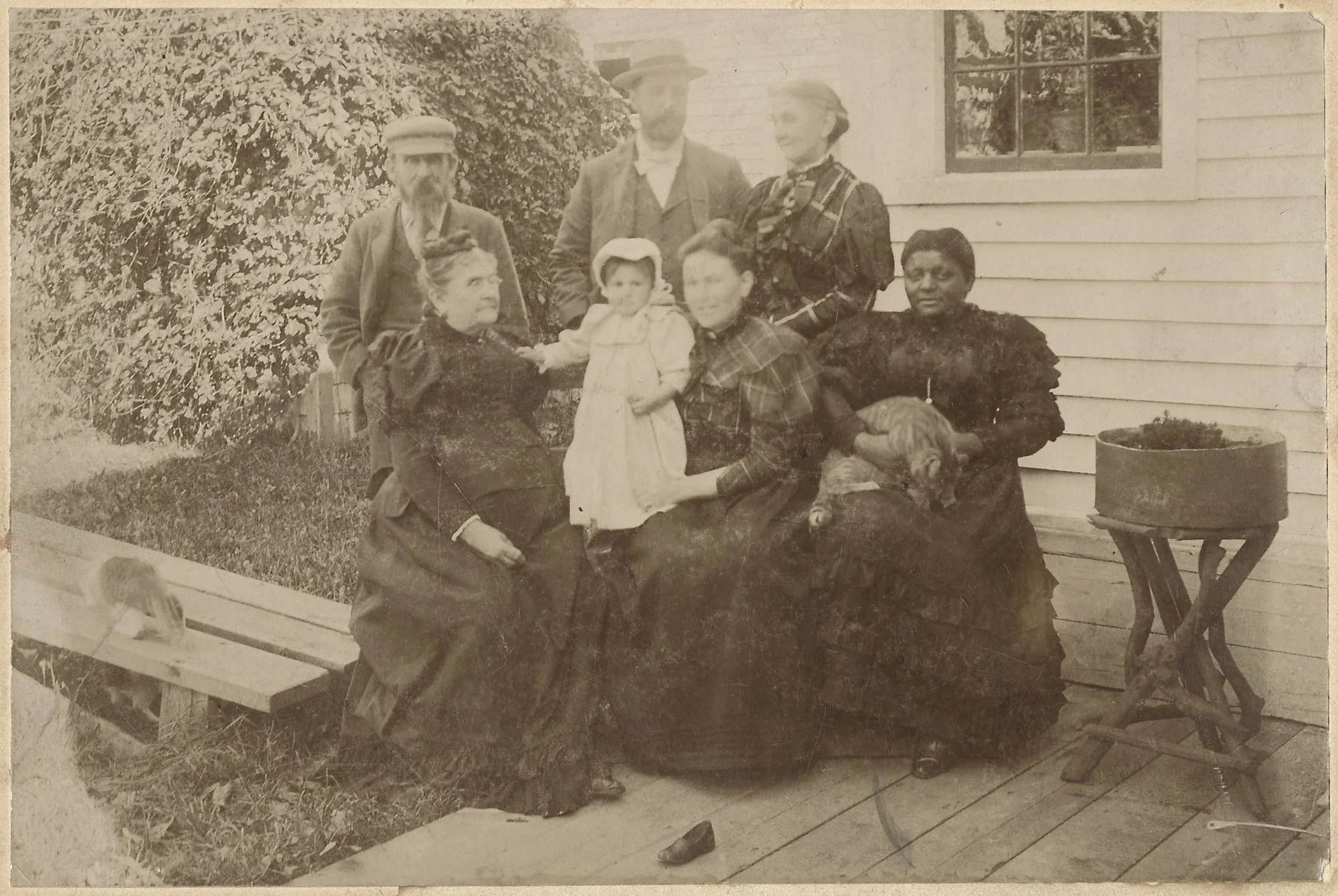
Mary Jackson (far right) with the Whiting Family - photo courtesy of the Castine Historical Society
Mary’s father, John J. Jackson, was born sometime between 1777-1795 in the area of the Bight of Benin or the Gold Coast in Africa. As a boy, John was kidnapped into enslavement and transported to Brazil, likely to work on a sugar plantation. He later escaped enslavement and stowed away on a ship bound for New York. It is believed he worked in the east coast shipping trade before arriving in Castine.
There is no known record of how John made his way to Castine, although it could be through his work as ships’ cook for Castine-resident Captain Leonard Whiting.
Here, John met his wife Catharine Boyce. She was a free African American woman born in the town, but little is known of her personal history. They married in 1833 and had nine children together.
In 1856, John acquired a portion of the land you see behind this sign, now partially hidden by a parking lot. He was one of only three known African or African American property owners in Castine prior to the 20th century.
John Jackson’s wife, Catharine, and all but one of their nine children died by the 1860s. When John died in 1864, he bequeathed his property to his only remaining child, Mary Tyler Jackson.
Upon John’s death, Mary became a domestic servant for the Whiting family. Although she accumulated significant wealth, she never left their household.
Mary died in 1917 at the age of 64 after leading a singular life in Castine as a prominent, well-respected resident.
Though her father owned a family plot in the Cemetery, Mary is buried with the Whiting family. With the support of Brad Tenney and the Cemetery Committee, the Jackson grave plot recently received corner markers with the letter “J” on them. Mary’s grave, still tended by the committee and community members, was recently cleaned, You can visit both plots in the Castine Cemetery.
Reflection Questions
Like most sites connected to African and African American history in Castine, the Jackson Homesite is no longer visible. How might we make the Jackson family’s story visible at the site of the former home? What could it look like to honor or commemorate them?
How do signs, memorials, and architecture contribute to our understanding of “permanance” and what gets remembered?
How does the land hold a different kind of permanence?
What might the land remember here?
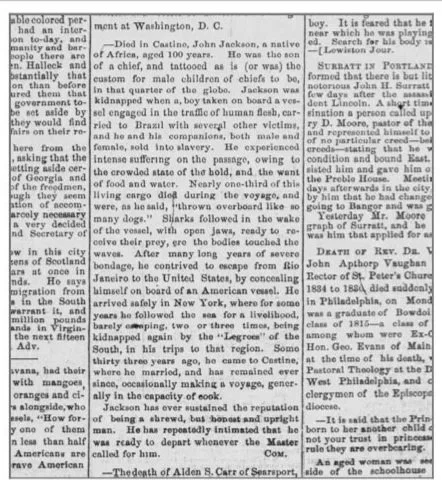
Who do you think wrote this obituary?
Do you think they were true to John’s story?
What was their motivation in sharing it?
How might we use this kind of information to reconstruct a life?
This research was compiled as part of the Mači-pikʷátohsək: A Wayfinding Walk which took place in Castine on October 5, 2025. For more information about this walk, click here. For more research related to this area, click on the tags below. To download a hi-res version of the posters below for educational use, please contact where@atlanticblackbox.com.
This event was a collaboration between Castine History Partners (CHP) and the Walks for Historical & Ecological Recovery (WHERE), a series convened by Atlantic Black Box.
Castine History Partners is a collaboration originally established to create virtual history tours for Castine. CHP supports a variety of learning opportunities around the history of Castine. The partners include Castine Community Partners, Castine Historical Society, Castine Touring Company, Maine Coast Heritage Trust, Maine Maritime Academy, Wilson Museum, and Witherle Memorial Library.