Wabanaki Survivance
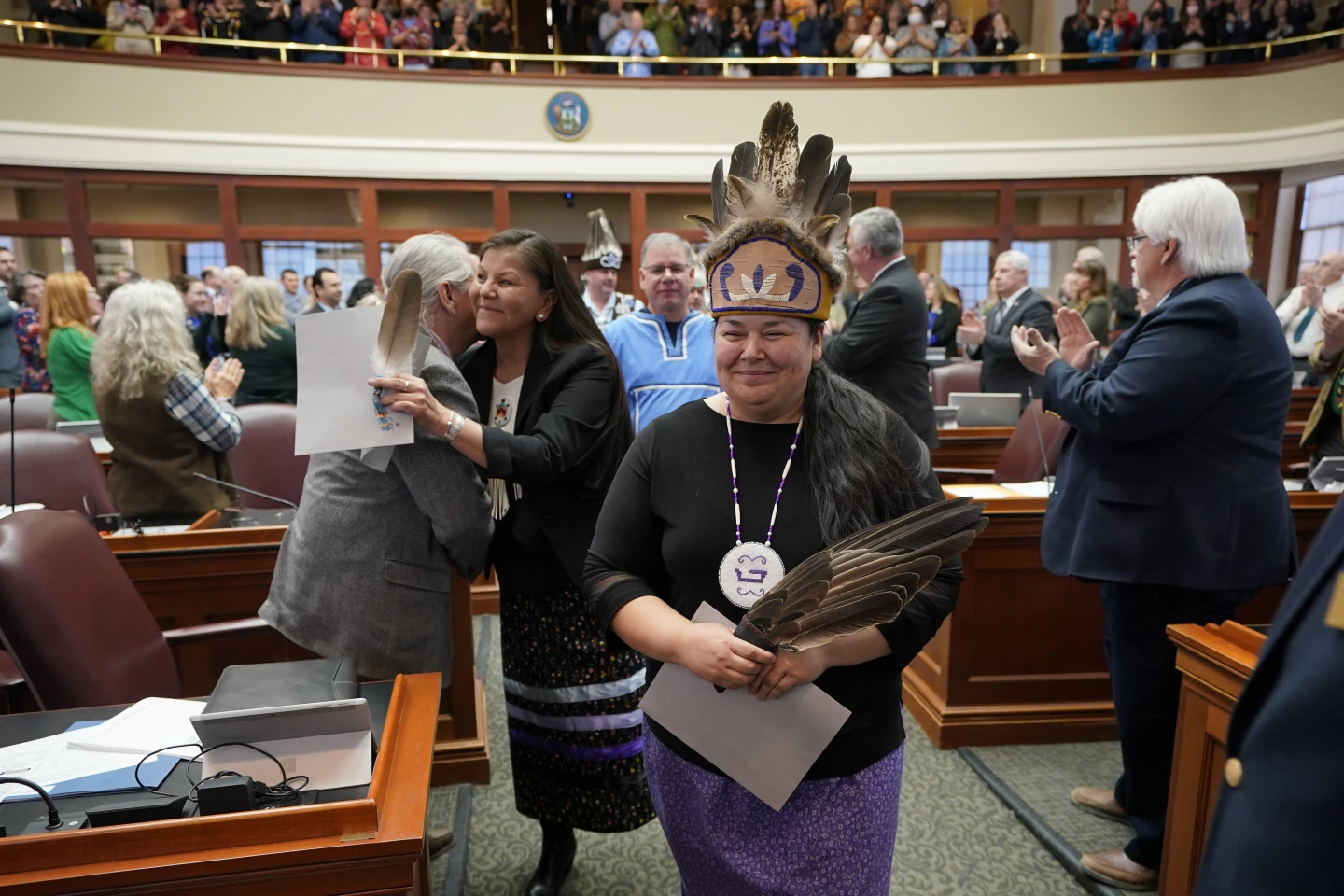
Clarissa Sabattis, Chief of the Houlton Band of Maliseets, foreground, and other tribal leaders are welcomed by lawmakers into the House Chamber, Wednesday, March 16, 2023 in Augusta, Maine.
Governor Janet Mills delivered a setback to the tribes’ effort to have their inherent sovereignty recognized when she vetoed a proposal on June 30, 2023, aimed at ensuring most federal laws apply to them.
(AP Photo/Robert F. Bukaty)
Over time, numerous laws were enacted to dispossess Indigenous people of their lands and force assimilation. These included the Removal Act of 1830 under President Jackson, the Homestead Act of 1862 (which granted citizens and future citizens the right to claim 160 acres of government land), and the Dawes Act of 1887, which allowed the federal government to break up Native American tribal lands and distribute them to individuals. The Religious Crimes Code of 1883 banned spiritual ceremonies, songs, and dances, and Public Law 280 in 1953 granted certain states criminal jurisdiction over Native people on reservations.
American Indian residential schools were established in the United States from the mid-17th to early 20th centuries with the primary goal of "civilizing" or assimilating Native American children and youth into Anglo-American culture. These boarding schools were initially founded by Christian missionaries, who often had federal approval to start missions and schools on reservations. The Bureau of Indian Affairs (BIA) later established additional off-reservation boarding schools.
At these schools, children were immersed in upper-class Anglo-American culture. They were stripped of their identities, forced to cut their hair, wear American-style uniforms, and adopt English names. Speaking their native languages or practicing their spiritual traditions was forbidden. Many children were forcibly separated from their families as young as four years old, and the harsh conditions they faced led to widespread physical abuse, emotional trauma, and, in many cases, death due to disease or maltreatment. Later investigations uncovered cases of emotional, physical, and sexual abuse.
The Civilization Fund Act of 1819 promoted this assimilation policy by funding societies, mostly religious missionaries, who ran Native American education programs, often in or near Native communities. After the Indian Wars, Lieutenant Richard Henry Pratt, stationed at Fort Marion in St. Augustine, Florida, famously said, "Kill the Indian, save the man." He furthered the assimilation model through the Carlisle Indian Industrial School. In 1891, a compulsory attendance law allowed federal officers to forcibly remove Native American children from their homes, including Wabanaki children from Maine, who were sent to Carlisle and other boarding schools. This dark history contributed to Maine's Truth and Reconciliation process, which began in 2008 and was formally established in 2013.
The enrollment in Indian boarding schools peaked in the 1970s, with an estimated 60,000 children attending these institutions by 1973. The last of these schools closed in the 1990s. Mass graves of children were discovered, shedding light on the immense abuse and devastation these schools inflicted on Native families. This led to the creation of the Every Child Matters movement and Orange Shirt Day, both commemorating the children who died due to the systemic abuse within these schools.
In 1980, the Maine Indian Land Claims Settlement Act was signed by President Jimmy Carter. The Passamaquoddy, Maliseet, and Penobscot tribes received $81.5 million in reparations for the lands taken from them, equating to just $1 per acre. However, in order to receive this money, the Tribes had to give up certain sovereign rights. The agreement was accepted under political pressure, with fears that if Nixon won the presidency, they might receive nothing.
The settlement led to ongoing issues, as the Wabanaki people lack full sovereignty over their own lands, including restrictions on water, fishing, and other rights. There have been multiple legal battles with the State of Maine, such as the fight for clean water rights under LD 906, which eventually passed, though many other bills concerning sovereignty have not.
This research was compiled as part of The Inclusive Walking Tour, which took place in Biddeford on October 27, 2024. For more information about this walk, click here.
For more research related to this area, click on the tags below. To download a hi-res version of the posters below for educational use, please contact where@atlanticblackbox.com.
This walk was a collaboration between Community Change Inc., Biddeford Saco area Showing Up for Racial Justice (SURJ), Heart of Biddeford, the City of Biddeford, and Atlantic Black Box.