Winona Cliff and the Indian Trail
Mythology, Stereotyping, and Erasure
The waves and wind that have pummeled the face of nearby Winona Cliff for centuries have disintegrated the rock face, eroding the invented stories about the cliff from local memory along with it.
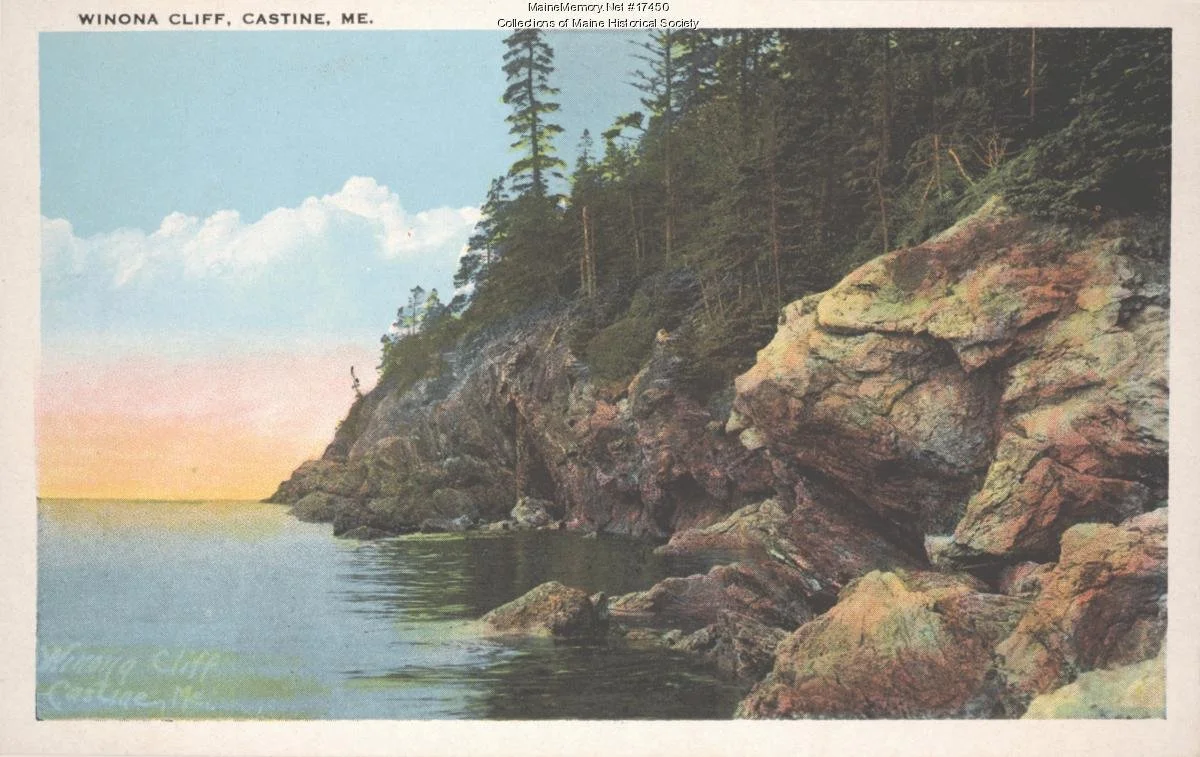
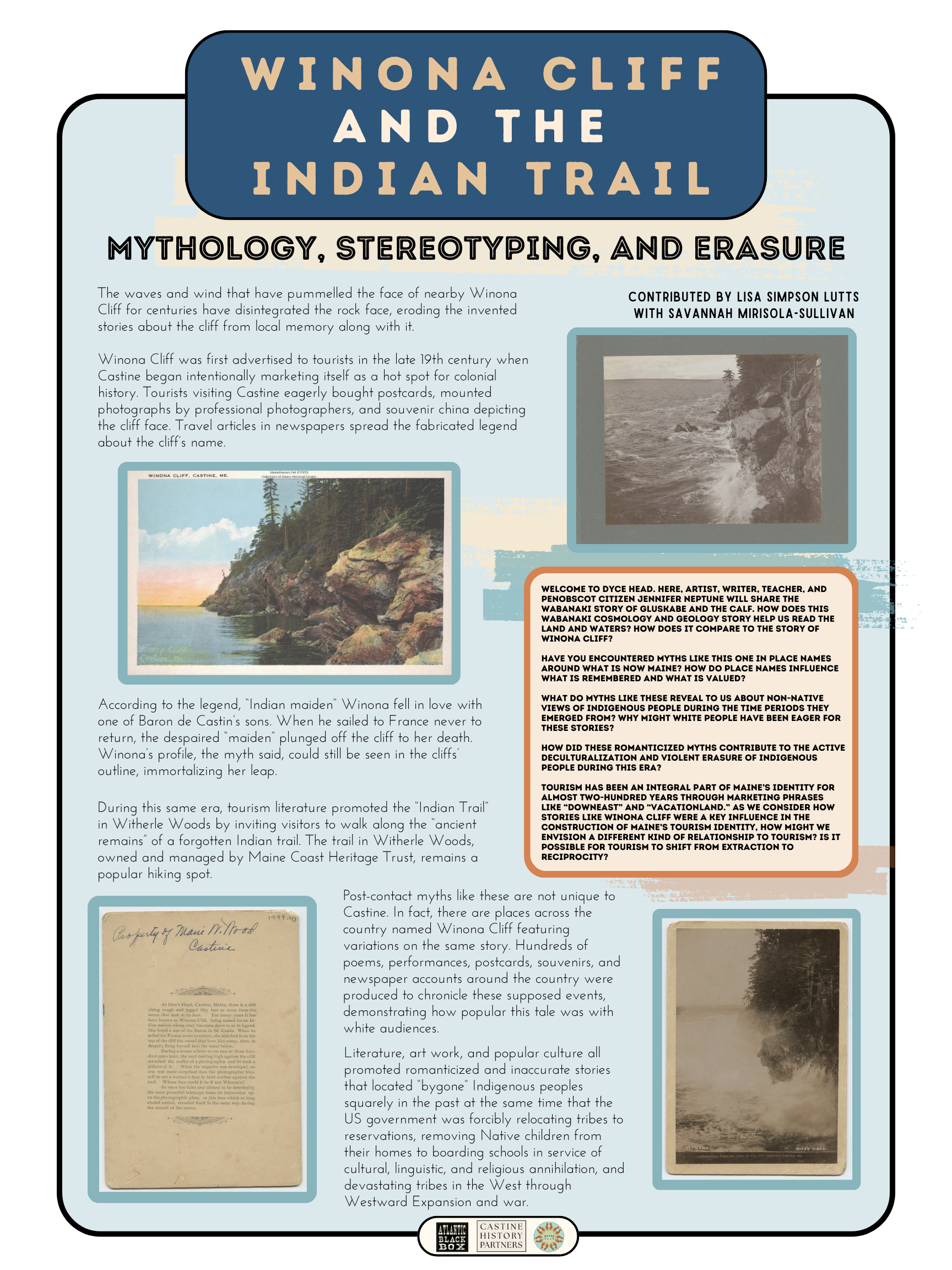
A postcard of Winona Cliff at Dyce's Head in Castine, taken about 1930.
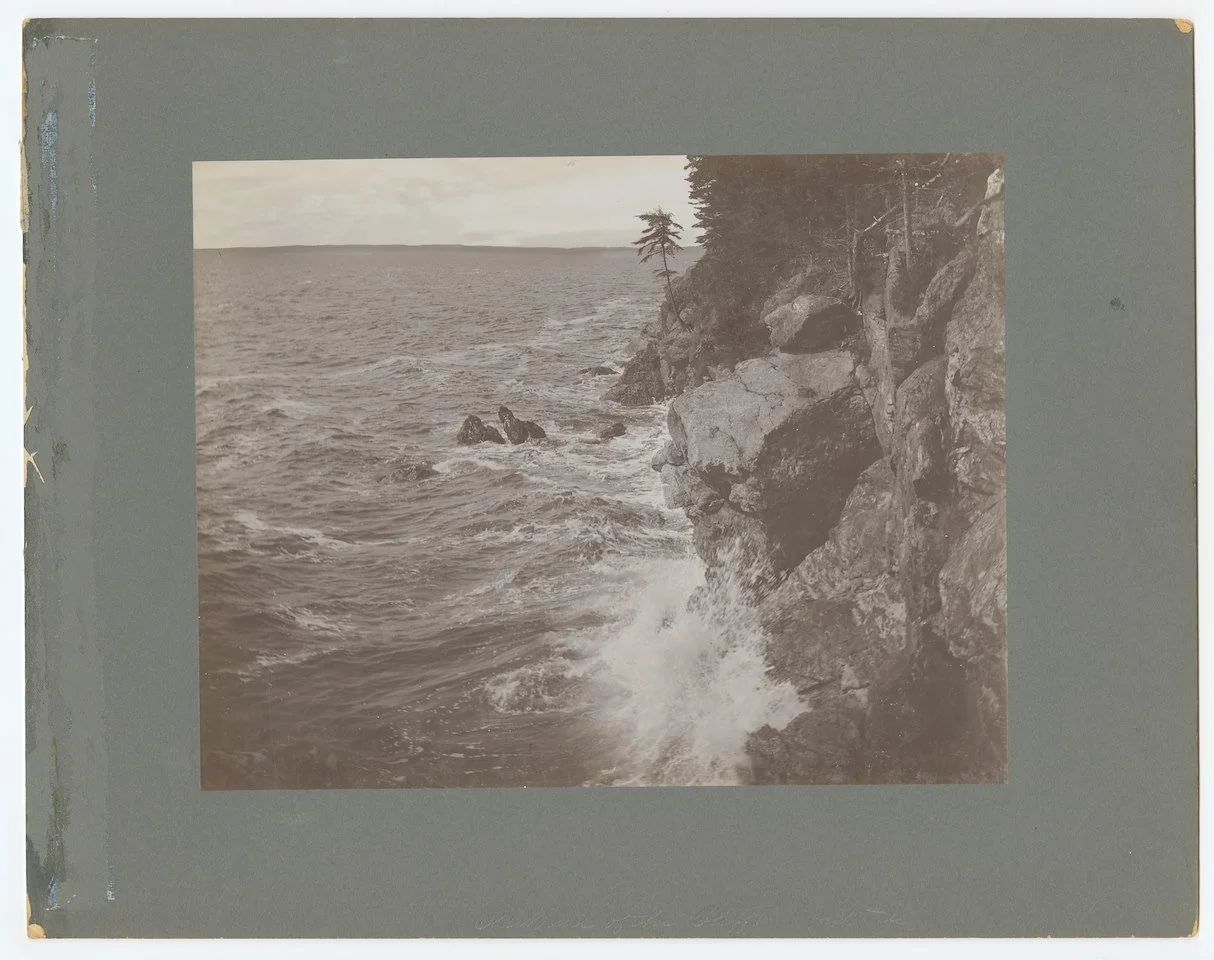
Winona Cliff was first advertised to tourists in the late 19th century when Castine began intentionally marketing itself as a hot spot for colonial history. Tourists visiting Castine eagerly bought postcards, mounted photographs by professional photographers, and souvenir china depicting the cliff face. Travel articles in newspapers spread the fabricated legend about the cliff’s name.
According to the legend, “Indian maiden” Winona fell in love with one of Baron de Castin’s sons. When he sailed to France never to return, the despaired “maiden” plunged off the cliff to her death. Winona’s profile, the myth said, could still be seen in the cliffs’ outline, immortalizing her leap.

Winona Cliff CHS photo by William George Sargent, 1896, with myth on back for sale to tourists

During this same era, tourism literature promoted the “Indian Trail” in Witherle Woods by inviting visitors to walk along the “ancient remains” of a forgotten Indian trail. The trail in Witherle Woods, owned and managed by Maine Coast Heritage Trust, remains a popular hiking spot.
Post-contact myths like these are not unique to Castine. In fact, there are places across the country named Winona Cliff featuring variations on the same story. Hundreds of poems, performances, postcards, souvenirs, and newspaper accounts around the country were produced to chronicle these supposed events, demonstrating how popular this tale was with white audiences.
Literature, art work, and popular culture all promoted romanticized and inaccurate stories that located “bygone” Indigenous peoples squarely in the past at the same time that the US government was forcibly relocating tribes to reservations, removing Native children from their homes to boarding schools in service of cultural, linguistic, and religious annihilation, and devastating tribes in the West through Westward Expansion and war.
Reflection Questions
Welcome to Dyce Head. Here, artist, writer, teacher, and Penobscot citizen Jennifer Neptune will share the Wabanaki story of Gluskabe and the Calf.
How does this Wabanaki cosmology and geology story help us read the land and waters? How does it compare to the story of Winona Cliff?
Have you encountered myths like this one in place names around what is now Maine? How do place names influence what is remembered and what is valued?
What do myths like these reveal to us about non-native views of Indigenous people during the time periods they emerged from? Why might white people have been eager for these stories?
How did these romanticized myths contribute to the active deculturalization and violent erasure of Indigenous people during this era?
Tourism has been an integral part of Maine’s identity for almost two-hundred years through marketing phrases like “Downeast” and “Vacationland.” As we consider how stories like Winona Cliff were a key influence in the construction of Maine’s tourism identity, how might we envision a different kind of relationship to tourism? Is it possible for tourism to shift from extraction to reciprocity?
This research was compiled as part of the Mači-pikʷátohsək: A Wayfinding Walk which took place in Castine on October 5, 2025. For more information about this walk, click here. For more research related to this area, click on the tags below. To download a hi-res version of the posters below for educational use, please contact where@atlanticblackbox.com.
This event was a collaboration between Castine History Partners (CHP) and the Walks for Historical & Ecological Recovery (WHERE), a series convened by Atlantic Black Box.
Castine History Partners is a collaboration originally established to create virtual history tours for Castine. CHP supports a variety of learning opportunities around the history of Castine. The partners include Castine Community Partners, Castine Historical Society, Castine Touring Company, Maine Coast Heritage Trust, Maine Maritime Academy, Wilson Museum, and Witherle Memorial Library.