Black Student Resistance
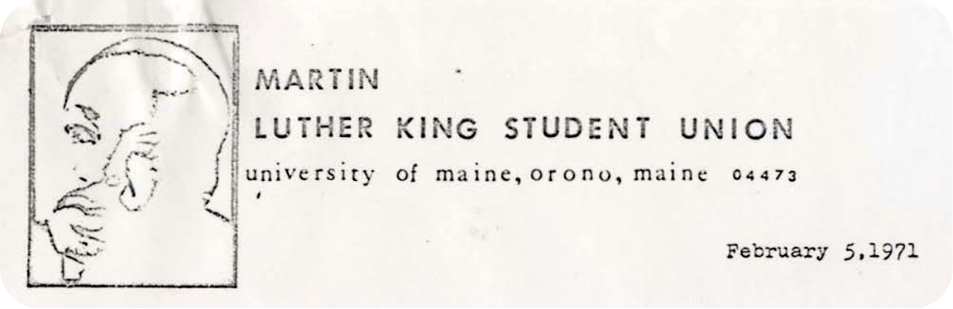
“If the white community and specifically the white press in Maine will not listen and take time to record the thinking of the Black community through constructive means, then you leave this community no positive alternatives. Is this what the white community wants? We, the Black Students at UMO think not... Give us your powerful support.”
Much of the history of Black student success on the University of Maine campus is also a history of resistance: resistance to racist policies and institutional barriers, resistance to Black erasure and assimilation, and resistance to violence.
In the early 20th century, Black students were barred from participating in many aspects of student life, including student-teaching, joining fraternities and sororities, and living safely in campus housing. The continued impact of such policies inspired the creation of campus groups to resist anti-Black racism and provide much needed affinity spaces.
The Committee Against Racism was formed in 1969, and the Martin Luther King Jr Student Union existed on campus in the 1970s. The MLKJ Student Union gave way to the African American Student Association in the 1990s.
Today, the Black Student Union, established in 2017, continues to fight anti-Black racism and foster a sense of belonging for Black students on campus.
This research was compiled as part of the Walk to Honor Wabanaki Veterans, which took place in Orono on June 21, 2025. For more information about this walk, click here.
For more research related to this area, click on the tags below. To download a hi-res version of the posters below for educational use, please contact where@atlanticblackbox.com.
This event was part of the Walk for Historical and Ecological Recovery (WHERE), a series convened by Atlantic Black Box devoted to grassroots truth-seeking and transformation. It was organized under the leadership of James Eric Francis, Sr. in collaboration with the Penobscot Nation Cultural & Historic Preservation Department, the Town of Orono, the City of Old Town, the UMaine Wabanaki Center, Bangor Public Library, Orono Public Library, RSU 26, The Wabanaki Alliance, The Abbe Museum, Wabanaki Public Health & Wellness, The Wilson Center, The Church of Universal Fellowship, Ça C’est Bon, and Orono Arts Fest.