Unsung Heroes
Black Soldiers from Maine
African Americans from Maine fought in the nation’s wars down through the centuries.
Legislation promoted by Hannibal Hamlin, Vice President to Abraham Lincoln, made it possible for Black men to enlist in the armed forces during the Civil War. Among those from the Bangor area who enlisted to fight with the “United States Colored Troops” (USCT) in 1863 were George Gillispe (21), Charles Gillispe (18) and William Gillispe (25). While these men served as members of the Colored Troops, there were still more Black servicemen who served with white troops during the war.
Prior to the Civil War and while enslaved, Henry Van Meter of Orono served in the War of 1812. He was a privateer seaman aboard the ship Lawrence, which was captured by the British in 1814. Henry spent the remainder of the war as a prisoner in Dartmoor, before being released and returned to the U.S. to settle in the Dudley neighborhood of Orono.
“Approximately 20 percent of USCT soldiers were killed in action or died of disease and other causes, a rate about 35 percent higher than that of white Union troops.”
During his time in Orono, Van Meter served as a witness in a trial. He was badgered so relentlessly by the white counsel that, unwilling to contain his outrage, Van Meter erupted in a righteous outburst during the proceedings.
During the Spanish-American War, the barber Paris O’Ree of Bangor served in the 8th and 18th Regiments.
Charles R. Talbot served in the Navy during WWI. During the second World War, a number of Black Bangor residents enlisted after a call for volunteers from the selective service. Alyson E. “Buster” Wise and Richard A. Biggs of Bangor both appeared in a Bangor Daily Commercial in 1941 after they volunteered for service. Many served in non-combat roles at the Dow Air Force Base in Bangor. At home, Roxy Peters served in the Women’s Army Corps in Bangor during WWII.
Black Mainers who served in other areas of the country faced discrimination. Some servicemen recalled being moved between bases on train cars, which were often siderailed, and they would go without food for some time. An interview with Arthur Jones, a veteran from Maine, revealed that they would often see German and Italian prisoners of war who were being fed regularly while African American servicemen were left hungry.
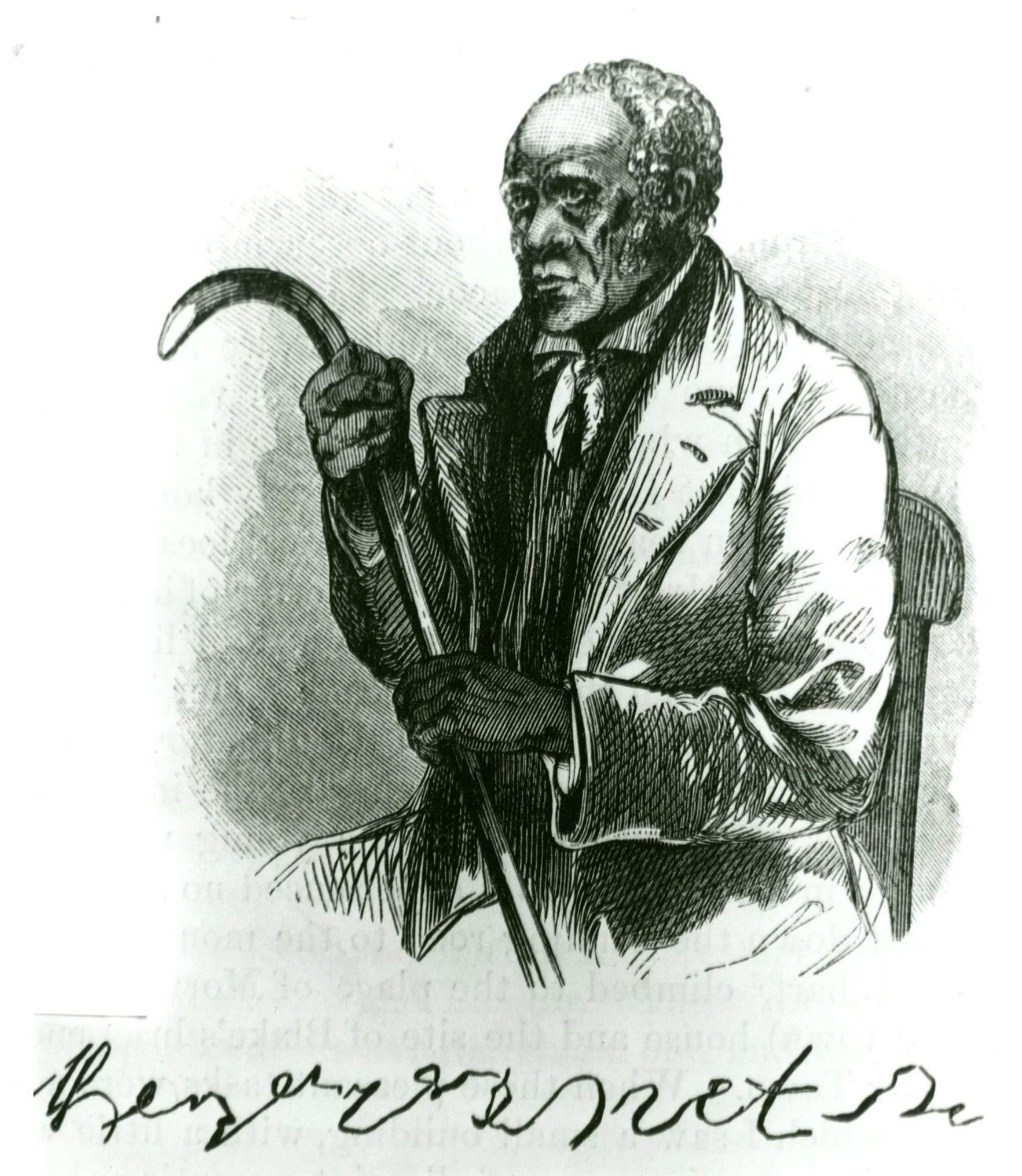
Henry Van Meter was enslaved by Governor Nelson of Virginia during the Revolutionary War and was sold at least three times before he self-emancipated from Kentucky to Ohio. Henry came to Bangor around 1850, where he lived with his wife until his death in 1871. He is buried in Bangor’s Mount Hope Cemetery.
An image scanned from a black and white photographic print of Henry Van Meter (sometimes spelled Henri Van Meter), a resident of Orono, Maine, in the early 1800s.
Image courtesy of Special Collections, Raymond H. Fogler Library, DigitalCommons@UMaine
Reflection Questions
What challenges did Black veterans face during and after their service?
What kind of hostility were these Black Veterans met with in the communities where they lived?
This research was compiled as part of the Walk to Honor Wabanaki Veterans, which took place in Orono on June 21, 2025. For more information about this walk, click here.
For more research related to this area, click on the tags below. To download a hi-res version of the posters below for educational use, please contact where@atlanticblackbox.com.
This event was part of the Walk for Historical and Ecological Recovery (WHERE), a series convened by Atlantic Black Box devoted to grassroots truth-seeking and transformation. It was organized under the leadership of James Eric Francis, Sr. in collaboration with the Penobscot Nation Cultural & Historic Preservation Department, the Town of Orono, the City of Old Town, the UMaine Wabanaki Center, Bangor Public Library, Orono Public Library, RSU 26, The Wabanaki Alliance, The Abbe Museum, Wabanaki Public Health & Wellness, The Wilson Center, The Church of Universal Fellowship, Ça C’est Bon, and Orono Arts Fest.