The Bangor and Pisquataquis Canal Railroad
Mapping Linear Time and Movement Onto the Land
Railroad Colonialism
The bike path you are walking on intersects with an old railroad bed that played a key role in the national and global construction of railroads. The Bangor and Piscataquis Canal Railroad is considered the first railroad built in New England, and the second in the United States.
As one of the first lines built in the country, the Bangor Piscataquis Railroad plays a significant role in what Professor Manu Karuka calls “railroad colonialism.” Railroads carved physical lines into the land, and imposed linear and standardized forms of time.
As you walk the railroad-turned-bike-path, can you feel the force of railroad colonialism in the straight, rigid line of the path? In how it interrupts the landscape? Consider how the railroad would have shaped the rhythm of movement along this route when it was still running; chugging chugging chugging along in one temporal direction to maximize efficiency and extract natural and human resources.
Consider an invitation to change this rhythm and pace in the way you move along or off the path. Can you notice and reclaim other ecological rhythms and time scales as you pass under the tree canopy and listen to the solstice chorus of the forest?
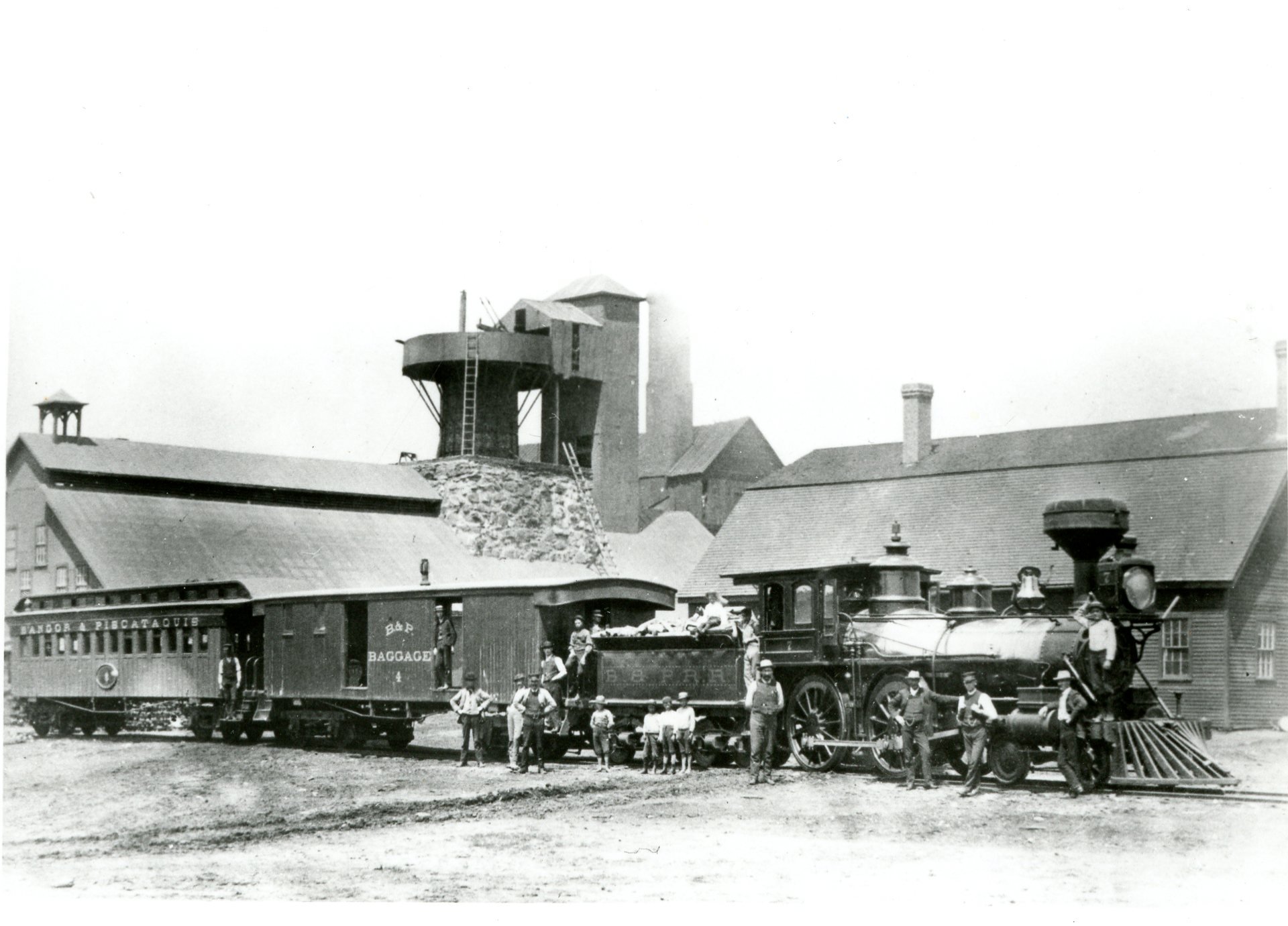
Bangor and Piscataquis Railroad at Katahdin Iron Works, c.1890
Lumber and Rails: An Extractive Relationship
Construction started on the line when the Maine State Legislature granted a charter to Samuel Smith and Rufus Dwinel in 1833, shortly after state formation. The first train ran from Bangor to Old Town in November of 1837. Passengers paid 37.5 cents to ride.
In addition to passengers, the train carried lumber, laths, clapboards, and shingles from the mills. “Lumber baron” Samuel Veazie acquired the rail line in 1850 after a property dispute, adding it to his long stack of deeds including sawmills and banks. The rail became known as “Veazie Road,” which the Old Veazie Railroad Storymap commemorates today. Keep a look out for the stone markers bearing a “V” as you walk the old line.
Downeast & Vacationland: Maine’s Tourism Identities
The 19th century witnessed the peak of Maine’s railroad construction. In addition to its profound impact on the Land and our sense of time, railroads also played a key role in articulating a “Maine Identity” still employed today. The railroad popularized two iconic representations of the State of Maine: Down East and Vacationland.
Inspired by well-known Maine writers Seba Smith and Henry Wadsworth Longfellow, the Maine Central Railroad company started to use the term “Way Down East” in their marketing materials to promote rail travel for tourism in the mid to late 19th century.
In the early 20th century, Maine Central Railroad invented “Vacationland.” They began using this name on a series of brochures. As rail lines gave way to car travel, Vacationland was adopted for Maine state license plates in 1936.
Railroads were therefore a powerful material and symbolic force for colonization. While rail travel is not what it once was, railroad colonialism lives on in the infrastructures, identities, mythologies, and recreational possibilities we inhabit today.
Road scene in Maine, Vacationland, ca. 1930, Tichnor Brothers Collection. Courtesy of Boston Public Library via the Maine Memory Network
Reflection Questions
Consider how the railroad would have shaped the rhythm of movement along this route when it was still running, chugging along temporally in one direction to maximize efficiency & extract natural and human resources.
This research was compiled as part of the Walk to Honor Wabanaki Veterans, which took place in Orono on June 21, 2025. For more information about this walk, click here.
For more research related to this area, click on the tags below. To download a hi-res version of the posters below for educational use, please contact where@atlanticblackbox.com.
This event was part of the Walk for Historical and Ecological Recovery (WHERE), a series convened by Atlantic Black Box devoted to grassroots truth-seeking and transformation. It was organized under the leadership of James Eric Francis, Sr. in collaboration with the Penobscot Nation Cultural & Historic Preservation Department, the Town of Orono, the City of Old Town, the UMaine Wabanaki Center, Bangor Public Library, Orono Public Library, RSU 26, The Wabanaki Alliance, The Abbe Museum, Wabanaki Public Health & Wellness, The Wilson Center, The Church of Universal Fellowship, Ça C’est Bon, and Orono Arts Fest.
Poster design by Meadow Dibble