Naming & Claiming
Inventing a River & Redrawing the Map to Exclude Penobscot Claims to Marsh Island
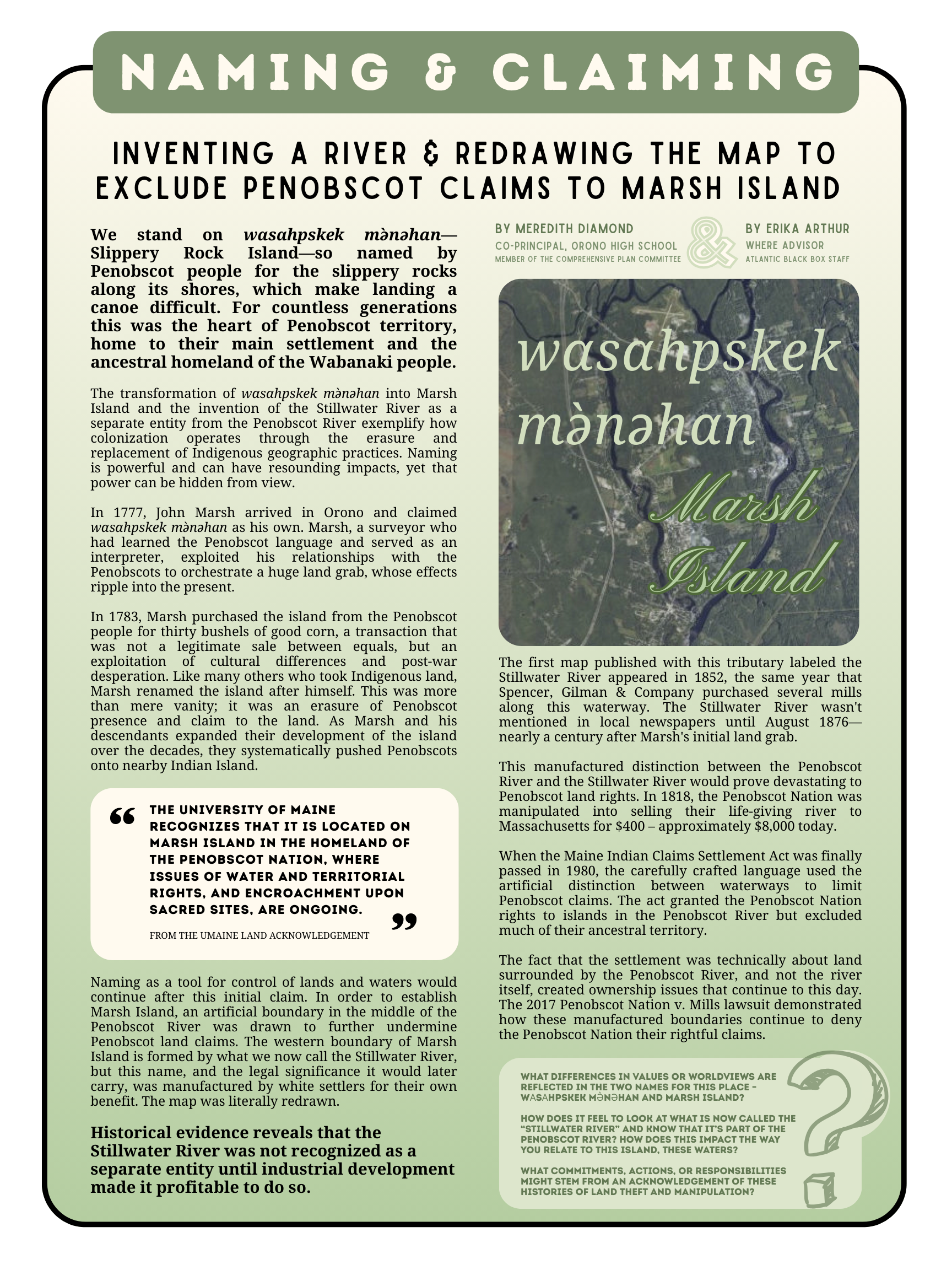
We stand on wαsαhpskek mə̀nəhan—Slippery Rock Island—so named by Penobscot people for the slippery rocks along its shores, which make landing a canoe difficult. For countless generations this was the heart of Penobscot territory, home to their main settlement and the ancestral homeland of the Wabanaki people.
The transformation of wαsαhpskek mə̀nəhan into Marsh Island and the invention of the Stillwater River as a separate entity from the Penobscot River exemplify how colonization operates through the erasure and replacement of Indigenous geographic practices. Naming is powerful and can have resounding impacts, yet that power can be hidden from view.
In 1777, John Marsh arrived in Orono and claimed wαsαhpskek mə̀nəhan as his own. Marsh, a surveyor who had learned the Penobscot language and served as an interpreter, exploited his relationships with the Penobscots to orchestrate a huge land grab, whose effects ripple into the present.
“The University of Maine recognizes that it is located on Marsh Island in the homeland of the Penobscot Nation, where issues of water and territorial rights, and encroachment upon sacred sites, are ongoing.”
In 1783, Marsh purchased the island from the Penobscot people for thirty bushels of good corn, a transaction that was not a legitimate sale between equals, but an exploitation of cultural differences and post-war desperation. Like many others who took Indigenous land, Marsh renamed the island after himself. This was more than mere vanity; it was an erasure of Penobscot presence and claim to the land. As Marsh and his descendants expanded their development of the island over the decades, they systematically pushed Penobscots onto nearby Indian Island.
Naming as a tool for control of lands and waters would continue after this initial claim. In order to establish Marsh Island, an artificial boundary in the middle of the Penobscot River was drawn to further undermine Penobscot land claims. The western boundary of Marsh Island is formed by what we now call the Stillwater River, but this name, and the legal significance it would later carry, was manufactured by white settlers for their own benefit. The map was literally redrawn.
Historical evidence reveals that the Stillwater River was not recognized as a separate entity until industrial development made it profitable to do so.
The first map published with this tributary labeled the Stillwater River appeared in 1852, the same year that Spencer, Gilman & Company purchased several mills along this waterway. The Stillwater River wasn't mentioned in local newspapers until August 1876—nearly a century after Marsh's initial land grab.
This manufactured distinction between the Penobscot River and the Stillwater River would prove devastating to Penobscot land rights. In 1818, the Penobscot Nation was manipulated into selling their life-giving river to Massachusetts for $400 – approximately $8,000 today.
When the Maine Indian Claims Settlement Act was finally passed in 1980, the carefully crafted language used the artificial distinction between waterways to limit Penobscot claims. The act granted the Penobscot Nation rights to islands in the Penobscot River but excluded much of their ancestral territory.
The fact that the settlement was technically about land surrounded by the Penobscot River, and not the river itself, created ownership issues that continue to this day. The 2017 Penobscot Nation v. Mills lawsuit demonstrated how these manufactured boundaries continue to deny the Penobscot Nation their rightful claims.
Reflection Questions
What differences in values or worldviews are reflected in the two names for this place – wαsαhpskek mə̀nəhan and Marsh Island?
How does it feel to look at what is now called the “Stillwater River” and know that it’s part of the Penobscot River? How does this impact the way you relate to this island, these waters?
What commitments, actions, or responsibilities might stem from an acknowledgement of these histories of land theft and manipulation?
This research was compiled as part of the Walk to Honor Wabanaki Veterans, which took place in Orono on June 21, 2025. For more information about this walk, click here.
For more research related to this area, click on the tags below. To download a hi-res version of the posters below for educational use, please contact where@atlanticblackbox.com.
This event was part of the Walk for Historical and Ecological Recovery (WHERE), a series convened by Atlantic Black Box devoted to grassroots truth-seeking and transformation. It was organized under the leadership of James Eric Francis, Sr. in collaboration with the Penobscot Nation Cultural & Historic Preservation Department, the Town of Orono, the City of Old Town, the UMaine Wabanaki Center, Bangor Public Library, Orono Public Library, RSU 26, The Wabanaki Alliance, The Abbe Museum, Wabanaki Public Health & Wellness, The Wilson Center, The Church of Universal Fellowship, Ça C’est Bon, and Orono Arts Fest.
Poster design by Meadow Dibble