Chief Joseph Orono
Honoring a Revolutionary War Diplomat, Leader, and Veteran
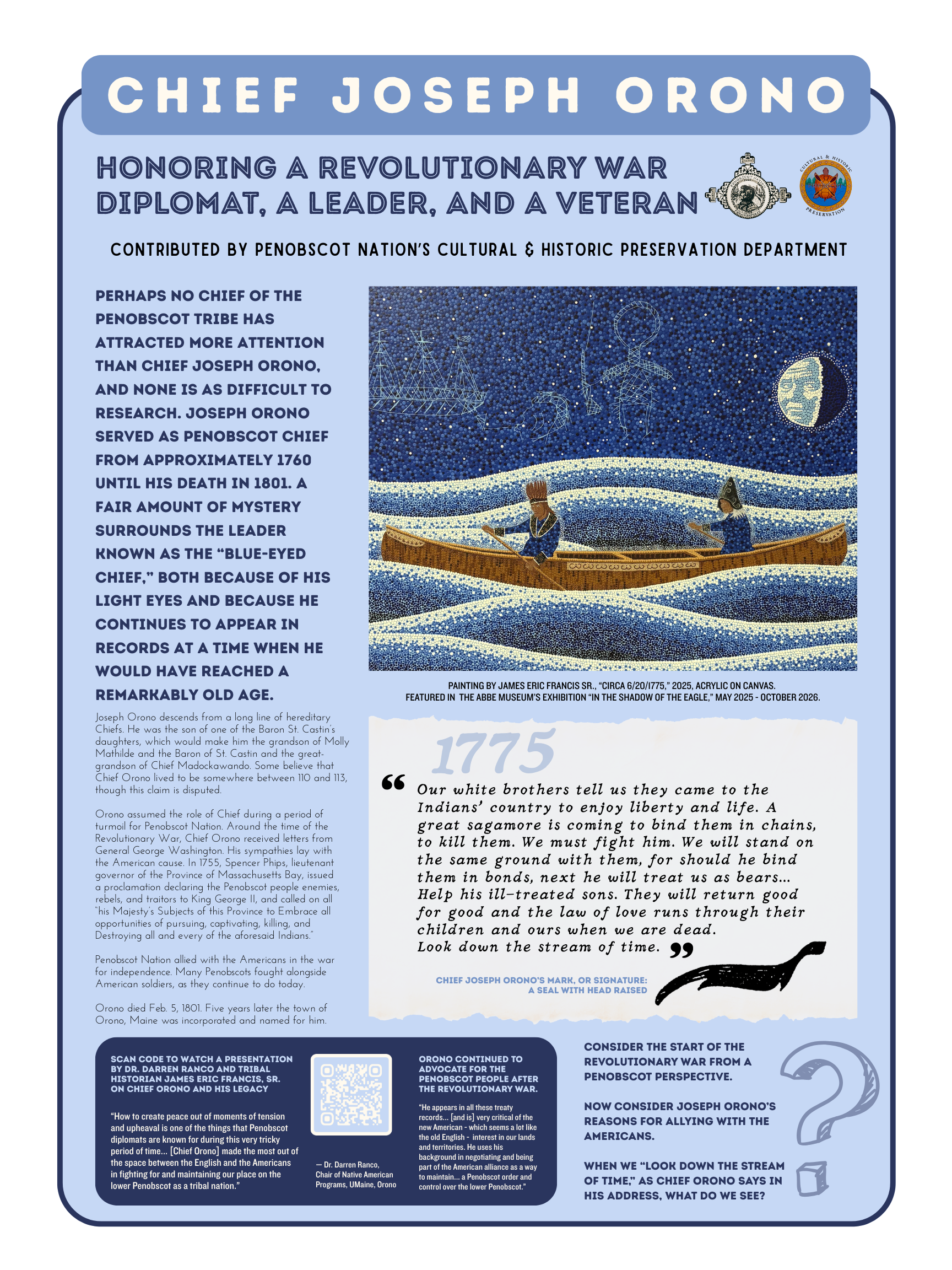
Painting by James Eric Francis Sr., “CIRCA 6/20/1775,” 2025, Acrylic on canvas.
Featured in the Abbe Museum’s exhibition “In the Shadow of the Eagle,” May 2025 - October 2026.
Perhaps no Chief of the Penobscot Tribe has attracted more attention than Chief Joseph Orono, and none is as difficult to research. Joseph Orono served as Penobscot Chief from approximately 1760 until his death in 1801. A fair amount of mystery surrounds the leader Known as the “Blue-eyed Chief,” both because of his light eyes and because he continues to appear in records at a time when he would have reached a remarkably old age.
Joseph Orono descends from a long line of hereditary Chiefs. He was the son of one of the Baron St. Castin’s daughters, which would make him the grandson of Molly Mathilde and the Baron of St. Castin and the great-grandson of Chief Madockawando. Some believe that Chief Orono lived to be somewhere between 110 and 113, though this claim is disputed.
“Our white brothers tell us they came to the Indians’ country to enjoy liberty and life. A great sagamore is coming to bind them in chains, to kill them. We must fight him. We will stand on the same ground with them, for should he bind them in bonds, next he will treat us as bears... Help his ill-treated sons. They will return good for good and the law of love runs through their children and ours when we are dead. Look down the stream of time.”
Orono assumed the role of Chief during a period of turmoil for Penobscot Nation. Around the time of the Revolutionary War, Chief Orono received letters from General George Washington. His sympathies lay with the American cause. In 1755, Spencer Phips, lieutenant governor of the Province of Massachusetts Bay, issued a proclamation declaring the Penobscot people enemies, rebels, and traitors to King George II, and called on all “his Majesty’s Subjects of this Province to Embrace all opportunities of pursuing, captivating, killing, and Destroying all and every of the aforesaid Indians.”
Penobscot Nation allied with the Americans in the war for independence. Many Penobscots fought alongside American soldiers, as they continue to do today. Orono died Feb. 5, 1801. Five years later the town of Orono, Maine was incorporated and named for him.
Reflection Questions
Consider the start of the Revolutionary War from a Penobscot perspective. Now Consider Joseph Orono’s reasons for allying with the Americans. When we “look down the stream of time,” as Chief Orono says in his address, what do we see?

Chief Joseph Orono’s mark, or signature: a seal with head raised
from Richard S. Sprague’s, “Chief Joseph Orono”
“How to create peace out of moments of tension and upheaval is one of the things that Penobscot diplomats are known for during this very tricky period of time... [Chief Orono] made the most out of the space between the English and the Americans in fighting for and maintaining our place on the lower Penobscot as a tribal nation.”
Additional Resources
Presentation by Dr. Darren Ranco and Tribal Historian James Eric Francis, Sr. on Chief Orono and his legacy. (8/17/2020)
This research was compiled as part of the Walk to Honor Wabanaki Veterans, which took place in Orono on June 21, 2025. For more information about this walk, click here.
For more research related to this area, click on the tags below. To download a hi-res version of the posters below for educational use, please contact where@atlanticblackbox.com.
This event was part of the Walk for Historical and Ecological Recovery (WHERE), a series convened by Atlantic Black Box devoted to grassroots truth-seeking and transformation. It was organized under the leadership of James Eric Francis, Sr. in collaboration with the Penobscot Nation Cultural & Historic Preservation Department, the Town of Orono, the City of Old Town, the UMaine Wabanaki Center, Bangor Public Library, Orono Public Library, RSU 26, The Wabanaki Alliance, The Abbe Museum, Wabanaki Public Health & Wellness, The Wilson Center, The Church of Universal Fellowship, Ça C’est Bon, and Orono Arts Fest.
Poster design by Meadow Dibble