Corn: Survival, Exchange, and Colonization
More than a staple food, corn reveals a complex story of survival, exchange, and colonization in southern Maine.
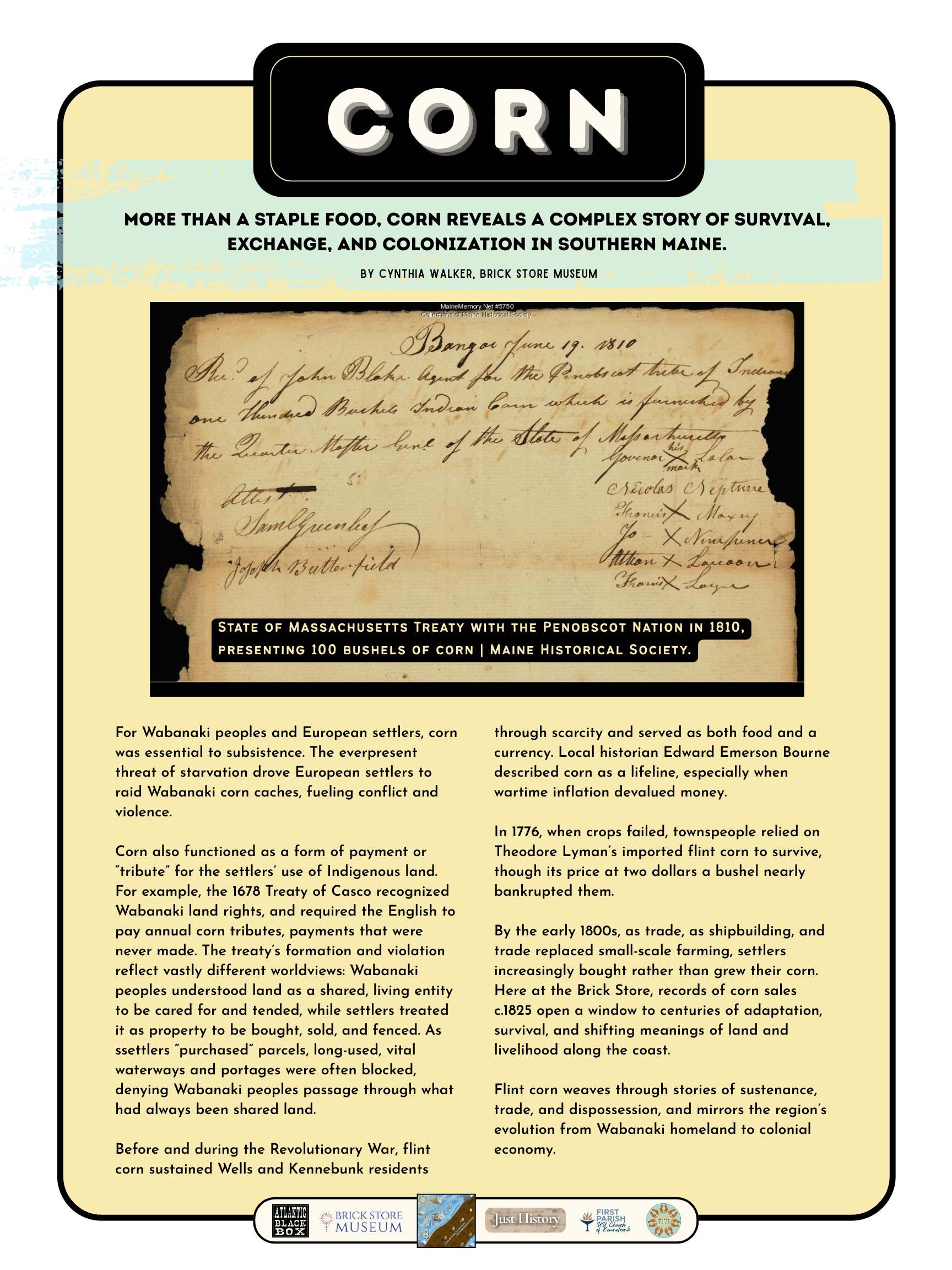
Indian corn for the Penobscots, 1810 - document courtesy of Maine Historical Society. For more info on this document, visit Maine Memory Network.
For Wabanaki peoples and European settlers, corn was essential to subsistence. The everpresent threat of starvation drove European settlers to raid Wabanaki corn caches, fueling conflict and violence.
Corn also functioned as a form of payment or “tribute” for the settlers’ use of Indigenous land. For example, the 1678 Treaty of Casco recognized Wabanaki land rights, and required the English to pay annual corn tributes, payments that were never made. The treaty’s formation and violation reflect vastly different worldviews: Wabanaki peoples understood land as a shared, living entity to be cared for and tended, while settlers treated it as property to be bought, sold, and fenced. As settlers “purchased” parcels, long-used, vital waterways and portages were often blocked, denying Wabanaki peoples passage through what had always been shared land.
Before and during the Revolutionary War, flint corn sustained Wells and Kennebunk residents through scarcity and served as both food and a currency. Local historian Edward Emerson Bourne described corn as a lifeline, especially when wartime inflation devalued money.
In 1776, when crops failed, townspeople relied on Theodore Lyman’s imported flint corn to survive, though its price at two dollars a bushel nearly bankrupted them.
By the early 1800s, as trade, as shipbuilding, and trade replaced small-scale farming, settlers increasingly bought rather than grew their corn. Here at the Brick Store, records of corn sales c.1825 open a window to centuries of adaptation, survival, and shifting meanings of land and livelihood along the coast.
Flint corn weaves through stories of sustenance, trade, and dispossession, and mirrors the region’s evolution from Wabanaki homeland to colonial economy.
This research was compiled as part of the Just History Walk: Lives Between Two Rivers, which took place in Kennebunk on November 8, 2025. For more information about this walk, click here. For more research related to this area, click on the tags below. To download a hi-res version of the poster below for educational use, please contact where@atlanticblackbox.com.
Poster design by Meadow Dibble