Displacement, the Wyoming, and Maritime History
The following was researched and written as part of Interco(a)stal: Reading Between the Ribs of Maine’s Maritime History. All Interco(a)stal-related archival material will be made available here.
Displacement
History never tells itself. All accounts of the past reflect their narrators’ personal, institutional, and cultural priorities. For most of the twentieth century, maritime museums routinely focused on ships and especially their design, rig, and readily quantifiable values like linear dimensions, number of masts and sails, feet or miles of rigging, speed, tonnage, and displacement. This approach descends from a venerable tradition at least as old as the book of Genesis, in which God tells Noah to build an ark “three hundred cubits long, fifty cubits wide and thirty cubits high. Make a roof for it, leaving below the roof an opening one cubit high all around. Put a door in the side of the ark and make lower, middle and upper decks.”[1]
Scripture is a distinguished pedigree in its own right, but the Maine Maritime Museum’s traditional emphasis on ships and shipbuilding also arises from its location in Bath, the self-styled “City of Ships,” and the fact that it originated in a project to underwrite the two-volume Maritime History of Bath, Maine and the Kennebec River Region, which includes construction records of thousands of vessels. The museum is also located on the grounds of some of the last US shipyards to build wind-driven, wood-hulled ships. The last of these was the Percy & Small Shipyard, which in 1909 built the six-masted schooner Wyoming, by some measures the largest wooden ship ever built.
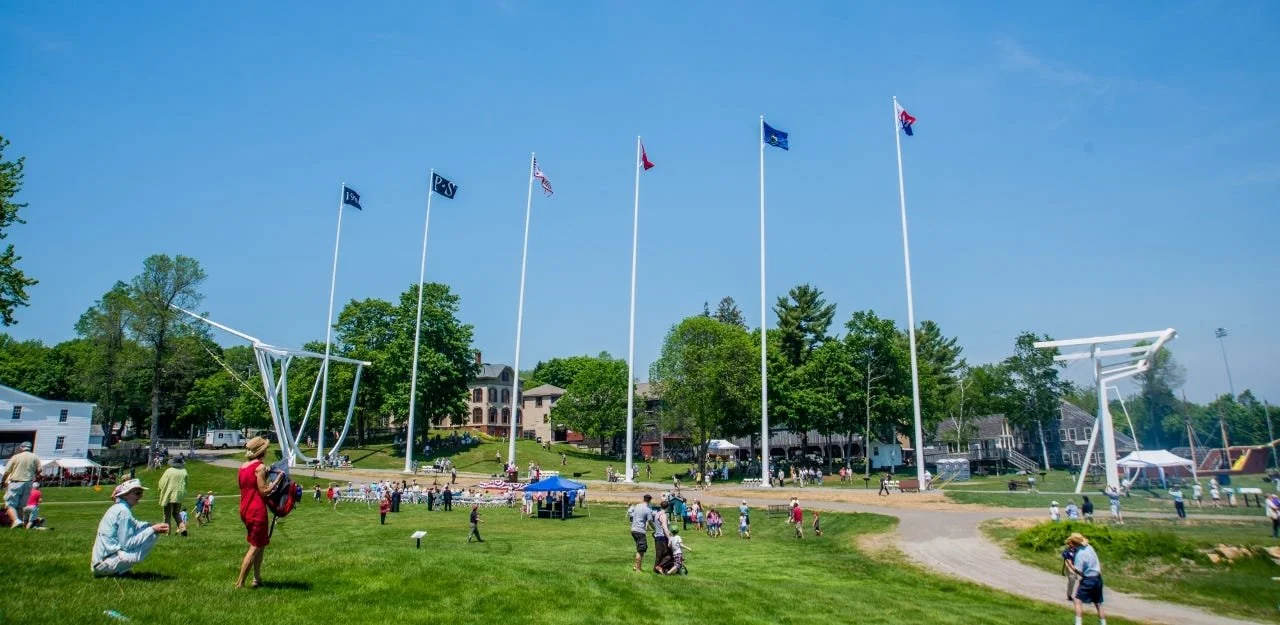
Sculptural evocation of the six-masted schooner Wyoming, courtesy of the Maine Maritime Museum, Bath.
Taken all in all, it is hardly surprising that a centerpiece of the museum is a monumental sculptural evocation of the Wyoming precisely where the original ship was built and that exhibits have traditionally emphasized the fact that its construction consumed 1.5 million feet of southern pine and white oak shipped from southern ports, and that each of its six two-part masts—123-foot lower masts and 56-foot upper masts—were of Douglas fir shipped cross-country from Washington State, the longest spars lying across three flatbed railroad cars. This mass of material, together with vast quantities of iron fittings and twelve miles of caulking, gave the ship a displacement of 10,000 short tons, or 20 million pounds.
One of many ways of describing a ship’s size, displacement is determined using Archimedes’ “Eureka!” principle: The weight of water displaced by a floating hull will equal the weight of the hull itself. Water is an important variable, because saltwater is about 2.5–3 percent denser than fresh water, while brackish water in a tidal river like the Kennebec falls somewhere in between.[2]
In simplest terms, displacement is the movement of something from one place or state to another, as in calculating tonnage. The various ways of defining and thinking about displacement make it a useful lens through which to consider maritime history generally and the Wyoming in particular. Most obvious, the whole point of boarding a ship is to go from place to place, but the story of the Wyoming encompasses multiple layers of displacement: environmental, physical, material, personal, and cultural.
From an environmental perspective, a supreme irony of Maine’s wooden shipbuilding industry at the turn of the twentieth century is that almost the only thing that could still be obtained locally was the labor to build the ships. In the case of the Wyoming, the wood, iron, and oakum came from as much as 2,500 miles away. Yet the English crown’s original interest in Maine was due to its reserves of Eastern white pine (Pinus strobus), which the Navy Royal desperately needed as masts for warships in its almost interminable naval conflicts in European waters during the seventeenth and eighteenth centuries. So precious were these that the crown declared a monopoly and sent surveyors into the woods to mark suitable trees with the King’s Broad Arrow: three strokes of an axe. By the late nineteenth century, the most mature and accessible trees had long since been felled, which explains the need to fetch spars from a continent away. Despite the expense of transporting wood “Brought from regions far away,” in Longfellow’s words, as the cost of labor and waterfront property in the old shipbuilding centers of New York City and Boston soared after the Civil War, and iron hulls became the norm, Maine became a more affordable alternative.[3]
While wood has always been one of Maine’s primary exports, for fuel as well as shipbuilding, construction, and containers from boxes to barrels, rapid industrialization in the late nineteenth century led to sharp increases in the demand for coal, which was abundant in the Appalachian Mountains, especially West Virginia, Kentucky, and Pennsylvania. In 1883, the Norfolk and Western Railroad began carrying coal nearly 400 miles from the Pocahontas Coalfield in southern West Virginia and southwest Virginia to the port of Norfolk, Virginia. The most economical way to distribute high-volume, low-value loads of coal from Norfolk to energy-hungry cities as far away as Halifax was via schooner because wind-driven ships didn’t consume their cargo.
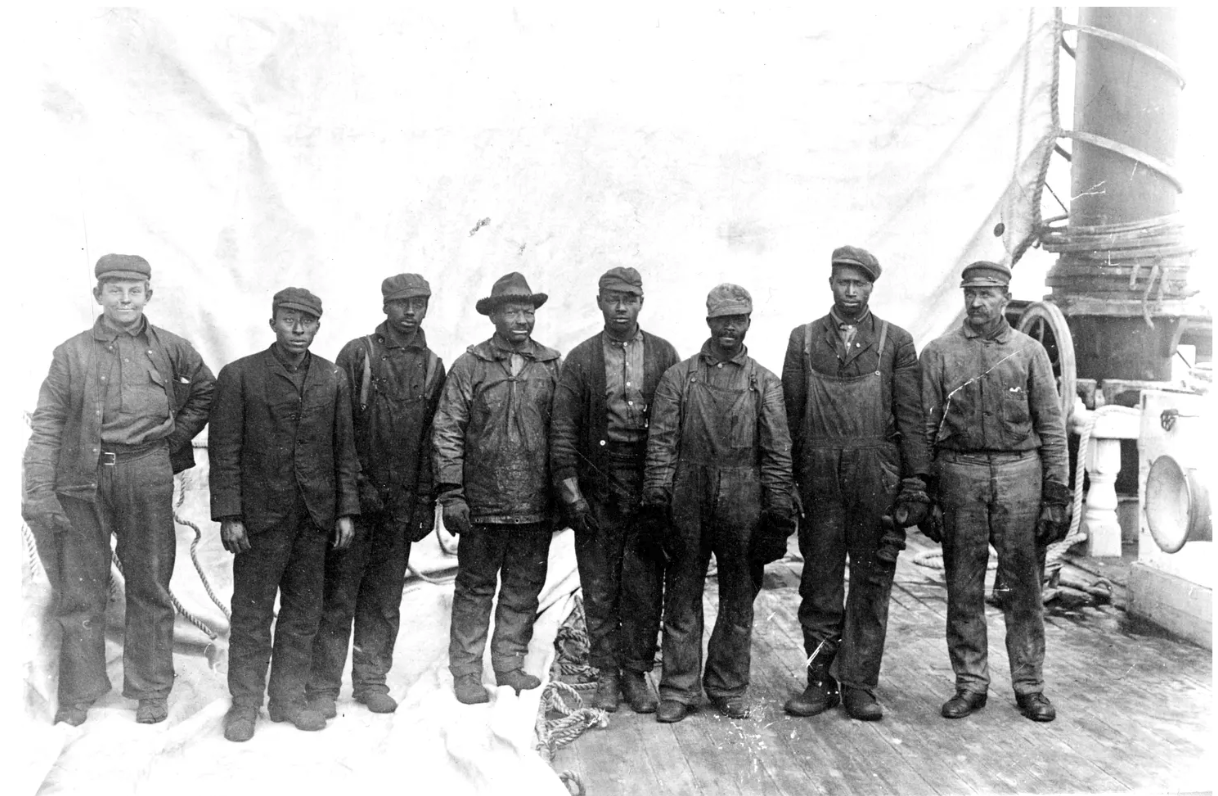
Photo of the Wyoming crew ca. 1917–21, from Capt. W. J. L. Parker Collection, Maine Maritime Museum, originally acquired from the F. Holm-Peterson Collection of the Svendborg Museum in Denmark.
The story of the Wyoming also embodies personal and social displacement. Given the danger and dismal working conditions of life in the coal trade under sail, to say nothing of the strain on family and community ties, seafaring was often an occupation of last resort. Ordinary seamen were drawn from the ranks of society’s marginalized and dispossessed, including Blacks and Native Americans, unskilled laborers, and recent immigrants. A portrait of eight sailors aboard the Wyoming shows six Black seamen flanked on either side by Whites. Judging from the makeup of the American merchant marine at the time, and because the photograph came to the museum from a Danish institution, at least one of the White crew is probably of Scandinavian origin.[4] Who these men are is a mystery, as is the date of the photo, which was taken sometime between 1917 and 1921. We don’t even know if any of them was sailing in the Wyoming when it sank with all hands on March 11, 1924.
The land from which the Wyoming and hundreds of other vessels were launched remains unceded territory of the people of the Wabanaki confederacy whose ancestors have lived in the Dawnland for thousands of years. The river into which the Wyoming was launched takes its name from the Kennebec band of the Abenaki tribe. Although English settlers and their US successors forced many Abenaki, Passamaquoddy, Penobscot, Mi’kmaq, and Maliseet from their riverside and coastal settlements and forced them further inland, the Wabanaki were never forced out of Maine en masse, as happened to a majority of tribes across the eastern and midwestern United States. Even so, many died from disease, warfare, or poverty, and for many years, the Indigenous people of Maine were spoken of in the past tense—if they were spoken of at all—all but displaced from the memory of settlers and their descendants.
W(h)yoming?
One of the most obvious questions about the sculptural evocation of the Wyoming in the museum’s shipyard is why the largest monument in New England bears the name of a landlocked state—the fifth driest in the country—2,000 miles to the west. The answer is a convoluted story of displacement of its own.
The first official use of the name for what became the state in 1890 came in 1865 legislation to create a territorial government. While the word is of Native American origin, it was chosen not to acknowledge any of the Shoshone, Arapaho, Cheyenne, Crow, Lakota Sioux, or Ute who called the land home. Wyoming means “at the big river flat,” a reference to the Susquehanna, the longest river in the eastern United States, which runs through eastern New York, Pennsylvania, and Maryland. The word is from the Lenni Lenape, the language of people who lived between Delaware Bay in southern New Jersey and eastern New York State until settler colonists drove them west into the Susquehanna Valley in the early 1700s.
The popularity of the name arose from a narrative poem called Gertrude of Wyoming; or, the Pennsylvanian Cottage written in 1809 by a Scottish poet Thomas Campbell who never visited the United States but who based his poem loosely on the popular story of the Revolutionary War battle of Wyoming, fought just north of Wilkes-Barre, Pennsylvania.[5] There, on July 3, 1778, Loyalists and their Haudenosaunee (Iroquois) allies overwhelmed a United States force in a fight that cost the Patriots roughly 300 dead, and the Loyalists only three. [6]
Rumors of the battle and its aftermath became a touchstone for the Patriot cause and “through continued use, the Wyoming Massacre became a central part of Patriots’ partisan arguments and assisted in the formation of a shared narrative of American victimhood that helped shape national identity.”[7] So it was that the battle became the backdrop of a poem written thirty years after the fact and inspired the name of a western territory more than half a century later still.
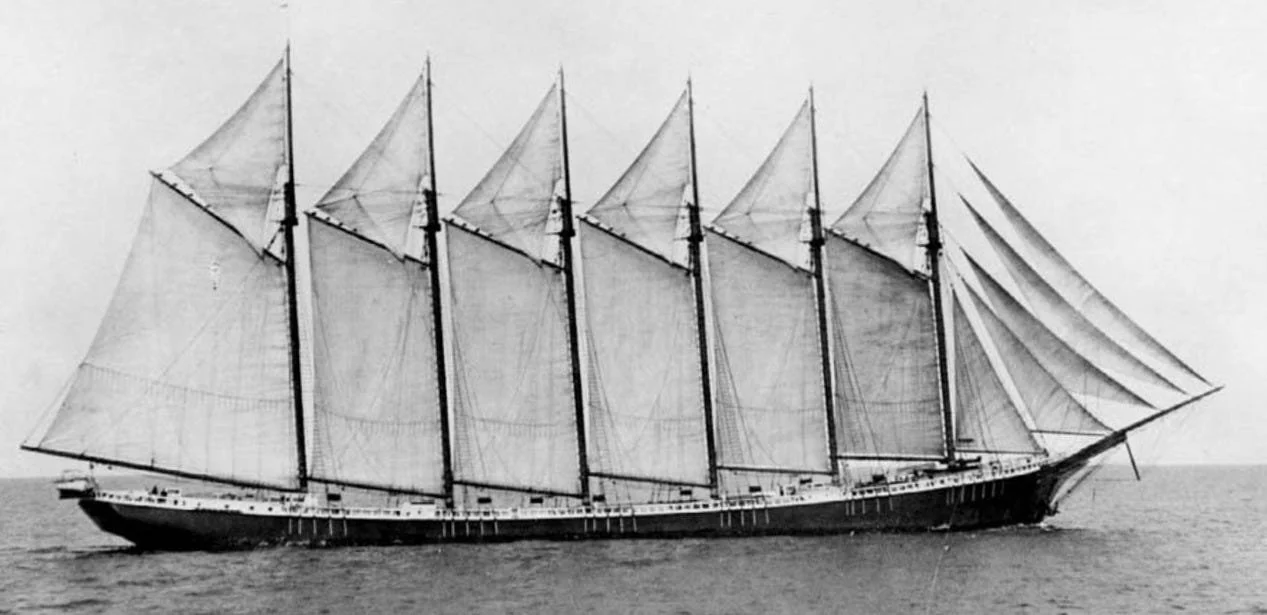
Six-masted schoonerWyoming under sail. Courtesy Maine Maritime Museum.Six-masted schoonerWyoming under sail. Courtesy Maine Maritime Museum.
As schooners grew in size, so did their cost, and Percy & Small relied increasingly on investors from well beyond Bath and environs, many of whom were honored as ships’ namesakes. The Governor Brooks was named for Bryant Butler Brooks, a native of western Massachusetts whose family moved to Chicago when he was ten. At nineteen, Brooks headed west, ultimately landing in Wyoming where he worked as a trapper, cowboy, and rancher, and where he was elected governor in 1905. His older brother John was part of a consortium of East Coast investors in Percy & Small and in 1907 he led a group including Samuel Percy to Wyoming “to interest Western capital and friendship for Eastern shipping.” The trip was a great success for Percy, who secured about a third of the investment needed for the five-masted schooner he named Governor Brooks, a “symbol of a handclasp of East and West, in mutual sympathy on maritime problems,” as the governor himself would later write.[8] Brooks never acknowledged that he amassed his wealth on land acquired through squatter’s rights and homesteading on government land seized from the dispossessed indigenous people of the territory and state he claimed to have pioneered.[9]
Percy & Small built their first six-master, the Eleanor A. Percy, in 1900 but although they built five more for other companies over the next eight years, it was not until the success of the five-masted Governor Brooks that they considered adding a second six-master to their own fleet. A team led by John Brooks secured more than a fifth of the funding required from Wyoming-based investors, hence the choice of name for the enormous ship.
* * * * *
In the context of an existing monument, monumaking (or monument making) is a form of collective curatorship, the focus of Interco(a)stal: Reading Between the Ribs of Maine's Maritime History being the sculptural evocation of the schooner Wyoming. Such a collaborative process affords us the opportunity not to remake or revise the past—what’s done is done—but to think about the past in new ways, to ask different questions of our sources, to peer around the corners of experience and expectation to see something previously missed or once known and now forgotten.
This is a process of addition and recollection, not subtraction or distortion. Just as we often find something new when we revisit a favorite book or movie, looking into the past with fresh eyes can sometimes lead us to forget or displace details that once seemed paramount as we foreground new insights and fresh interpretations. After all, we can be mindful of only so much at once. What we choose to remember—or what chooses to be remembered by us—changes with time and circumstance. History doesn’t change, but knowing history can change us.
Footnotes
[1] “three hundred cubits”: Genesis 6:15. The Quranic version of the flood story offers less detail. Allah simply instructs Nuh (Noah) to “build the Ark under Our watchful Eyes and directions” (Quran 11:37).
[2] displacement is determined: For a brief explanation of how to calculate displacement, see Ship Stability Basics: Understanding Law of Flotation, Displacement, Volume & Density: https://www.youtube.com/watch?v=H9v_h-UWXUo.
[3] “Brought from regions”: Henry Wadsworth Longfellow, “The Building of the Ship” (1869).
[4] A portrait: a part of the museum’s Capt. W. J. L. Parker Collection, the photo of the Wyoming crew was acquired from the F. Holm-Peterson Collection at the Svendborg Museum in Denmark.
[5] Gertrude of Wyoming: Thomas Campbell, Gertrude of Wyoming: A Pennsylvanian Tale (1809). Campbell was born in 1777, a year before the poem’s climatic scene.
[6] battle of Wyoming: While the battle is often referred to as a massacre, a week later the British commander, Lieutenant-Colonel John Butler, wrote, “But what gives me the sincerest satisfaction is that I can, with great truth, assure you that in the destruction of the settlement not a single person was hurt except such as were in arms” (in Earnest Cruickshank, Butler’s Rangers and the Settlement of Niagara, Lundy’s Lane Historical Society, 1893).
Visiting the region a few weeks after the battle, J. Hector St. John de Crèvecœur wrote: “Happily these fierce people, satisfied with the death of those who had opposed them in arms, treated the defenceless ones, the woman and children, with a degree of humanity almost hitherto unparalleled.” J. Hector St. John de Crevècœur, “The Wyoming Massacre,” in Sketches of Eighteenth Century America: More “Letters from an American Farmer,” edited by Henri L. Bourdin, Ralph H. Gabriel, and Stanley T. Williams, 192–206 (Yale University Press, 1925); 201. The editors admit that “The title of this essay has been provided by the editors.”
[7] “Through continued use”: William R. Tharp, “‘Savage and Bloody Footsteps Through the Valley’: The Wyoming Massacre in the American Imagination” (Master’s thesis, Virginia Commonwealth University, Richmond, 2021), 7.
[8] “to interest Western capital”: Bryant B. Brooks, Memoirs of Bryant B. Brooks, Cowboy, Trapper, Lumberman, Stockman, Oilman, Banker, and Governor of Wyoming (Arthur H. Clark company, 1939), 261.
[9] squatter’s rights: Brooks, Memoirs of Bryant B. Brooks, 113, 129, and 134.
About the Author
Lincoln Paine is a visiting scholar at the Center for Oceans and Coastal Law, University of Maine School of Law, and president of the North American Society for Oceanic History (NASOH). His books include the award-winning The Sea and Civilization: A Maritime History of the World, Down East: An Illustrated History of Maritime Maine, and Ships of the World: An Historical Encyclopedia. He has published more than 100 articles, chapters, and reviews for peer-reviewed and generalist publications, including the The Mariner’s Mirror, International Journal of Maritime History, and Wall Street Journal. He is currently writing a maritime history of indigenous North America. Learn more at LincolnPaine.com