The Eight Black Seamen: Recovering the Forgotten Crew of the Wyoming
The following was researched and written as part of Interco(a)stal: Reading Between the Ribs of Maine’s Maritime History. This piece is one of two inter-related pieces by Anne Farrow—read part 2: The Three Cape Verdean Sailors on the Wyoming here.
In September 2016, I began working a day a week in the Maine Maritime Museum’s research library, where I would assist the public in researching their questions. They were looking for lost vessels, great-great- grandfathers, family stories they had heard at the table on Sunday.
Most haunting were the contents of the New York Maritime Register. A weekly newspaper published in New York City from 1869 to 1948, the Register tracked vessels’ departures and arrivals and destinations; it tracked the names of masters, international trade, shipwrecks and other marine disasters. Vessels reported when they encountered unusual things or saw wreckage on the water, pieces of ships that had been lost.
I was drawn to vessels that were “overdue,” and those that were identified as “missing.” There is a whole human world between those two words. Overdue could mean the vessel was just later than expected at its destination, delayed by bad weather, damage to the ship or for another cause. A ship identified as “missing” meant that it was presumed lost and the business of tallying the human and material losses could begin. Insurance claims could be brought, families watching the overdue listings could move from hope to grief. Shipping concerns like the Chase Leavitt & Company in Portland, which chartered voyages for the Wyoming and her sister schooners, would begin to gather the relevant documentation.
Since then, I have wondered what it meant to be lost, to be in the midst of life and lost.
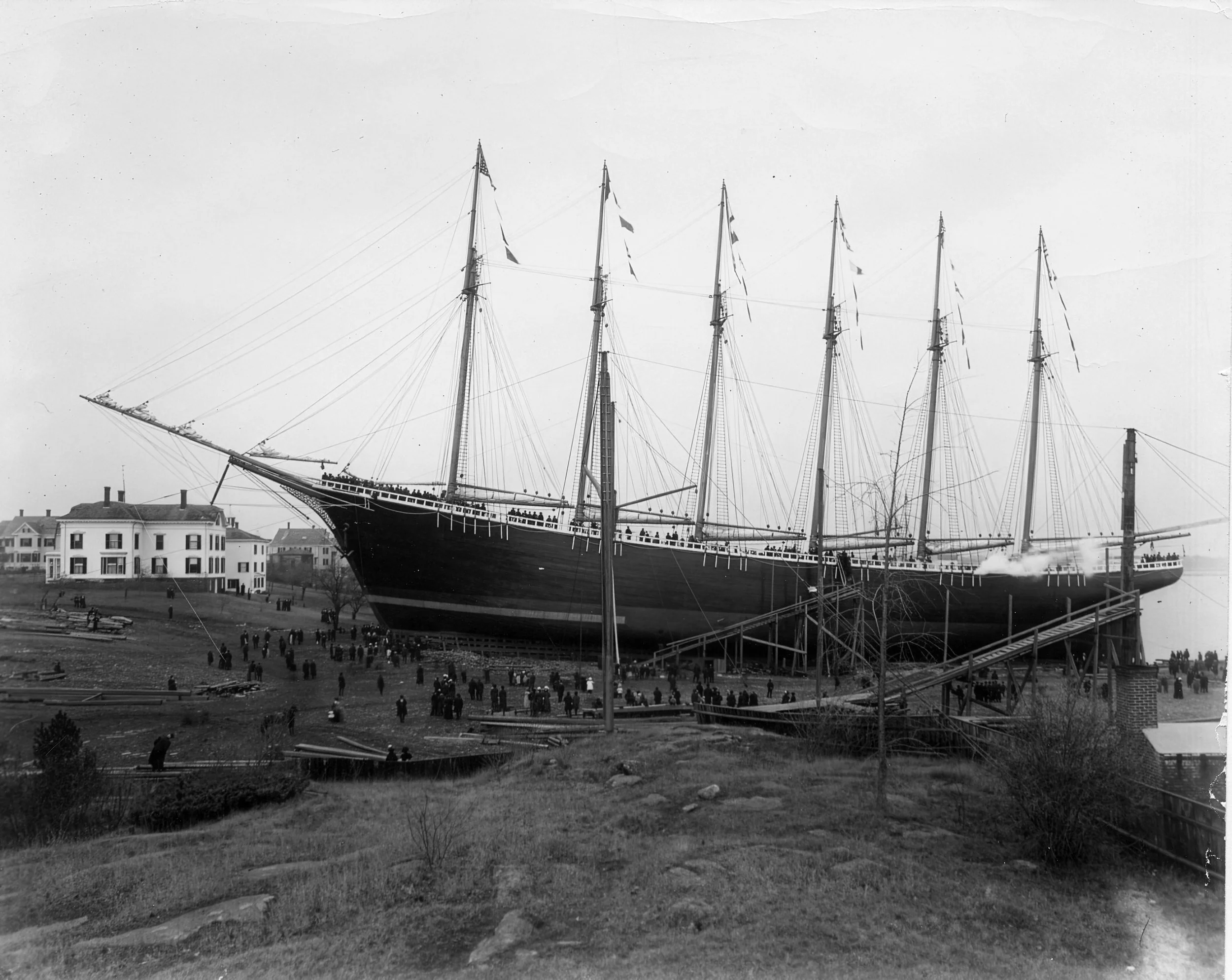
The three decks of the Wyoming were punctuated with what looked like trap doors but were actually deck hatches used for depositing the coal cargo, then offloading it at the vessel’s destination. This photograph of the Wyoming shows the starboard side of the deck, and suggests the might and size of the collier. A full load of coal for the Wyoming, which is what she was carrying, was more than six thousand tons.
Courtesy of Maine Maritime Museum
This brought me to the Wyoming, and to the men aboard her when she was lost. The vessel sank with all hands on March 12, 1924, and the wreckage of the schooner began washing ashore on the northern shore of Nantucket within barely a day. At one time the largest wooden sailing vessel in the United States, the Wyoming seems, in retrospect, to have been a tragic coda to the Age of Sail.
I studied a 1920s-era photograph of Black men who were crew aboard a Wyoming voyage, though not the last crew. When the Wyoming sank in that March storm, the destruction of the vessel was understood almost at once to be a disaster and made headlines all over New England. In many of those newspaper accounts, the captain, the mates and the engineer were named. Many times, the crew were listed, simply, as “eight Black seamen.”
In early 1924, the Chase Leavitt brokerage recorded a crew list with the seamen’s names, ages, heights, country of origin, their color, and the addresses where they resided at the time. A later document in the Chase Leavitt archives notes the names of the captain, mates, engineer, cook, and all the Black seamen. It says for each man that he “was discharged” on March 12th. That was the day they drowned in a lethal gale experienced by much of the eastern seaboard. The 2016 movie “The Finest Hours,” which chronicles the daring 1952 rescue of the tanker Pendleton by Coast Guardsmen stationed in Chatham, recreates a severe nor’easter on Pollock Rip.
This nine-mile length of shoal extends roughly from the elbow of Cape Cod to the northern reach of Nantucket. The men would have died with a roaring, deafening wind in their ears. Ship’s agent William Whicker of Boston, who assembled part of that last crew, said later in a newspaper story that the men probably could not even have seen each other on deck in the storm. A federal casualty report stated that it was snowing and very dark, and that the wind was blowing 84 miles per hour, which is 10 miles over a Force 12 storm on the Beaufort Scale – generally considered unsurvivable.
The crew lists and the newspaper accounts show serious discrepancies in the spellings of some seamen’s names, and one discrepancy illuminates the discriminatory way Black seamen were regarded. Early on in the building of this project, artist Athena Lynch of Portland, wanting to honor the Black seamen by creating pieces that would bear their accurately spelled names, noticed a crewman named J. Bouvios from Puerto Rico and another crewman named Pedro Barrios of Colombia.
She wondered if the two crewmen could have been the same person and that only one name was the correct one. “Was the name recorded incorrectly?,” she asked. “Because that’s something I take into consideration when looking at Black names from the before times (anything before 1980). I’ve encountered this myself… our names weren’t carefully recorded in terms of spelling because it simply didn’t matter to the person recording.”
“But I just want to make sure that I’m working with the correct names” the artist added. “I just want to do my best and honor these men the way they should’ve been honored.”
Over the summer I kept trying to find unanimity in both handwritten and typewritten information. J. Bouvios, or John Bouvios, of Puerto Rico, was listed on more of the surviving crew lists than Mr. Barrios. But the case for Pedro Barrios, a citizen of Colombia, was strong. Of the 13 men on board the Wyoming when she sank, Barrios’s seaman’s papers, and other personal documents were the only ones to wash ashore on Nantucket. Not all had his name correctly, but they were spelled Barrios or close to it.
When re-reading primary documents at, quite literally, the 11th hour of this project, I noticed Pedro Barrios’s Able Body Seaman Certificate. It bore the number 122978. My heart dropped because I knew I had seen that number earlier in the day, next to the name J. Bouvios. According to the various crew lists, both lived at the same address in Boston and both were 5’6”. According to the records, Bouvios was 26 and Barrios was 27. Their surnames never appeared on the same crew list.
Yet earlier in the summer, when the reality of the two names suggested that I needed to do more research, Athena Lynch saw the real question at once, and understood the terrible answer. The person or persons recording the crew lists didn’t care enough to get Pedro Barrios’s information right. He was Black, he spoke Spanish and he held an AB certificate. Close enough, right? And if he had not died and his seaman’s documents washed ashore in a small black case with a fabric tie, we might still not know.
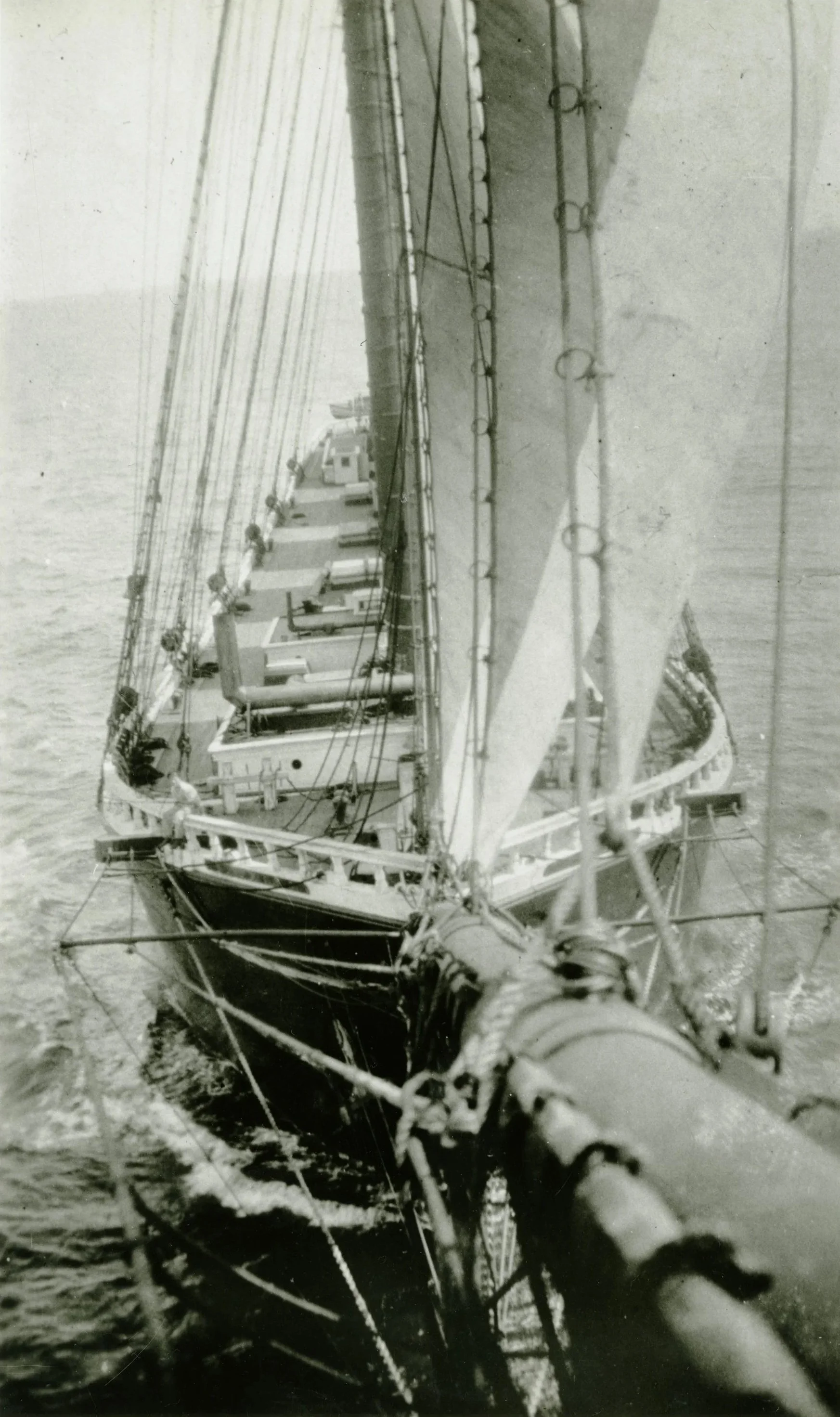
The Wyoming looked every inch “The Pride of the Fleet” on the mid-December day she was launched in 1909. The Bangor Daily Commercial reported that the masts were made from Oregon pine shipped from Washington state. The daughter of the governor of Wyoming, an investor in the vessel, threw roses, pinks, and flowers over the bow and into the water. A crowd of “several thousand” watched “the pretty ceremony,” according to the Bangor newspaper.
Otis N.E. Card, Photographer/Courtesy of the Maine Maritime Museum
The names of the other seven Black seamen who appear most often on the crew lists are Edward Lawrence (or Rollins), John Lopes (or Lopez), Jacob A. Gammon (or Jacob O. Gammon), Antonio Santos, E. Carina (or E. Coriveau or E. Covineau), John Media (or Medina or Medino), and Richard Borden. There appears to be a man who signed on the voyage then left the vessel at some point—Frank Smith of Huntsville, Missouri. A line was drawn through his name on an undated crew list, though in some newspaper accounts he appears among the dead. There was also a John G. Peters who signed on in Boston on January 6, 1924, according to Captain Glaesel in a note to the U.S. Shipping commissioner in Boston. But Peters left the vessel without notice the following day and asked that his possessions be forwarded. His name does not appear on any surviving crew lists.
Of the eight seamen – three men cited the Cape Verde Islands as their birthplace, one man South Carolina, one from the British Virgin Islands, one from Chile, one from Colombia and one from Massachusetts – they are all described in the “complexion” column as “colored.”
The most often cited chapters of the Wyoming story are its great size, the local pride and achievement it represented for the Percy & Small Shipyard and its distinguished western investors, its many voyages, its profitability and its tragic end. But there is a missing chapter. This and the other Bath-built coal schooners were built by white men, owned by white men, and made good money for white men but they were nearly always crewed by Black seamen.
Yet in the era of Jim Crow and the often-lethal race prejudice that followed the late 19th century and the early 20th, Black men seem to have been barely part of the record. But they were the crewmen of choice for reasons that were not, even at the time, hidden: They could be paid less, and because many were foreign-born and had not become naturalized U.S. citizens nor were they in the process of becoming citizens, they could be excluded from protections available to white seamen born in the United States.
Their lives don’t seem to figure in the stories of the great coal schooners, though they were the sinew of the endeavour. Where are the shared stories and accounts of these men? Is it because they were Black and many of them were immigrants? Barbara Burgo studied anthropology and is a researcher into the lives of Cape Verdeans. She said that these men were not even regarded as men.
Shipboard life was harsh for any seaman and that is well-documented. Iron discipline, hard labor in every kind of weather, inedible food, and rough accommodations were commonplace. But Black seamen were in an especially difficult position on the coal schooners. When the Wyoming was smashed in two by that nor’easter while anchored near Pollock Rip Lightship in Chatham, Mass., on a vessel almost 450 feet long —90 feet longer than a football field—the crew was, as mentioned in many newspaper accounts, “eight black seamen.” Eight men. It was a long-time practice on the coal schooners to keep crew numbers small and thus maximize profits.
Scholar Ralph Linwood Snow, who has written the Bible on shipbuilding at the Percy & Small shipyard, believes the vessel was in about 60 to 70 feet of water and was being violently pushed up and down by immense waves, hitting the sea floor until it broke amidships. (The wreckage of the Wyoming was discovered off Chatham’s Monomoy Island in 2003 and one of the identifying characteristics was the structure of iron bands that had been installed around the vessel to keep it from twisting apart in a storm. But then it did twist in two.)
Every man from Captain Charles Glaesel – who was an experienced, well-regarded ship master from Boston—on down was battling to save the ship and themselves, but basically, there were only 13 men – the captain, two mates, an engineer, a cook and the eight seamen to manage an immense wooden schooner in a storm that was without exaggeration, off the charts. No bodies were ever found.
Sold in 1917 to the France & Canada Steamship Co., then again in the early 1920s to A. W. Frost, a Portland-based shipping company, the schooners were chartered and managed by the firm of Chase Leavitt & Company, also based in Portland.
I asked Maine Maritime Museum Curator of Collections Kelly Page if she thought the last Wyoming seamen would have suffered from the extreme punishments cited on Bath-built vessels in the 1880s and 1890s. She thought probably not, and flogging and other forms of physical abuse were prohibited in the ship’s articles Captain Glaesel signed. But the curator thought that men would have heard those earlier, cruel stories of men beaten insensible, or chased aloft by a mate with a gun. The late 19th century was not the unimaginable past, buried in myth and the fog of history. I realized that my mother was born the year before the Wyoming sank, and it brought the story close.
Though much information probably has been lost in the century-plus since the Wyoming’s sinking, some food lists have survived, and it appears that the meals for the Wyoming crews were not the weevil-ridden horrors of maritime lore. The provisioning lists for the late voyages of the Wyoming show an impressive amount of fresh meat, fruit, eggs and vegetables, macaroni and yeast for bread. On the Wyoming’s second to last voyage in October 1923, the food stores included 29 pounds of pilot crackers and 40 pounds of cookies. And the Swedish cook was paid one-third more than the crewmen—$90 a month to their $60—so that suggests he had cooking skills. No grog or spirits were permitted on board, and no smoking was permitted because of coal’s combustible properties, but the men were allowed to dip chewing tobacco, according to the ship’s articles.
When we talk about the great shipyards and the great ships, we need to talk about these Black men and a system that disenfranchised them on the basis of their color and often, their lack of citizenship. It is accepted as accurate that the seamen were discriminated against in the early 20th century because that’s how it was for many Black people then. But their stories still aren’t investigated, barely a part of even relatively recent books on Bath and her ships and legacy. In a story of dangerous work, environmental horror and human damage, they are there and not there.
But they did exist. And we know how much they were paid, and what they ate. And because sailor Pedro Barrios, whose personal papers washed up on Nantucket shortly after the storm, we know that in the month before his last voyage, he went to a Boston jeweler named M.B. Bloom on Hanover Street in Boston and bought a chain described as “17-jewell.” It cost $18, a little more than his week’s wages, which were at that time about $15. Some of Senor Barrios’s papers have been on display at Maine Maritime Museum since November as part of the “Re-Sounding” exhibition, designed to explore maritime history through Black and Wabanaki perspectives. There is a moving story in the museum collections of the Nantucket man who found the Barrios papers amid the wreckage on the Nantucket shoreline and ensured their survival by mailing them to the Chase Leavitt office in Maine.
And we know that 28-year-old crewman Jacob Gammon, who was one of the tallest crewmen on that last voyage, shared a correspondence with a woman named Estelle, who appears to have been a volunteer worker at the Seamen’s Friend Society in Boston. I had thought the seamen’s bethels offered meals, help with correspondence and prayer. On February 26, Estelle wrote to say she had received both of his letters, and was glad to know he was well. She also said she wished he had a job on land, rather than “on the water,” and closed her missive with “much love and many kisses.”
At the time of her surviving letter to seaman Gammon, who was from South Carolina, Estelle Beatty was 52 or 53 years old. She was living at 37 Grove Street as a boarder in what the U.S. 1920 Census described as a boarding house/tenement.
The historic Beacon Hill area of Boston is now affluent but in the early 1920s was home to merchants, immigrants, boarders and working people. She was a short walk from the busy Charles River waterfront, and is described in the census as single, and as having been born in 1871. I found a photograph of the brick row house where she lived and it looks pretty much as it would have looked in 1924. One record says it was built in 1899.
Jacob Gammon had about two weeks to live. Miss Beatty addressed her letter to the Schooner Wyoming, care of a major coal and lumber shipper in the port of Saint John’s, New Brunswick, Canada—which was the destination of the voyage. Her letter seems to express longing, but it never reached him and was forwarded to the Chase Leavitt offices in Portland. Another affectionate letter to Gammon survives, this dated the same week in February 1924 and sent to him by a woman in Cuba with whom he also corresponded. She sympathized with him, because he had mentioned being cold in his letters, and signed her letter R. A. Roy with a return address of 35 Calle Cortes, Santiago de Cuba. She was hoping he could send her some ideas for funny skits and songs for an Easter celebration. Her letter followed the same route as Estelle Beatty’s, forwarded to the Wyoming’s Canadian destination, then Chase Leavitt in Portland and now held in the research library at the Maine Maritime Museum.
Jacob Gammon’s last recorded address in Boston was 166 Cambridge Street, and I could not find a modern-day address with that same number. But very near it on that part of the street are two large boarding houses, much spiffed up, which reflect styles of the late 19th and early 20th centuries. My hopeful guess is that the seaman lived in one of those.
According to a U.S. Treasury Department casualty record dated March 22, 1924, the Wyoming was insured for $75,900 and the cargo (5,395 tons of bituminous coal) for “about $32,000.” Other records say the vessel was not insured. I can’t find any records of life insurance held by the seamen, and it seems likely that Black seamen in a dangerous trade in the 1920s would have had difficulty getting life insurance, and it would not have been affordable.
One document shows a payout of crewmen’s wages ranging from $38 to $54 for each of seven men – these seven had each received $8 in Norfolk before the final leg to Canada. The numbers are smaller for Richard Borden, who boarded in Norfolk some 12 days after the Boston crew, and was on board for only nineteen days. He did specify that he wanted his allotment to go to his mother, Mary Borden, in the British West Indies. Captain Glaesel , who was 65 years old and a bachelor, did have a will, which his brother, Paul Glaesel in Troy, New York, asked to have settled the week after the sinking. The speedy settlement of Glaesel’s will seems to have signaled community understanding that he and all his men were gone. Glaesel’s correspondence suggests he was a worrier, and very conscientious. He was also master on the Wyoming’s second to last voyage.
In late March, I began studying the Chase Leavitt records in the museum’s research library. I decided I’d study files related to the Wyoming, but also those of schooners that seemed to me like sister vessels and fellow travelers – all Bath built, all substantial vessels, working in the same era, and all coal carriers. The Edward J. Lawrence, the Cora F. Cressey – which narrowly escaped the same fate as the Wyoming – the Ruth E. Merrill, and the Oakley C. Curtis all were overseen and managed by Chase Leavitt.
The writing styles and contents of the business records are similar, ship to ship, but the crew lists available (and only a few are) vary substantially. Those of the Wyoming are the most detailed, though there are variations in these too, and only one appears to be reliably dated. When I first saw the list with the men’s many personal details– I was grateful. (Humbly, I must add that this research is fragmentary and only more research will resolve the many questions surrounding the Wyoming and the men who sailed aboard her.)
Before I made a first presentation of my work last May, I practiced it for my husband, Stephen. Before retirement, Steve worked for decades at Pratt & Whitney as an industrial supervisor, but he can build or fix anything, and after college he began his working life as a shade-tree mechanic in Florida. He has always felt a deep bond with working men.
He felt that I gave short shrift to the seamanship of the Black crewmen. He said they had to have been experienced seamen because they were vetted by a shipping agent and then approved by Captain Glaesel, a stickler for detail. The crewmen ranged in age from 26 to 39. Senor Barrios’s seamen’s papers contained job recommendations from other ships’ officers and a business card from William Whicker, a hiring agent in Boston. (As it turns out, Whicker hired four seamen, two mates and a cook for the last voyage.)
Yes, they could be paid less than a white seaman and they were disadvantaged in exclusionary ways, but to stay alive, they had to have been very able seamen. And indeed, one crew list shows that all the seamen held AB tickets, which meant they were rated as Able Body seamen, not deckhands, and had at least two years of experience at sea.
As AB seamen they had specialized training, and were responsible for keeping the ship moving and on course, for which they used magnetic instruments. They all stood watch and were charged with keeping the vessel safe and as clean as possible, which on a coal collier was not easy. They worked at the direction of the two mates and were responsible for getting 5,000 tons of coal onto the vessel and then off again at their final destination. There were machines to help with some of this but when the engines didn’t work, the AB seamen were the manpower in what was filthy, backbreaking, dangerous work. The last column on one printed Chase Leavitt crew list forms had the heading: Address of Wife or Next of Kin. That seems to underscore the dangerous and potentially fatal nature of working on a coal schooner.
There were probably exceptions made, but Kathryn DiFilippo, executive director of the South Portland Historical Society, wrote that coal schooners of the Wyoming era tended to work on a first-come, first-served basis. So, captains wanted to load and then deliver the coal cargoes to market as quickly as possible to guarantee top prices, and that meant pushing their vessels and crews hard.
Last spring, I started to feel discouraged that I couldn’t write the story of the Black seamen in the same way I had written newspaper series and books. Project director Meadow Dibble asked why Interco(a)stal had to be the kind of project I had done before. Could it be something new for me—written from the perspective of a human being who has not lived racial prejudice but documented, since 2001, its presence in New England. Even if racism itself has obscured, overlooked or left out of the written record basically everything I want to know, could this be my service? To try?
And then I thought of my dad. “Do your work,” he always said to me, “and do the best you can.” He grew up in deep poverty in North Boston during the early decades of the 20th century. Through the longest of long odds, without a college degree, he studied law at Northeastern University at night, passed the bar, and eventually joined the U.S. Civil Service. Dad became part of a team of lawyers working to integrate the federal service, and was responsible for Maine, New Hampshire and Western Massachusetts. For more than two decades he traveled these states, going to post offices, hospitals, military installations, universities, and other places that were part of the government or received federal money. He would present his credentials and ask to see the results of the recent hiring exams.
He looked for patterns of discrimination and found them. But he believed that good work – the kind of work that made it possible to buy a home and educate one’s children – was key to social justice. His own life was saved by good work, and he wanted to use the law to make that happen for all disenfranchised people. Dad lived, to use Isabel Wilkerson’s phrase, a kind of radical empathy. He would have grieved the lost Wyoming seamen, and they would have been as real to him as they are real to me.
On a slave trade research project In Sierra Leone, West Africa, I learned a Krio phrase that people would sometimes say in place of “thank you” and it makes me think, always, of my dad and now, eight Black seamen:
I no go forget.
About the Author
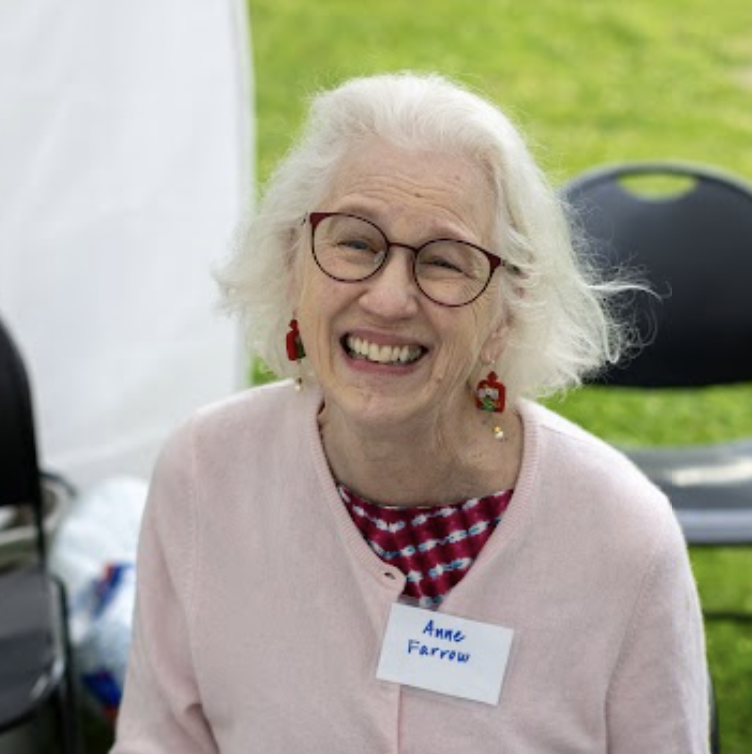
Anne Farrow is an award-winning journalist, author, and independent historian whose work has transformed public understanding of New England's deep ties to slavery. A former reporter for The Hartford Courant and two-time Pulitzer Prize nominee, she is co-author of Complicity: How the North Promoted, Prolonged, and Profited from Slavery and author of The Logbooks. For more than two decades, Anne has collaborated with museums, historical societies, and scholars to uncover and interpret the histories of slavery, the slave trade, and racial injustice in the Northeast. Her public history work—including the award-winning exhibition A Vanished Port: Middletown and the Caribbean, 1750–1824—has helped reshape how museums and communities engage with these histories.