Down Through the Generations
Weaving Relationships Through Place and Time
Our presence at this site today honors the relationships woven through time and place by the descendents of Penobscot Chief Madockawando, through his daughter Pidianiske and her French husband, Jean-Vincent d’Abbadie, Baron de Saint-Castin. These relational threads connect their descendents and their French allies and kin across the globe to the present day.
“On the evening of 5 June, 1944, I was aboard the (U.S.S.) Henrico, heading across the channel when I got a surprise visit—a Penobscot Indian warrior named Melvin Neptune. He didn’t trouble me with his combat experience nor did he offer me advice, instead we talked about home because he knew I had never been in combat; all hell was about to break loose on me.”
Penobscot Veteran and tribal elder Charles Norman Shay (b. 1924), descendent of Madockawando, is an integral thread in this weaving.
As a 19-year old combat medic, Shay saved the lives of many American soldiers during the Allied landing at Omaha Beach on June 6, 1944. He was held as a POW by the Germans for a period of time. Enrolling as a medic once more, he served with distinction in the Korean War. Shay was honored with both the Silver Star from the American Army, and the Legion d'Honneur by the French government. Shay served more than twenty years in the military.
He worked for decades at the International Atomic Energy Agency (IAEA) for the United Nations in Vienna, Austria, an organization dedicated to peaceful use of nuclear energy and its inhibition for any military purpose, including nuclear weapons. He then retired to his family home on the Penobscot Reservation on Indian Island in 2003, before ultimately returning to live in France in 2018, homeland of his ancestor Saint-Castin.
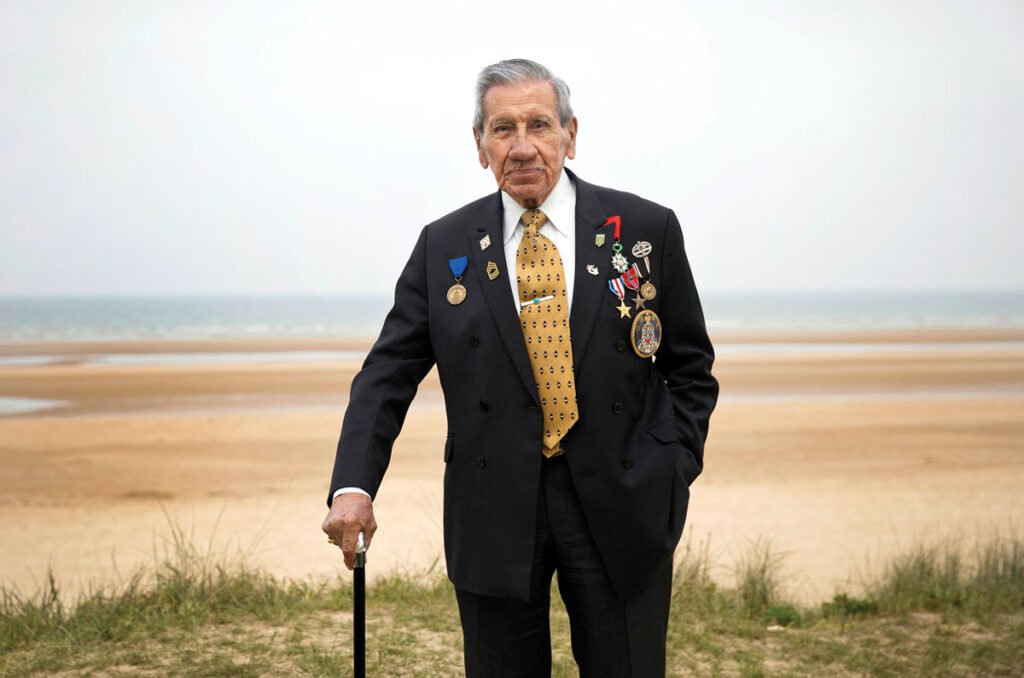
Charles Norman Shay regularly attended commemoration events at Omaha Beach in Normandy, France.
Here, a stone turtle sculpture carved by Penobscot sculptor Tim Shay (Shay’s nephew and Madockawando descendent) honors Indigenous people who served in WWII and marks the Charles Shay Memorial. Shay continues to dedicate himself to preserving and sharing Penobscot cultural heritage.
“ In the early years, I was the only Native American present at the commemorations. Over the years, many people have joined us. We succeeded in highlighting their role in the war. It was important not to forget them.”
Reflection Questions
What threads do you see weaving back and forth between Penobscot homelands and France?
What threads help to strengthen and honor relationships?
This research was compiled as part of the Mači-pikʷátohsək: A Wayfinding Walk which took place in Castine on October 5, 2025. For more information about this walk, click here. For more research related to this area, click on the tags below. To download a hi-res version of the posters below for educational use, please contact where@atlanticblackbox.com.
This event was a collaboration between Castine History Partners (CHP) and the Walks for Historical & Ecological Recovery (WHERE), a series convened by Atlantic Black Box.
Castine History Partners is a collaboration originally established to create virtual history tours for Castine. CHP supports a variety of learning opportunities around the history of Castine. The partners include Castine Community Partners, Castine Historical Society, Castine Touring Company, Maine Coast Heritage Trust, Maine Maritime Academy, Wilson Museum, and Witherle Memorial Library.