This piece was written by Cipperly Good of the Penobscot Marine Museum with research by Cipperly Good, Roger Moody, Emily Fredet Jackson, Izzy Healy, John Golden, Matthew Pickarski as part of Interco(a)stal: Reading Between the Ribs of Maine’s Maritime History.
What could be more ‘Maine’ than a Bean Supper? And what would baked beans be without molasses? And in the 1800s, that molasses came from the West Indian slave plantations. The laborers involved in the Sugar Trade stretched from the Maine North Woods to the West Indian sugar plantations:
Maine lumbermen harvested timber
Penobscot and Kennebec River sawmill workers cut raw timber into sugar box and molasses barrel components
Maine merchant mariners transported those wood components to the West Indies
West Indian enslaved Africans and indentured Chinese and Canary Islander laborers grew sugarcane and assembled and filled the molasses barrels and sugar boxes
West Indian longshoremen loaded molasses and raw sugar onboard Maine cargo vessels
Maine merchant mariners transported molasses and raw sugar to Portland sugar refineries
Portland refinery workers turned raw sugar into fine sugar and refined molasses
Maine lumber camp cooks bought Portland molasses to sweeten their baked beans to feed Maine lumbermen[1]
…and the process began again.
A step in this reciprocal economic relationship is epitomized in a watercolor from the Penobscot Marine Museum (PMM) collections that shows the Searsport schooner C. Mathews loading barrels of molasses at Cárdenas, Cuba. By narrowing our search in the PMM collection to the keyword Cárdenas, we found the shipping documents of seven cargo vessels engaged in the Searsport, Maine and Cárdenas, Cuba sugar trade from 1850 to 1873. The ten sea captains and seven cargo vessels are a small part of Maine’s participation in the West Indies sugar trade. These Searsport-built and/or captained two-masted schooners, brigs, and brigantines and three-masted barks carried Cárdenas molasses and raw sugar to the sugar and rum refineries of Portland, Boston, New York, and Philadelphia. The records name the suppliers, consignees, and shippers. The unnamed laborers, however, are very much a part of the economic story of the sugar trade between Maine and the West Indies.
Searsport’s merchant marine history is divided into four time periods. From 1800-1820, mostly sloops and topsail schooners shipped local goods to Boston, New York, and Baltimore. Between 1820-1840, larger schooners and brigs ventured to South America, the Mediterranean, and the West Indies and Southern United States ports exporting slave-grown commodities to European and American ports for manufacture. After 1840, some Searsport merchant mariners continued to follow the coastal trades, while those on square-rigged ships rounded Cape Horn to engage in the global trans-shipping trade where these ships rarely saw Maine waters again. After global shipping moved to steamships at the turn of the 20th century, Searsport merchant mariners returned to coastal shipping routes on schooners.[2]
Cárdenas, on Cuba’s northern coast, found its niche as a sugar port after its founding in 1828. In the 1840s and 1850s, a sophisticated railway network was built from Cárdenas into Cuba’s interior. This connected new sugar lands directly to the port, ensuring cut cane could be processed before its sugar content dropped.[3]
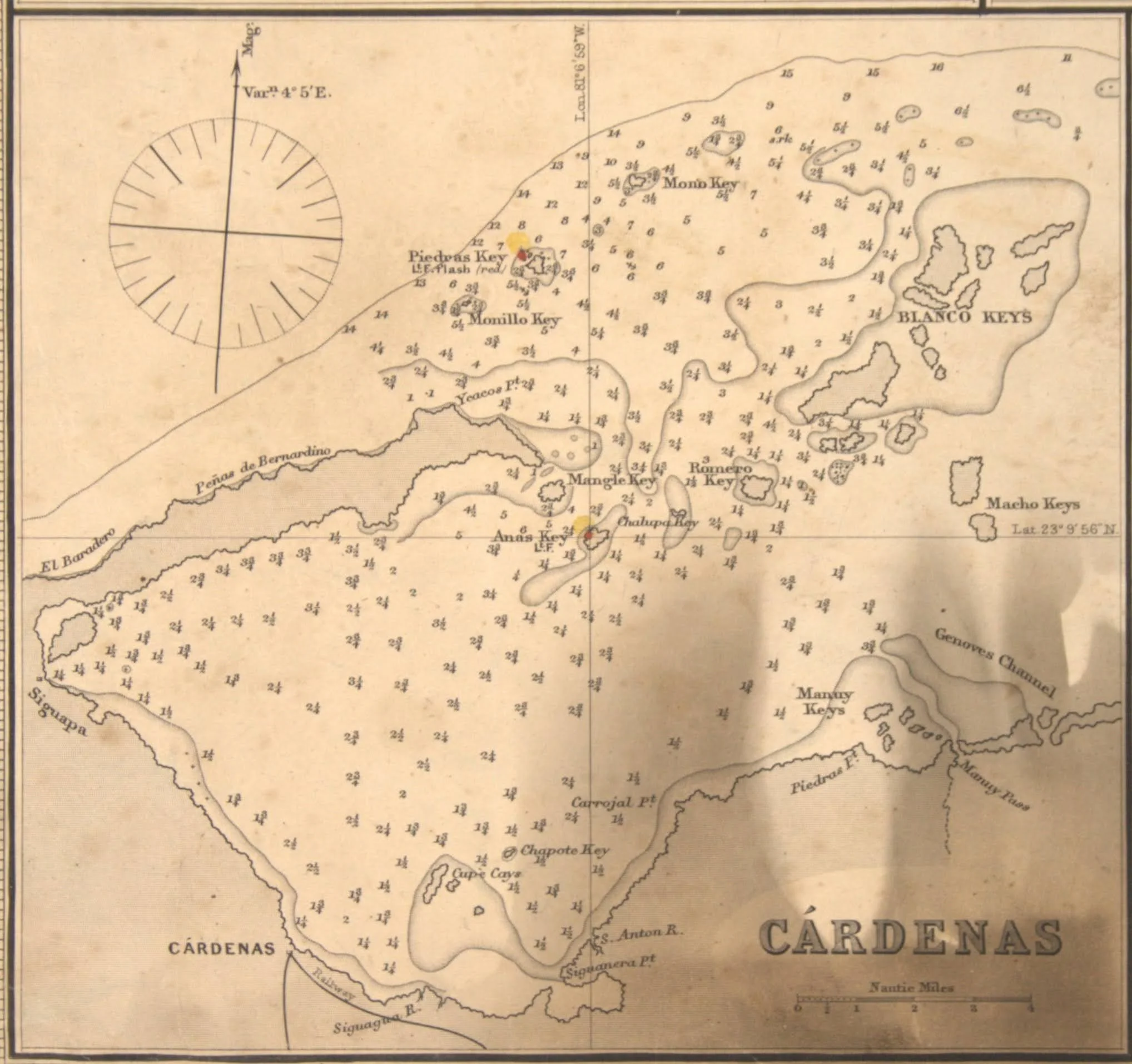
Cuba with Plans of Harbors nautical chart
Along the north coast of Cuba east of Havana, Maine merchant mariners visited the sugar ports of Matanzas, Cárdenas, Sagua la Grande, and Caibarien. The Maine trading vessels had a draft of about ten feet, allowing them to take the direct route over the Bahama Banks from Maine rather than having to detour to deeper water.
Image courtesy of Penobscot Marine Museum, Nautical Chart Collection, LB0000.01.0564.
Harvesting sugar cane plus clearing land to expand the lucrative sugarcane crop in Cuba required a huge labor force of enslaved Africans and indentured Chinese and Canary Islanders. Cuba thus became the largest slave colony in all of Hispanic America. Between 1790 and 1860, about 800,000 enslaved Africans arrived in Cuba—double the number brought to the United States. Enslaved workers faced grueling 18-hour workdays during the harvest, contracted rampant diseases, and experienced extreme violence.[4] As the British pressured Cuba to end slavery in the 1860s, plantation owners sought other sources of cheap labor. Through kidnapping or false pretenses, over 141,000 indentured workers, known as "coolies", came from China and the Canary Islands. While legally not slaves, their working conditions were often as brutal.[5]
New England merchant sailing ships formed the economic backbone of the lucrative Cuban sugar trade. New England’s booming timber industry provided the exact materials Cuban planters required: staves and hoops for molasses barrels and shooks for sugar boxes. Other commodities carried on ships from Maine, Massachusetts, and Rhode Island included salt cod, corn, and dairy products, alongside ice and lime. Vessels returned to New England loaded with raw sugar and partially refined molasses, commonly in tierces (35 gallon casks) or hogsheads (64 gallon barrels). These commodities were vital to New England's massive sugar refineries in Portland, Maine, and Boston, Massachusetts.
The Searsport cargo vessels engaged in the sugar trade measured around one hundred feet (100′) in length. Their moderate drafts in the ten feet range, allowed them to take the most direct route to Cuba across the Great Bahama Bank. With a ready supply of shipbuilding lumber nearby, building costs for Maine vessels were less than their competitors in Massachusetts and Rhode Island. Cheaper to build did not equal a lesser quality – these vessels lasted decades on the sailing route between Maine and Cuba. Most vessels made only two trips to Cuba a year, leaving Maine in late December and returning with a cargo by late February and immediately turning around for a second voyage that returned in late April. They avoided the West Indies in the summer’s extreme heat when yellow fever and hurricanes ran rampant.[6]
The shipping papers in the PMM collection show the network of shipping agents operating in American and Cuban ports. These firms acted as intermediaries, arranging the complex logistics of financing, shipping, and insuring raw cargo in transit. Working with shipping firms removed the onus of finding cargo for the Searsport captains. Let’s get to know the vessels, their captains, and their business partners better:
Brig Leghorn, Captain John G. Pendleton[7]
Built in Belfast, Maine in 1846, the 95′ brig Leghorn made multiple voyages between Cárdenas and Boston from 1850 to 1852 under the command of Searsport sea captain John Gilmore Pendleton (1828-1899). Stephen S. Stone of Boston owned the brig Leghorn at this time. Stone’s ships primarily engaged in the transatlantic cotton trade between New Orleans and England, but occasionally shipped sugar, timber, and even immigrants.
Captain Pendleton’s career lasted until 1894, sailing in both the coastal and deep sea trades. The Pendleton family master mariners spanned three generations (1805-1910) and their network of business ties in foreign ports served them well. In Cuba, Pendleton worked with Galarraga & Doyle, stockholders in the Matanzas Railroad Company, which transported raw sugar cane from the interior,[8] as well as Queipo & Pidal. Mora & Brother owned sugar estates in Cuba and handled sales through a New York commission office.[9] William F. Safford, a Portland shipping merchant, established the prosperous firm of Matthews & Safford in Cárdenas giving himself an assurance of a market on both ends of the route.[10] In Boston, Pendleton carried shipments for sugar merchant Edwin Gossler & Company, a subsidiary of the Hamburg, Germany banking firm,[11] and commission agent Daniel Deshon, dealing in Maine lumber and West Indies molasses.[12]
Brig Albatross, Captain Franklin Cochran[13]
Built in Searsport in 1847 by Henry Matthews, the 92′ brig Albatross made voyages between Cárdenas, Portland, and Boston in 1852 and 1853 under the command of Searsport sea captain Franklin Cochran (1822-1875). The Albatross was Cochran’s first command in 1847 and he transitioned to the global shipping trade on square-rigged barks, ending his career in 1869. His logbook tracks the voyages from Cárdenas and back, but does not disclose cargos, shippers, and consignees.
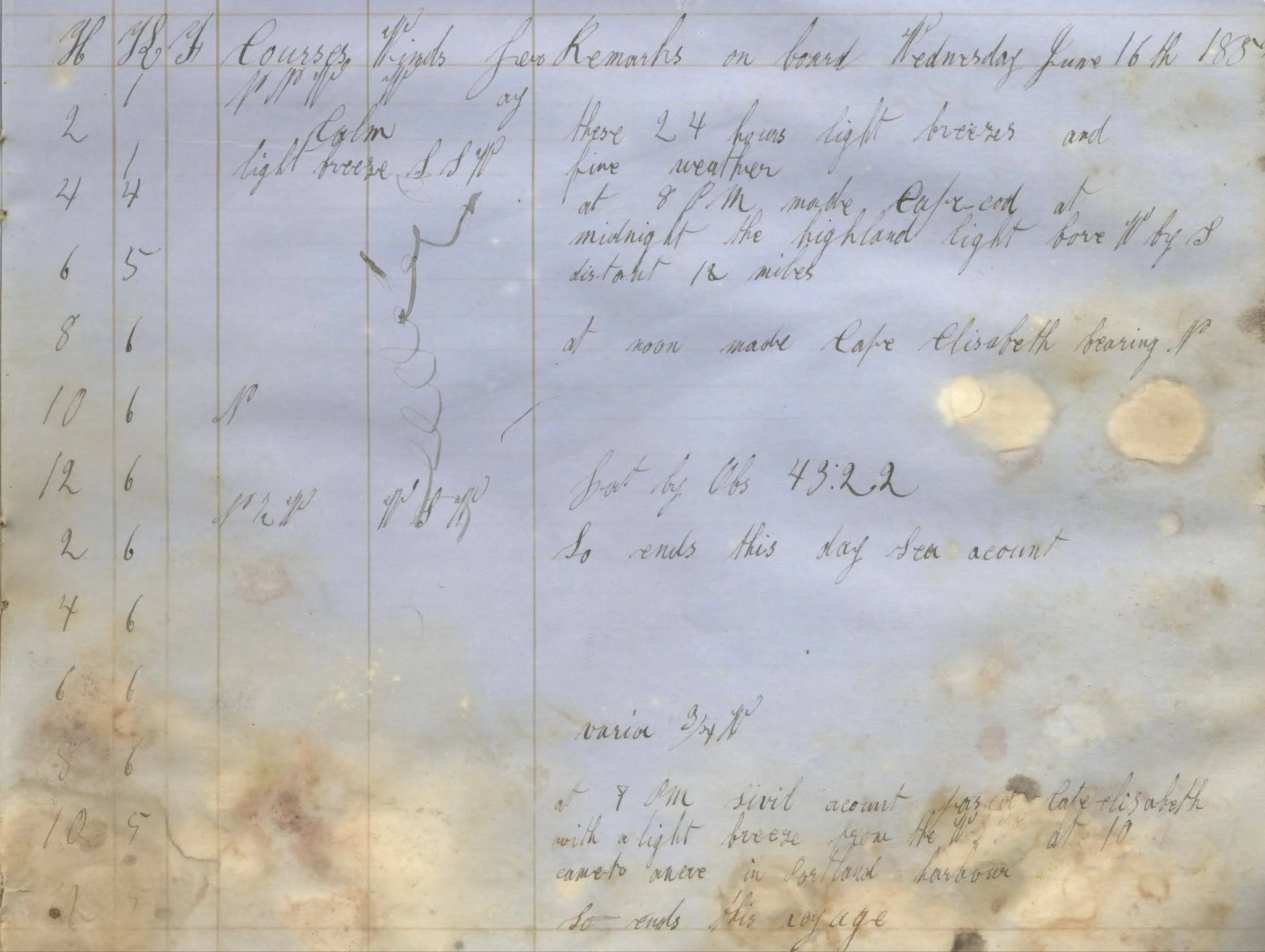
Logbook of the brig Albatross from Cárdenas to Portland
Searsport sea captain Franklin Cochran of the Searsport-built brig Albatross documents its arrival in Portland on June 16, 1852 from Cárdenas with a cargo of molasses for the Portland sugar manufacturers. The Albatross made many voyages between Cárdenas, Portland, and Boston in 1852 and 1853.
Image courtesy of Penobscot Marine Museum, Bound Manuscript Collection, MS 25.
Bark Sarah A. Nickels [14]
Built in 1852 by Marshall Dutch in Searsport, the 109′ bark Sarah A. Nickels made many voyages to and from Cárdenas under Nickels family ownership. At least three of David Sr. and Catherine Clifford Nickels’ sons participated in the coastal and global shipping trades from the 1850s to the 1890s on the bark: Jonathan Clifford Nickels (1827-1889) was its captain from 1852-1855 when he documented the voyage from Havana to Cárdenas in his logbook and account book; John Frederick Nickels (1832-1899); and Albert Vinal Nickels (1838-1902), who ran the family’s shipowning account book, and had a controlling ownership interest in the bark in addition to being its occasional captain. The route between the sugar plantations of Cárdenas and the sugar refineries in Portland, Boston, and New York proved to be lucrative for the family.
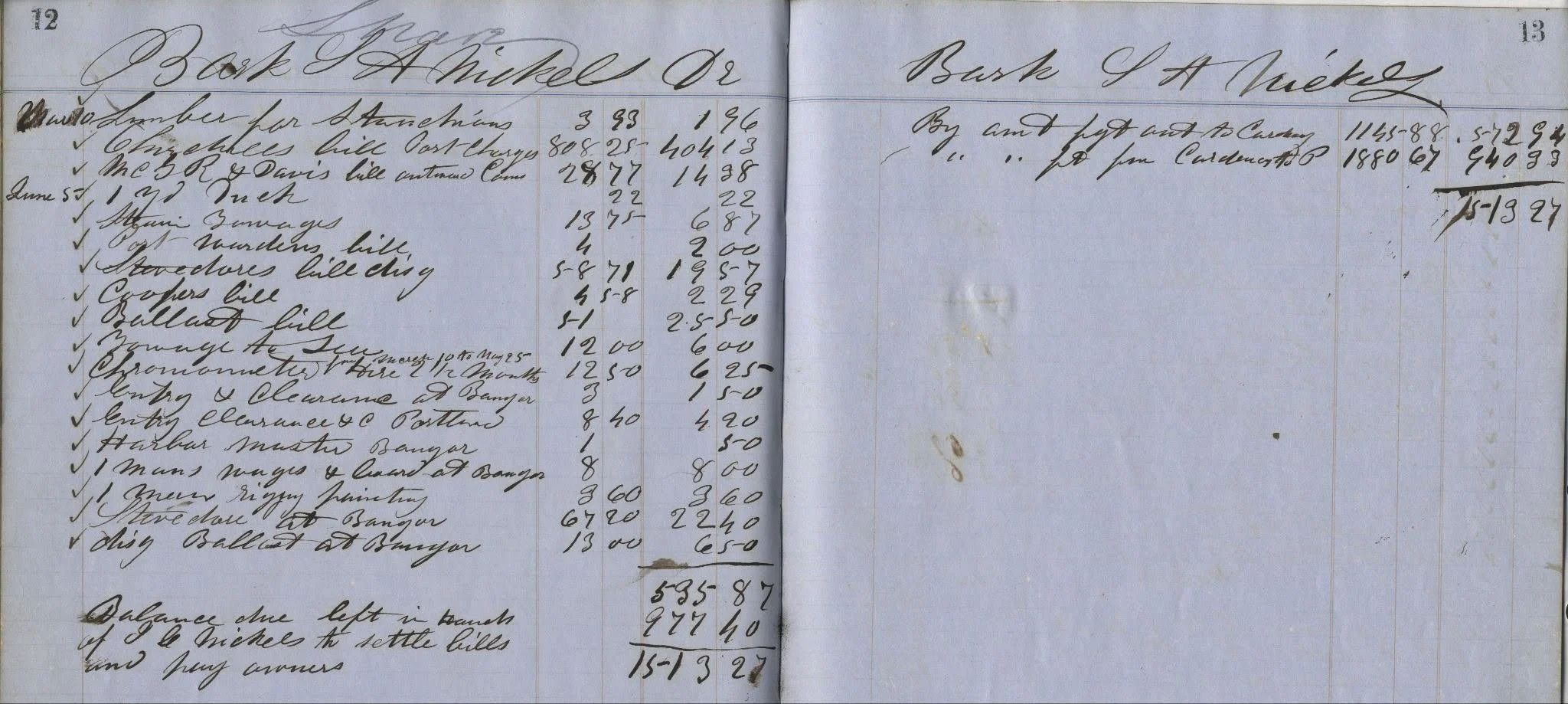
Bark Sarah A. Nickels Cárdenas Accounts
The Searsport-built, owned, and captained bark Sarah A. Nickels made numerous trips between Boston, Portland, and Cárdenas between 1854 and 1861. According to Searsport owner Albert Vinal Nickels’ account book for 1859, he sold the Sarah A. Nickels’ multiple cargoes of Cárdenas molasses in Portland in the $1,100 to $1,900 range, and a cargo of Maine lumber in Cárdenas for $6,300.
Image courtesy of Penobscot Marine Museum, Bound Manuscript Collection, MS 67.
Brig Isaac Carver, Captain Franklin Shute[15]
Built in 1848 by John Carver in Searsport, the 94′ brig Isaac Carver under the command of Searsport sea captain Franklin Shute (1830-1878) shuttled lumber and molasses between Cárdenas and the sugar refineries in Boston and Philadelphia and the lumber ports of Frankfort and Wilmington in 1866. Both captain and brig continued in the West Indies trades until their deaths: Franklin Shute in the sugar port of Matanzas, Cuba in 1878 and the Isaac Carver off the Bahamas a year later on May 7, 1879. Shute traded with a number of businesses. William and James Treat of Frankfort’s Treat & Company ran an extensive mercantile business as well as building and owning ships.[16] Kidder & Martin of Wilmington, North Carolina were frequent business associates of Searsport vessels carrying lumber.[17] Portland-based Churchill, Brown, & Manson conducted extensive business in both Maine and Cuba arranging contracts for Maine lumber used for sugar containers and Cuban molasses to fill said containers. Jonathan Carricaburn was a Cuban sugar merchant.[18]
Bark John Carver, Captain Jasper N. Nichols[19]
Built in 1841 by John Carver in Searsport, the 109′ bark John Carver under the command of Searsport sea captain Jasper N. Nichols traded food stuffs and sugar by-product containers from New York for molasses and raw sugar from Cárdenas. In Nichols’ logbook, we catch a glimpse of the Afro-Cuban coopers assembling barrels for the incoming cargo of molasses in Cárdenas: January 29, 1866 “4 coopers on board, 1 white man, 3 Negroes.” The logbook also notes produce coming from the United States: beans, potatoes, lard and butter.
Brigantine Manson [20]
Built in 1867 in the William McGilvery yard in Brewer for Searsport owners, the 125′ brigantine Manson shipped coal, train components, lumber, and barrels from New York and Philadelphia to Cárdenas in exchange for molasses. The shipping papers document the commands of Searsport sea captains Robert Cushing Gilkey (1827-1876) from 1867-1871 and his brother Lincoln Gilkey (1825-1895) from 1872-1873, and finally Enoch Brooks, a Philadelphia relief captain for one voyage in 1873. The Gilkeys worked with various shipping agents in Cárdenas to arrange cargos: G.A. Pacetti; Henry Treat; Tomas C. Yanes; Melvill, Reed & Co.; Manuel and Pedro A. Acevedo; and P.A. Calderon. In addition to being Cárdenas sugar traders, Samuel Trask (1822-1897) was a Portland native who set up business in Cuba and engaged in the illegal slave trade[21] and G.G. Sibles was a Lieutenant Governor of the Cárdenas region.[22]
Most often in Philadelphia, the Gilkeys worked with shipping agent G.W. Bernadon & Brothers[23], who engaged in the sugar trade with Cárdenas merchant Ferrin & Company[24] and prominent Philadelphia sugar industrialists Henry Welchman Bartol (1847–1918) and Edward Collings Knight (1813-1892), who partnered to establish the Southwark Sugar Refinery.[25] Other cargos leaving Philadelphia were coal from R.B. Wigton, Walter Donaldson & Co., and John C. Scott & Sons and railroad car parts from W.C. Allison & Sons.
In New York, the Gilkeys moved cargo for a variety of shippers: the sugar trading firm of Benjamin Huntting Howell (1811-1900) and his son Thomas Andrews Howell (1843-1896);[26] Pomares, Morrill & Cushman; Waydell & Company; Cuban sugar trader Jules Sazerac & Company; Rafael R. Barthold, who was also Consul General of Paraguay at one time;[27] and Lewis Benjamin and Joaquin Rionda y Pollendo, whose uncle was a Cuban sugar exporter with Pollendo, Rionda & Company.[28]
Brig Novelty, Captain Clifton H. Havener[29]
Commissioned in 1868 by Searsport captain Clifton Henry Havener (1832-1906) especially for the West Indian sugar trade, the brig Novelty East Boston builders installed seven huge iron molasses tanks. This allowed Havener to load in Cuba and unload in Boston within 24 hours at each port stop. In Havener's 1873 logbook, his seven roundtrips proved an aberration from the more typical two trips a year between December and April to avoid the summer yellow fever, hurricane season and extreme heat. He notes the heat in his June 10 log entry: “hot enough to roast to death anything that ever drew breath." This “novelty” scheme only lasted until 1873 when the brig sprung a leak and sank on a trip to Cuba. Although they do not mention each other, both the Manson and the Novelty were trading in Cárdenas at the same time.
Footnotes
[1] Charles D. Woods, Edward Raymond Mansfield, United States Department of Agriculture, and United States Office of Experiment Stations, Studies of the Food of Maine Lumbermen. (Washington: Government Printing Office, 1904), 16.
[2] Frederick F. Black, Searsport Sea Captains. (Searsport, ME: Penobscot Marine Museum, 1960), 14.
[3] Laird W. Bergad, “The Economic Viability of Sugar Production Based on Slave Labor in Cuba, 1859–1878.” Latin American Research Review 24, no. 1 (1989): 95–113. https://doi.org/10.1017/S0023879100022688.
[4] Marial Iglesias Utset and Jorge Felipe Gonzalez. Cuba and the United States in the Atlantic Slave Trade (1789–1820). https://hutchinscenter.fas.harvard.edu/cuba-us-slave-trade.
[5] R. Ng & University of Portsmouth. “Chinese “Coolies”: Hidden drivers of Nineteenth-Century Cuba’s economic transformation,” Itinerario Vol. 49 (2025): 357–381. https://doi.org/10.1017/S0165115325100089
[6] William Hutchinson Rowe, “The Old West Indies Trade” in White Pine and Blue Water: A State of Maine Reader, ed. Henry Beston (Camden, Maine: DownEast Magazine, 1950), 48.
[7] “Shipping papers of Brig Leghorn.” 1850-1852. Folders 16 and 19, PMM 40 Stephen S. Stone Collection. Penobscot Marine Museum, Searsport, Maine.
[8] United States War Department, Annual Reports of the War Department for the Fiscal Year Ended June 30, 1900. Part 12. Report Of The Military Governor Of Cuba On Civil Affairs. In Two Volumes. Vol. II— In Four Parts. (Washington, DC: US Government Publishing Office, 1901), 2:33.
[9] Lisandro Perez, Sugar, Cigars, and Revolution (New York: New York University Press, 2018), 50.
[10] “Happy 10th Anniversary, Safford House!” Greater Portland Landmarks. 7 November 2019. https://www.portlandlandmarks.org/gplblog/2019/11/4/safford-houseiversary
[11] “Edwin Gossler & Co. advertising sale of molasses and sugar at 31 India Wharf,” The Boston Advertiser, 17 December 1852.
[12] The Boston Directory: Containing the City Record, a General Directory of the Citizens, and a Special Directory of Trades, Professions, &c. An Almanac, from July, 1849, to July, 1850, with a Variety of Miscellaneous Matter. (Boston: Sampson & Murdock Company, 1849), 116 and 146.
[13]Cochran, Franklin A. “Log of Brig Albatross.” 1852-1853. MS 25, Bound Manuscript Collection. Penobscot Marine Museum, Searsport, Maine.
[14] Nickels, Albert V. “Account Books for Sarah A. Nickels and William McGilvery.” 1859-1861. MS 67, PMM 77 Albert V. Nickels Account Books; Jonathan Clifford Nickels. “Log of the Bark Sarah A. Nickels.” 1854. MS 10, Bound Manuscript Collection; and Jonathan Clifford Nickels. “Account Book of the Bark Sarah A. Nickels.” 1854. MS 336, Jonathan Clifford Nickels Papers, Penobscot Marine Museum, Searsport, Maine.
[15] “Shipping papers of Brig ISAAC CARVER.” 1861-1866. 1983.8, Vessel File Archival Collection. Penobscot Marine Museum, Searsport, Maine.
[16] History. (n.d.). https://www.frankfortme.com/about-frankfort/history/
[17] MS# 234 Kidder Family Correspondence, Center for Southeast North Carolina Archives and History, University of North Carolina Wilmington.
[18] Records of Churchill, Brown & Manson Company. (2016, June 3). Collections & Research. https://research.mysticseaport.org/coll/coll162/
[19] Nichols, Jasper N. “Log of Bark John Carver.” 1865-1866. MS 343, Bound Manuscript Collection. Penobscot Marine Museum, Searsport, Maine.
[20] Shipping papers of Brig MANSON. 1869-1873. PMM 32-1388, Vessel File Archival Collection. Penobscot Marine Museum, Searsport, Maine.
[21] “Maine-built and -captained Vessels in the Slave Trade,” Atlantic Black Box, 12 June 2026, https://atlanticblackbox.com/art-in-the-wake/
[22] Lista de los Sres Suscritores. (n.d.). http://cdigital.dgb.uanl.mx/la//1080012366/1080012366_43.pdf
[23] J.M. Schofield, Board of Marine Underwriters, shipowners, masters and pilots, of the port of Philadelphia, Removal Of Obstructions In The Delaware River. In House Of Representatives. (1868). https://www.govinfo.gov/content/pkg/SERIALSET-01346_00_00-008-0318-0000/pdf/SERIALSET-01346_00_00-008-0318-0000.pdf
[24]Business Letters Describing the Financial Market in Cuba, George A. Smathers Libraries, University of Florida, Gainesville, Florida. https://findingaids.uflib.ufl.edu/repositories/2/resources/546
[25] Edward Collings Knight (1813-1892) - American aristocracy. (n.d.). https://americanaristocracy.com/people/edward-collings-knight
[26] Jaime Montilla, B. H. Howell Son & Co. (n.d.). https://www.jaimemontilla.com/b-h-howell-son
[27] ”Finishes,” Cincinnati Daily Star, 12 July 1878, Front page. https://tile.loc.gov/storage-services/service/ndnp/ohi/batch_ohi_himilco_ver01/data/sn85025759/00296026931/1878071201/0563.pdf
[28] Jaime Montilla, Manuel Rionda. (n.d.). https://www.jaimemontilla.com/manuel-rionda
[29] Havener, Clifton Henry. “Diary of Captain Clifton Henry Havener Aboard the Novelty, 1873.” 1873. MS 590, Bound Manuscript Collection. Penobscot Marine Museum, Searsport, Maine.
About the Author
Cipperly Good, Curator of Maritime History, Penobscot Marine Museum
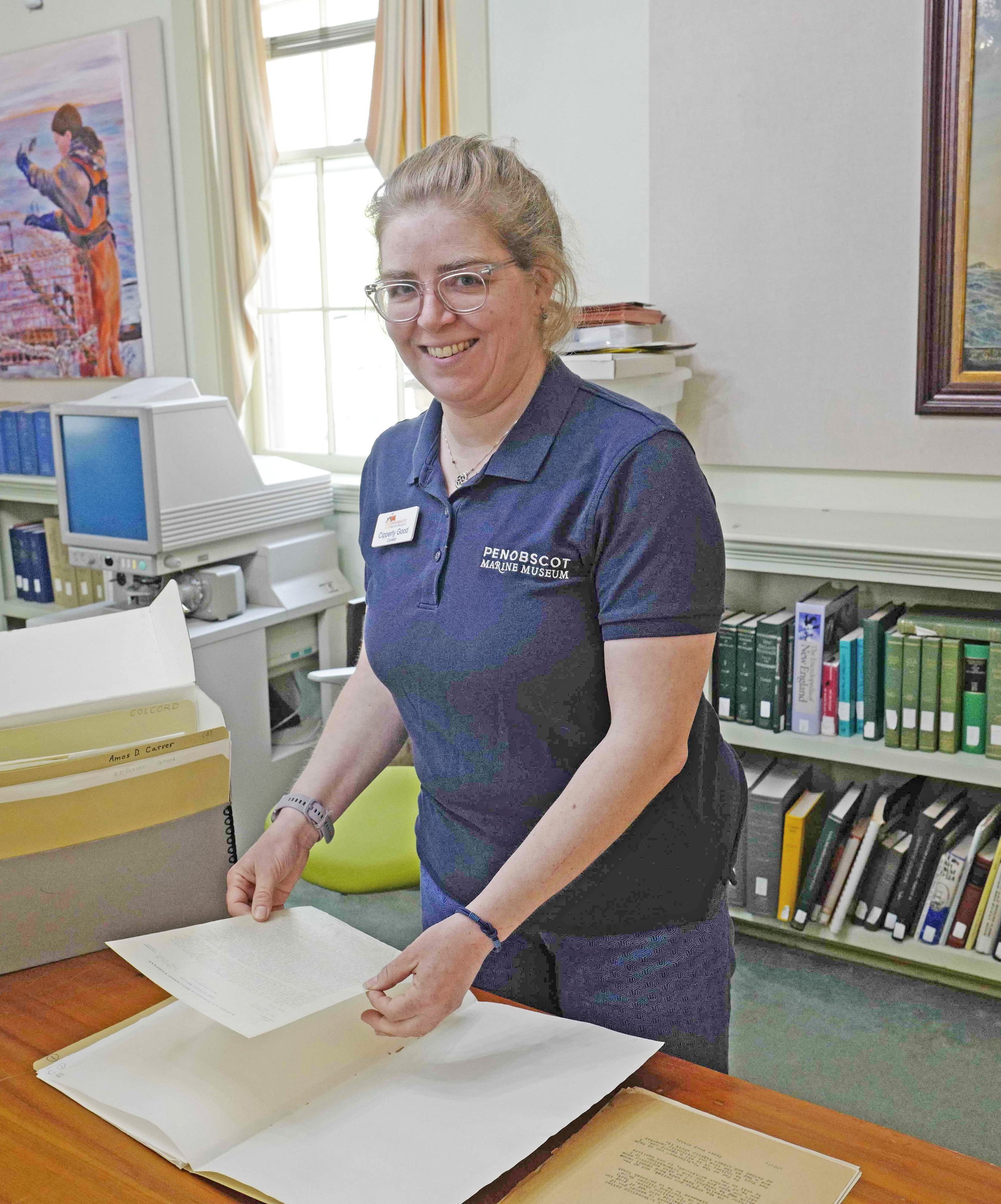
Cipperly Good serves as the Richard Saltonstall Jr. Curator of Maritime History at Penobscot Marine Museum, where she has been on staff since 2010. In her many roles at the Museum, Cipperly preserves and provides access to the object, archive, and library collections. She previously served as the Maine Archives and Museums board president and is a contributor to the Atlantic Black Box blog. Cipperly holds a Bachelor’s degree from Colby College in Waterville, Maine, where she double majored in History and American Studies; she additionally holds a Masters of Arts in Museum Studies, with a concentration in American History, from The George Washington University. To reach Cipperly, email: cgood@pmm-maine.org.