Maine Families, Wealth, and the Domestic Slave Trade
The following was researched and written by Lisa Simpson Lutts with Richard Ames, as part of Interco(a)stal: Reading Between the Ribs of Maine’s Maritime History.
An advertisement for the firm which made fortunes for the two Maine brothers, Samuel and John Perkins Whitney.
Just as Mainers were involved in the transatlantic slave trade, they also amassed significant wealth in the domestic slave trade.
In 1832, the Whitney family of Lincolnville, Maine launched the brig Samuel and John. Probably that same year the two eldest Whitney sons, John P. Whitney and Samuel Whitney, Jr., moved to Norfolk, Virginia to start a business. By 1835 the brothers moved to the larger, thriving port of New Orleans, forming the company S. & J. P. Whitney & Co., Commission Merchants and Consignees of Ships.
Commission merchants like the Whitneys were pivotal figures in the American economy during the mid-19th century, serving as essential intermediaries in a rapidly expanding commercial landscape. Unlike traditional merchants who bought and sold goods for their own account, commission merchants like S. & J. P. Whitney & Co. operated by buying and selling merchandise on behalf of others, earning a percentage commission for their services. This business model allowed them to facilitate trade without taking direct ownership of the goods, thereby minimizing their personal financial risk.[1]
Their role extended far beyond simple brokerage. Commission merchants often provided a suite of services crucial to the flow of commerce, including the storage of commodities in their warehouses, arranging insurance to protect against loss, and even offering financing to producers or buyers. This comprehensive approach was particularly vital in connecting the agricultural producers who used enslaved labor from regions like the Mississippi Valley with distant markets and manufacturers. In a period with less developed financial and transportation systems, these merchants helped manage the inherent risks and complex logistics of moving goods across vast distances.[2]
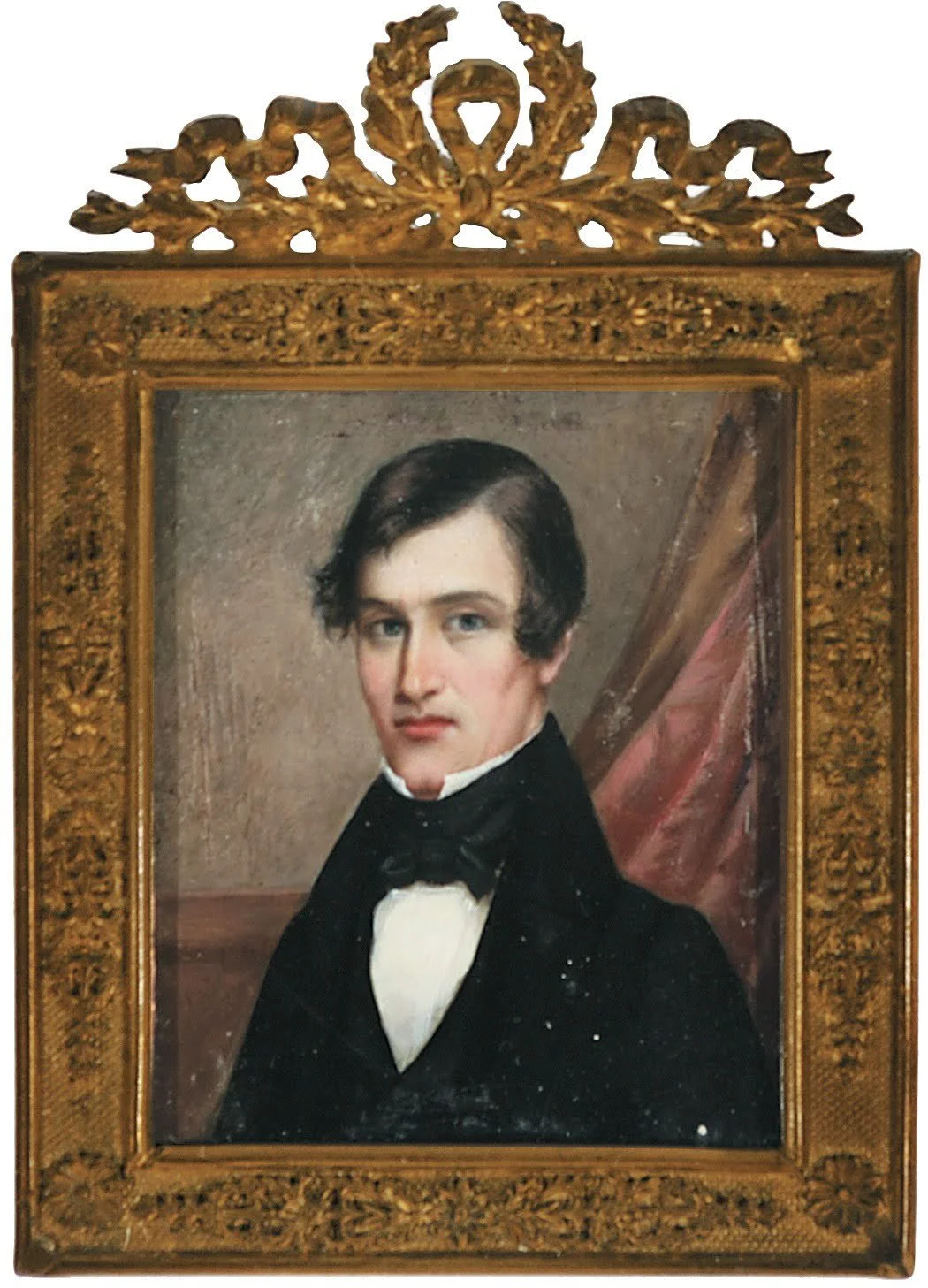
Portrait of John P. Whitney (1805–1848
John P. Whitney of Lincolnville, Maine moved to New Orleans in the 1830s with his brother Samuel. Together they amassed fortunes as commission merchants in the cotton trade. In the 1830s, they also used their own vessel or others to traffick enslaved workers from Norfolk, Virginia to New Orleans, Louisiana to be sold in the domestic slave trade.
Photograph courtesy Neal Auctions, New Orleans. This portrait was sold at Neal Auctions in New Orleans to a private buyer. Neal Auctions gave permission to use this image.
The Whitneys business in New Orleans quickly became successful in the shipping trade with vessels traveling throughout the world, mainly exporting cotton to European ports. While the majority of their wealth came from the cotton trade, in 1835 they entered the rapidly expanding domestic slave trade, forcibly transporting men, women, and children from Norfolk, Virginia, to New Orleans, Louisiana for sale in the city's slave markets.
S. & J. P. Whitney & Co. not only transported enslaved people aboard its own vessels, but also acted as consignee for enslaved people trafficked on ships owned by others. Two voyages were conducted using their own ship named for the brothers, the Brig Samuel & John. This ship was captained by a distant relative, Captain John Hovey Perkins of Kennebunkport, Maine, who likely profited from the sale of the people transported aboard the vessel. Today, Perkins' grand home is lauded as an example of the wealth and prestige of this Maine port’s sea captains with no acknowledgment that some of that wealth derived from the domestic slave trade.
The Whitney brothers, along with ship captain John H. Perkins, are examples of New Englanders’ participation in the domestic slave trade, often referred to as the Second Middle Passage. Today, family genealogies, local history books, and local historical societies make no mention of how these men acquired their vast amounts of wealth through the domestic slave trade.
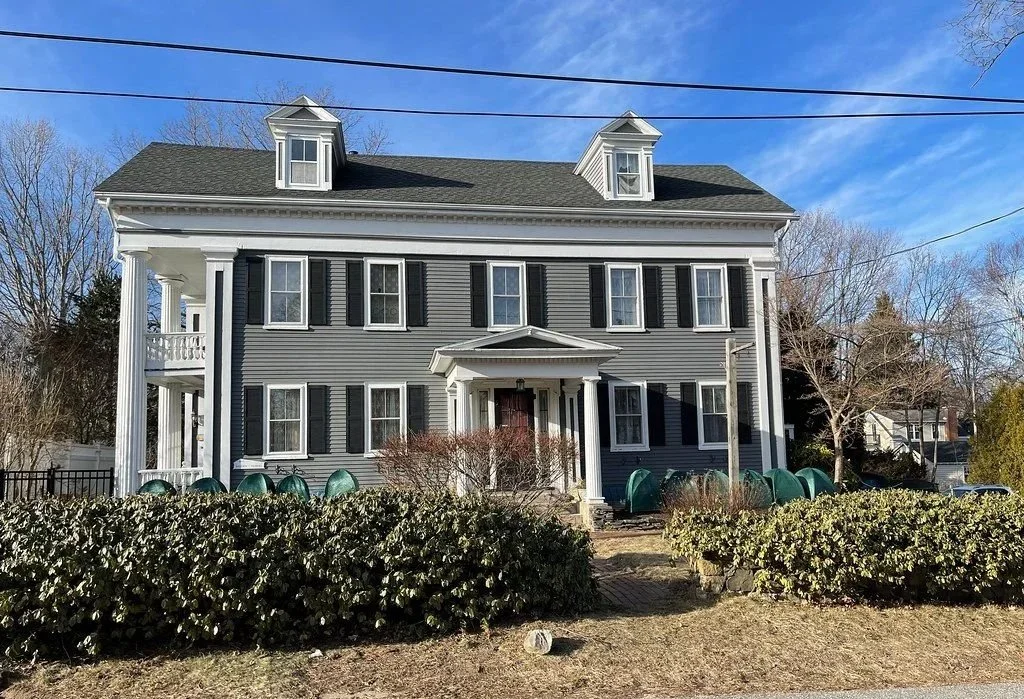
The Captain John Hovey Perkins House, Kennebunkport
Captain John Hovey Perkins’ home in Kennebunkport is admired today as a fine example of a wealthy ship captain’s home with no acknowledgement of Perkins’ acquiring wealth through the domestic slave trade.
Credit: BuildingsofNewEngland.com
After the United States outlawed the transatlantic slave trade in 1808, a flourishing domestic slave trade took off due to several economic factors. The collapse of the tobacco economy prompted enslavers in Maryland and Virginia to sell enslaved people to the rapidly expanding cotton economy of the Deep South, where demand for enslaved labor was soaring.
During this time, New Orleans became the largest slave market and ports such as Norfolk, Virginia began making huge profits from this domestic slave trade. The Whitneys took advantage of this expanding market, transporting at least 27 men, women, and children in eight domestic slaving voyages spanning from October 1835 to October 1838.[3] From this trade, the Whitneys would have made an immense profit that enriched their families’ wealth and status in New Orleans.
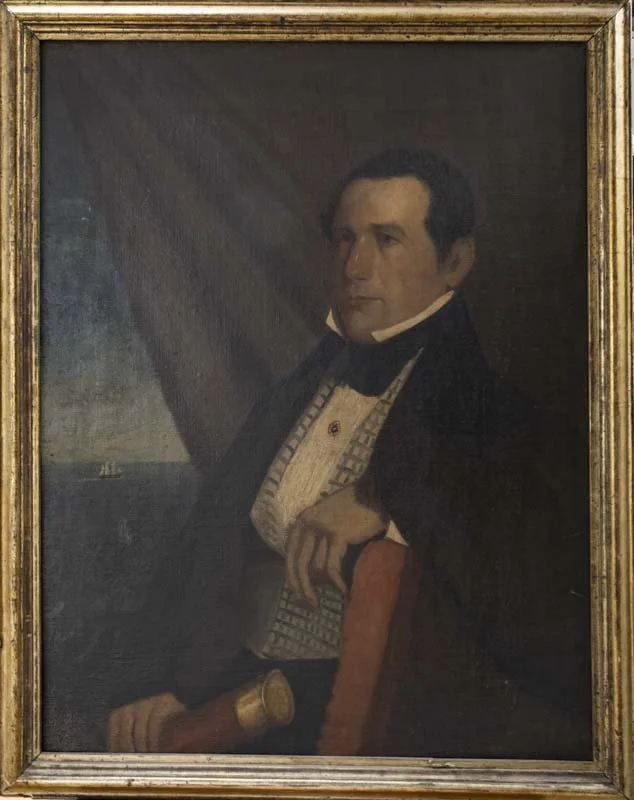
Portrait of Captain John Hovey Perkins (1795-1859)
Captain John Hovey Perkins of Kennebunkport, Maine served as captain on a number of domestic slave voyages for the company S. & J.P. Whitney. At his death, his estate was valued at over $600,000 in today’s money.
Courtesy of the Brick Store Museum
John P. Whitney married Temperance Johnston, the sister of his business partner Daniel Johnston. Like the Whitneys, the Johnston family of Castine Maine—including two brothers, three sisters, and their mother—moved to New Orleans in the 1830s to seek opportunity and fortune. As residents of that city, John and Temperance also enslaved individuals. In 1840 there were two men and two women listed in their household on the slave census, while in 1850 one woman and one man are listed in the household. In addition, J. P. and S. Whitney & Co enslaved at least four men, including William, Henry, and Joe.[4]
In 1844 brother Samuel chose to retire and moved back to Lincolnville, Maine. The company continued to prosper until the untimely death of J. P. Whitney in January of 1848 from scarlet fever. One of his daughters, Clara, had succumbed to the same disease three days earlier at the age of seven. He left behind his wife, Temperance Johnston Whitney and two sons and two daughters. His obituary states that J. P. Whitney was “one of New Orleans’ most enterprising citizens and eminent merchants.”[5]
At the time of his death in addition to his merchant business, John P. Whitney owned:
a dry dock in Algiers (across the river from New Orleans)
the newly built Belville Iron Foundry, one of the most extensive in the country
a line of steamers between New Orleans and New York
a shipping business between 1835 and 1848 that owned shares in 16 Ships, 6 schooners, 4 Brigs, 3 Barks, 3 Steamboats
an elegant home on St. Charles Street in New Orleans
up to eight enslaved men, women and children
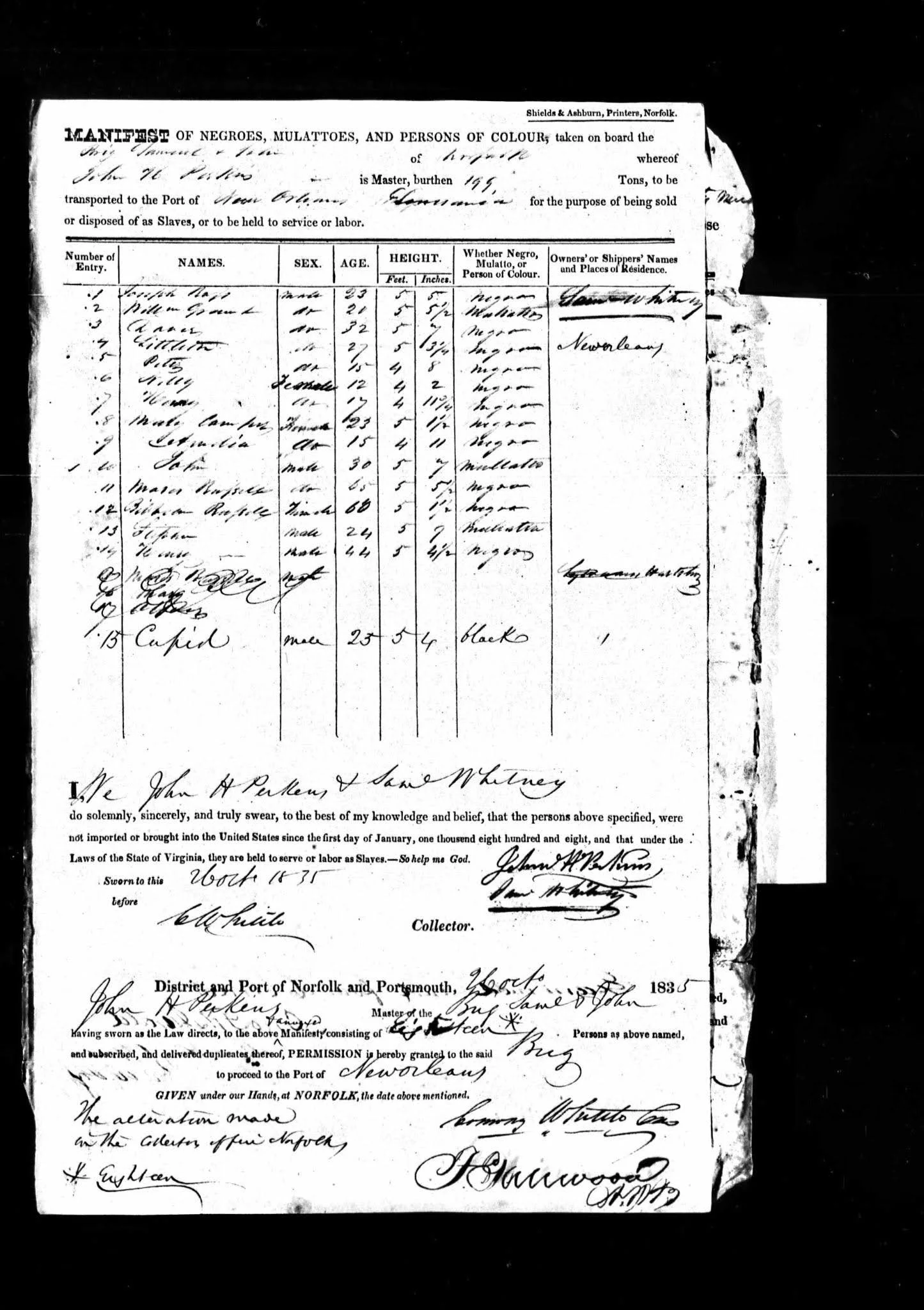
Domestic Slave Trade Ship Manifest, October, 1835
In October of 1835, S. & J. P. Whitney & Co. embarked on the firm’s largest domestic slave trade voyage trafficking 15 enslaved individuals ranging in age from Nelly age 12 to a married couple, Moses and Bibbson Russell, in their 60s. The brig Samuel and John, named for the two brothers and built in Lincolnville, Maine, was captained by distant relative and Kennebunkport ship captain, John Hovey Perkins. The trafficked individuals were destined to be sold at one of New Orleans many slave auction houses with family groups such as the Russells often split up.
Source: National Archives and Records Administration (College Park, Maryland), Ancestry.com
After his brother’s retirement, J. P. Whitney took on another New Englander, Richard B. Sumner, as a partner. Their co-partnership agreement gives us a glimpse of the accumulated wealth by the Whitneys through their involvement in the cotton economy and the domestic slave trade. The document writes: “in the event of the death of either partner, the surviving partner shall continue the business for two years for the benefit of the heirs of the deceased.” In his will, J. P. estimated that his share of the two years of continuing business would be worth $100,000 ($4.2 million in 2026 dollars).[6]
In addition, the merchants of New Orleans “held his qualities in such respect that as a complimentary tribute to his many virtues they secured a life insurance upon him to the extent of $30,000 ($1.3 million in 2026 dollars).[7]
The Whitneys are just one example of Maine merchants moving to the South to make their fortunes through participation in the domestic slave trade and the cotton economy.
Footnotes
[1] Fred Bateman and Thomas Weiss, A History of the American Economy (New York: W. W. Norton, 1999), 167-189.
[2] Stuart Bruchey, Growth of the Modern American Economy (New York: Dodd, Mead & Company, 1975), 78-95.
[3] "Louisiana, United States records," images, FamilySearch (https://www.familysearch.org/ark:/61903/3:1:3Q9M-CSVZ-V93K-T?view=index : Jul 18, 2025), image 894 of 1273; United States. National Archives and Records Administration (College Park, Maryland). Image Group Number: 103413590. This is just one example of a voyage from Norfolk to New Orleans with 17 enslaved on board.
[4] Orleans Parish Clerk of Civil District Court; New Orleans, Louisiana; McCay, David L. 1836-1847 Volumes 10, Act 22. Ancestry.com. This is one example being the purchase of Joe in 1842.
[5] Times Picuyne, February 1, 1848. Newspapers.com.
[6] Record of Wills, 1807-1901; Author: Louisiana. Probate Court (Orleans Paris). Ancestry.com.
[7] Boston Evening Transcript, February 9, 1848. Newspapers.com.
About the Author
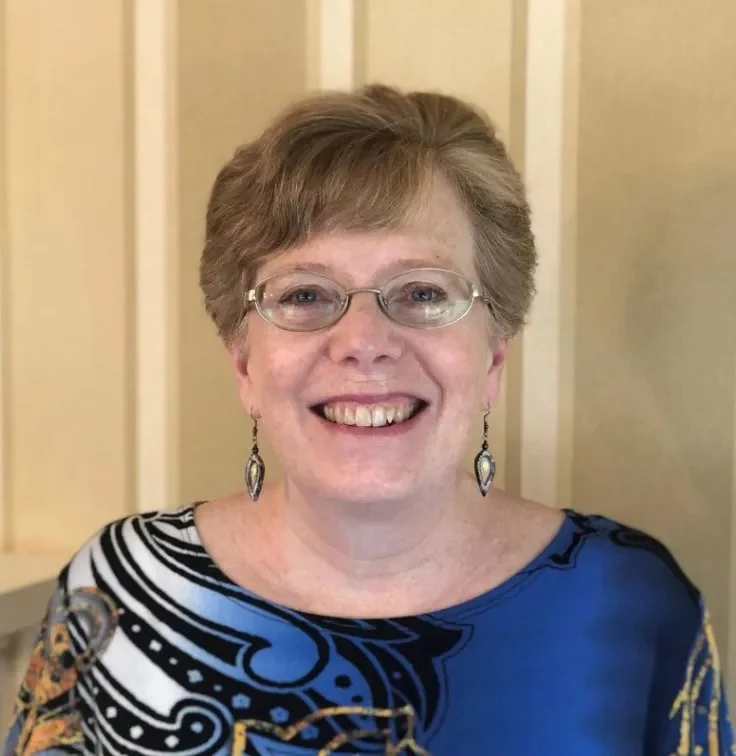
Lisa Lutts recently retired from a 40-year career leading history museums in the Northeast, most recently the Castine Historical Society in Castine, ME. In 2020, Lisa became involved with ABB as a citizen historian researching, writing, and speaking about Castine’s hidden African American history and complicity with slavery through the maritime cotton and cod trades that brought great wealth to the town. Through her leadership at the Castine Historical Society, she brought this history to the public through a year-long lecture series, historic walking tours, and the creation of a five-week learning unit on Castine’s African American history for the local school. Lisa received her undergraduate degree in Art History from the University of Tennessee and a masters degree in Art History and Museum Studies from George Washington University.