Pillars of Their Community: Portland, Maine’s Black Mariners
The following was researched and written as part of Interco(a)stal: Reading Between the Ribs of Maine’s Maritime History.
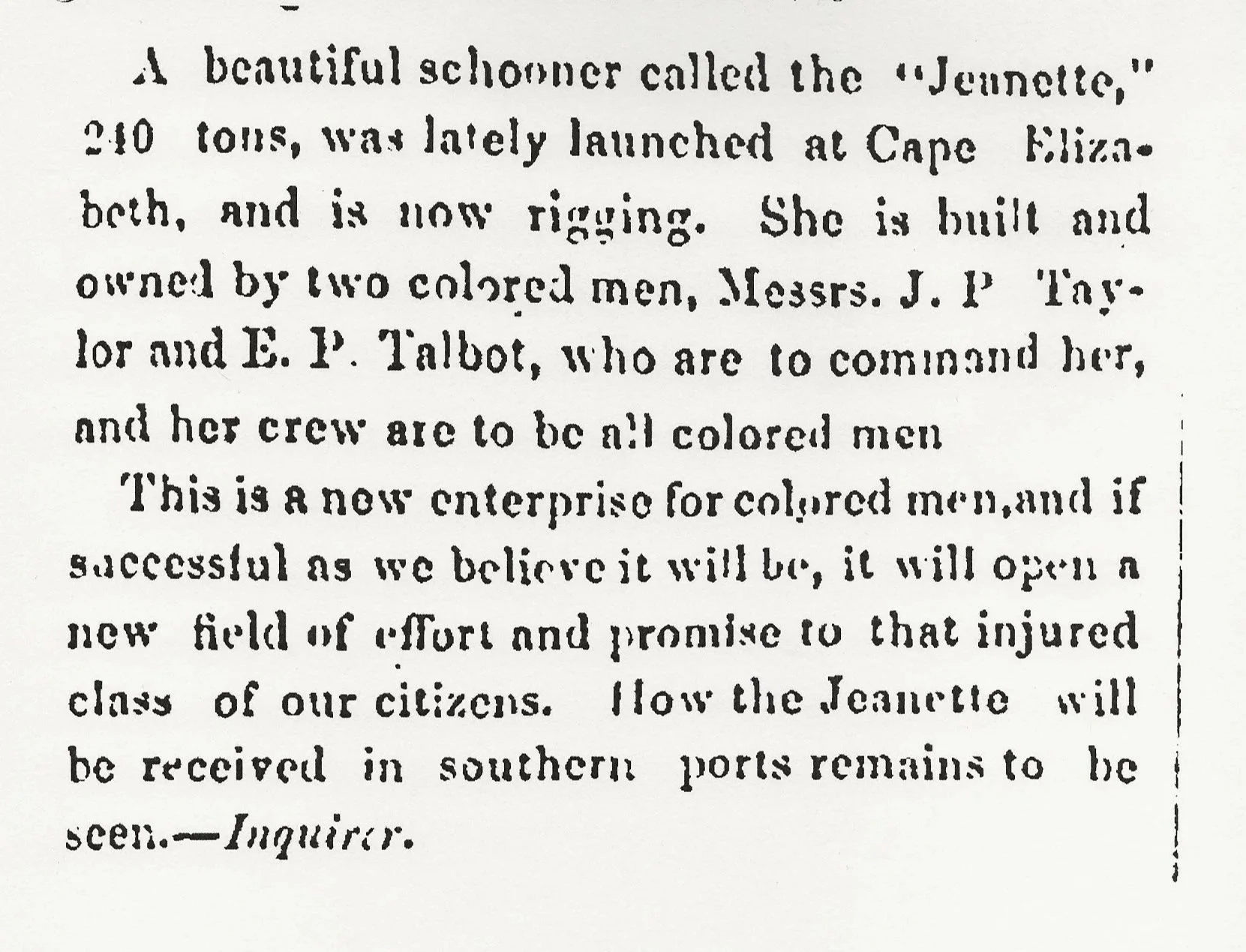
April 29, 1853, from Zion’s Advocate, Portland, Maine
Joseph Taylor and Elbridge Talbot were both Black mariners sailing out of Portland Harbor. They had a 240 ton “schooner-clipper” (a fore and aft rigged ship, likely with two masts) named the Jeanette and built for them at Turner and Foster shipyard in what is today South Portland. The ship was named after Taylor’s wife and was launched in 1853. Based on later newspaper obituaries following Taylor’s death we believe that the Jeanette was the first ship in United State’s history to be built for, and sailed by, a Black captain. Furthermore, the Jeanette sailed with a Black first officer, Talbot, and an all Black crew.
We find it surprising that we can find very little evidence regarding the voyages of Taylor, Talbot, and the Jeanette. Typically vessels coming into, and departing from, a given port would be noted in local newspaper’s shipping news. Taylor’s obituaries, written in a variety of contemporary national newspapers, assert that he was the first Black man in the U.S. to build and captain his own vessel. They further state that his ship made, “a number of successful voyages to the West Indies,” before the ship was wrecked. The Society has been able to uncover just one article referring to the voyages of the Jeanette which state that she was sailing in the “Gulf” with Taylor as her commander and that they were attempting to find a cargo of guano (bird droppings used in fertilizer and gunpowder production). When the Portland custom house was destroyed during the Great Fire of 1866 many shipping records were lost and this could account for the lack of documentation regarding the Jeanette’s voyages.
Research on Captain Elbridge Talbot finds him working in the maritime trades at a young age. He captained at least one vessel before he took command of the Jeanette. We believe this ship was the 240-ton bark rigged Odd Fellow, built in 1844 by Robert and Thomas Knight in their Portland yard. In vessel clearance reports from 1846 and 1847 the Odd Fellow is listed as being commanded by “Captain Talbot.”
April 6, 1870, from the Eastern Argus
Newspaper articles from the 1860s and 1870s exhibit that Talbot was a well respected leader of Portland’s Black community and a frequent public speaker. For example, one article shares that Talbot spoke at a meeting to celebrate the ratification of the 15th amendment at Portland City Hall in 1870. He was one of five speakers at the event. On January 1, 1872, Talbot spoke at Portland’s Newbury Street Church to commemorate the ninth anniversary of the emancipation proclamation.
We have not found as much information about Taylor. However, using newspaper reports, we have pieced together the following information: Taylor was born in Virginia and had been living in Charleston, South Carolina before he moved to Portland and married Jeanette C. Small in July of 1840. We don’t know if he was born into enslavement or if he was free at the time of his birth. He worked for many years for the Portland Steam Packet Line. After the Jeannette was built Taylor purchased the 110 ton schooner Jerome from the Willard family (the Jerome had been owned by Captains Ben and Enoch Willard, Willard Beach in modern-day South Portland is named after their family.) Articles published following his death assert that Taylor played an important role in Portland’s Underground Railroad assisting self-emanciaptors make their way to Canada. In 1862 Taylor obtained a liquor licence and opened Burnside Eating Saloon on Fore Street. During the Great Fire of 1866 he lost substantial property and in his later years he worked as a barber in Portland. He died in 1891 at the age of 85.
As an all Black crew sailing before the Civil War Taylor, Talbot, and their crew members were subject to the many Negro Seamen Acts that became law starting in South Carolina in 1822. Other Southern states soon adopted similar laws. These laws stipulated that all Black sailors sailing into a given Southern port would have to spend their time in that port in the local jail. These laws sought to prevent the insurrections of enslaved Africans living in those locales who might be inspired to abscond or revolt by free Black sailors from Northern States.
Portland Maine’s Black sailors provided the income for their families and were pillars of their community. Before the Civil War Black sailors in the U.S. earned the same wages as their White counterparts. Black sailors were often the heads of their households and hence the occupation of mariner provided both familial and community financial stability. Portland’s Black sailors bought land and homes on the city’s Munjoy Hill and provided funding for community organizations such as benevolent societies and the city’s first Black church; the Abyssinian Meeting House. The church was known as the “Anchor of the Soul” due to its large number of congregants who worked as sailors or in shore-side maritime related occupations such as longshoremen and blacksmiths.
The status of Black sailors in the United States began to change following the Civil War. Jeffery Bolster refers to this period as “Jim Crow at sea” to suggest that the racism that evolved on land in the U.S. during and after reconstruction had a parallel on the water. Black sailors begin to be paid less than their White counterparts. Black mariners also begin to be relegated to certain shipboard positions such as cook and steward, in part due to racial stereotypes that suggest that these positions are more appropriate for Black sailors than sailing, “before the mast,” or a common deck hands. This could work to the advantage of some Black sailors since the position of cook became increasingly important in the later 1800s as demand for better shipboard food increased.
In Portland many Black sailors chose to work on “overnight” steamships so they could be closer to home. These boats provided passage to nearby cities such as Boston, Bangor, and Halifax and, hence, Black community members residing in Portland would have the opportunity to be with their families every couple of days instead of being away at sea for months on end. The wreck of the SS Portland provides an instructive lesson regarding the importance of maritime jobs for Portland’s Black community in the late 1800s. When the SS Portland sank on November 27, 1898, twenty individuals from Portland’s Munjoy Hill Black community perished. This number constituted an astounding 20 percent loss of that community. Furthermore, many of the Black men and women who perished in the wreck were the financial providers for their families.
It is remarkable that we see so much of Black Portland during the 1800s embodied in these two individuals. In addition to both men being mariners, both men were deeply involved in the city’s Black community. Taylor participated in the activities of the Underground Railroad and also owned a restaurant and worked as a Barber, both occupations were very common for Black citizens of Portland. Talbot was a community leader and public speaker who attended and spoke at several meetings celebrating emancipation and the 15th amendment. Their special place in United States history as the first Black men to have a ship built for them, and to then sail that ship, is worthy of acknowledgement and celebration.
About the Authors
Kathryn Onos DiPhilippo, Executive Director, South Portland Historical Society
An author and publisher of several local history books, Kathy joined the Society as its historian in 2004. She negotiated with Portland Pipe Line for its donation of the Cushing's Point House, executed a capital campaign, oversaw the building move and site development, and curated the exhibits to create the Cushing's Point Museum that opened in 2009. In addition to her role as executive director, Kathy conducts ongoing research, writes a weekly history column, and assists with research inquiries. She also oversees the Society's archives, and provides content and management of its Online Museum and Research Library.

Seth Goldstein, Director of Cushing’s Point Museum
Seth Goldstein grew up on Cape Cod where he developed his passion for maritime history. He received his bachelor’s degree in European History from the University of California at Santa Cruz and his master’s degree in World History from Northeastern University. He has taught at the University of New England, Southern Maine Community College and the Maine College of Art and Design. His research and writing has been featured in exhibits at the Maine Historical Society, Portland Museum of Art and Maine Maritime Museum. He is currently Director of Development for the South Portland Historical Society and Director of the Cushing’s Point Museum at Bug Light Park.
Bibliography/Further Resources for Researching Maine’s Black Mariners
Bachelder, Peter Dow and Mason Philip Smith. Four Short Blasts: The Gale of 1898 And The Loss of the Steamer Portland. Portland, Maine. The Provincial Press, 2003.
Bolster, Jeffrey W. Black Jacks: African American Seamen In the Age of Sail. Cambridge, Mass. Harvard University Press, 1997.
Finley, Skip. Whaling Captains of Color: America’s First Meritocracy. Annapolis, Maryland, Naval Institute Press, 2020.
Goldstein, Seth. Portland and the Underground Railroad. Presented by South Portland Public Library. Video accessible online.
Green, Bob. "Black History of Maine” YouTube, Presented by Lewiston Public Library. Video accessible online.
Candace, Greene, Lorenzo J. The Negro in Colonial New England 1620-1776. New York, Columbia University Press, 1942.
Greene, Lorenzo J. "Slave Holding New England.” The Journal of Negro History, Oct. 1928 pp. 492-533. (Available through JSTOR)
Hoose, Shoshana and Karine Odlin. “Anchor of the Soul - Black History in Maine 1994” YouTube, uploaded by blacksdahistory. https://www.youtube.com/watch?v=B64bbvEo9N0
Price, H.H. and Talbot, Gerold E., editors. Maine’s Visible Black History: The First Chronicle of Its People. Gardener Maine, Tilbury House Publishers, 2006.
Redicker, Marcus. The Slave Ship: A Human History. New York, New York, Penguin Books, 2007.
Redicker, Marcus. Outlaws of the Atlantic: Sailors, Pirates, and Motley Crews in the Age of Sail. Boston, Beacon Press, 2014.
Walker, Timothy D. Sailing to Freedom: Maritime Dimensions of the Underground Railroad. Amherst and Boston, University of Massachusetts Press, 2021.
Blacks in Maine. Accessible online: https://www.mainememory.net/sitebuilder/site/793/page/1203/display
Portland Freedom Trail, brochure. Accessible online here.
Wall, Patricia Q. Lives of Consequence: Blacks in Early Kittery & Berwick in the Massachusetts Province of Maine. Portsmouth Historical Society, 2017.