Fiddler on the Point: the 200-Year-Old Mystique of St. Domingo-Born Musician Major John “Jack” Douglass in Nineteenth Century Midcoast Maine
The following was researched and written by Michele Christle with research support from Alex Mann as part of the Interco(a)stal: Reading Between the Ribs of Maine’s Maritime History. This is part one of two interrelated pieces written by Michele Christle. “Cape Verdeans in Nineteenth Century Prospect, Maine” is coming soon.
Frankfort Census, 1850
John Douglass, age: 70
Occupation: musician
Race: mulatto
Place of birth: St. Domingo
These seven details, printed on the page of a book of census records I had been absentmindedly leafing through one afternoon at the Belfast Free Library, quickly imprinted themselves in my imagination.
Who was this man that lived 170 years ago in the town where I now live?[1] What did his music sound like? How did he get here? How had I never heard of him?
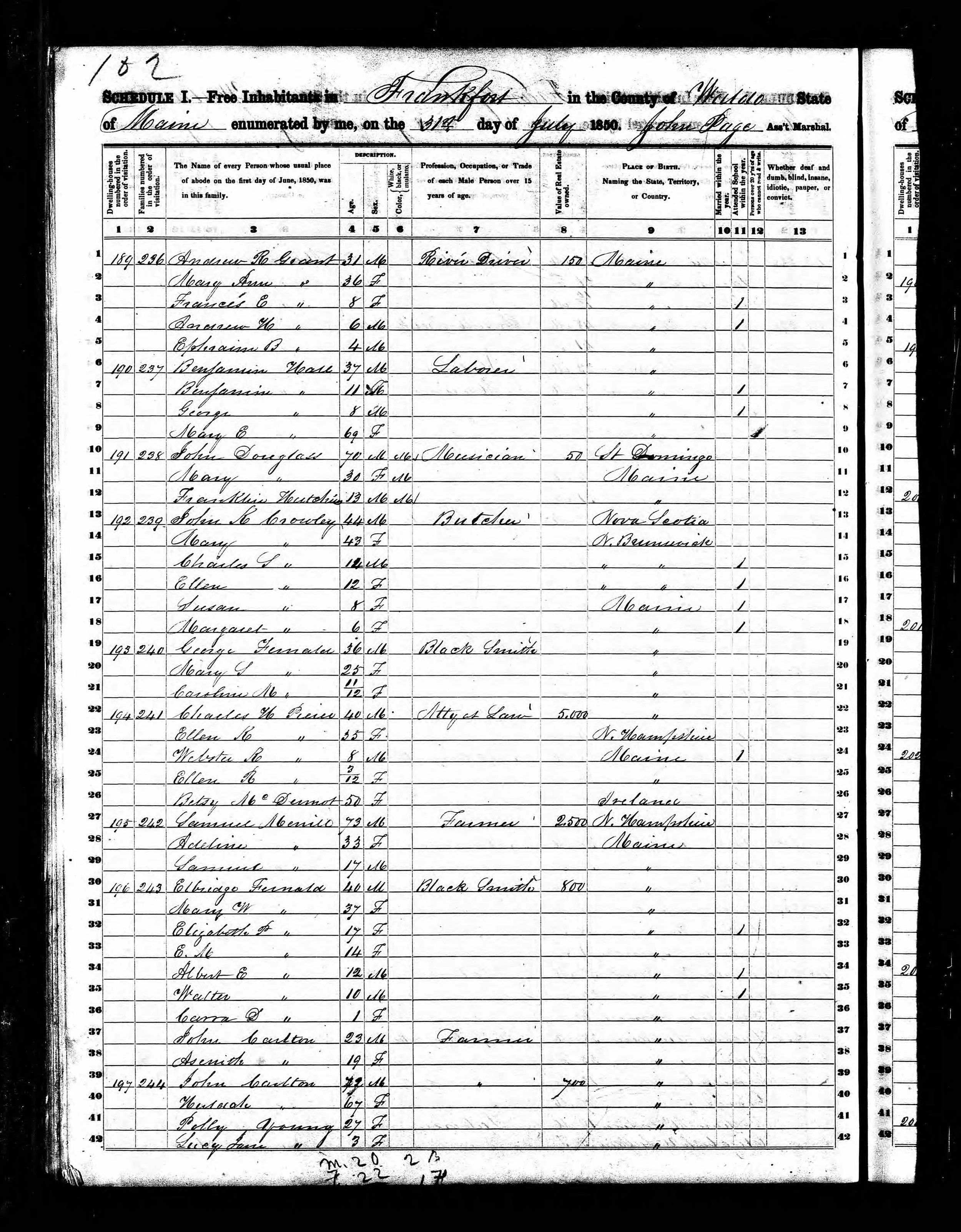
1850 Census for Frankfort, Maine
John Douglass appears on line 10, along with his wife, Mary Olney, and a 13-year-old boy, Franklin Hutchins.
Here’s another detail:
In 1828, one of John’s tunes was published in Violin Instructer (5th Edition), when he was around 50 years old. Called “Douglass’ Favorite,” it was among the earliest tunes published by Black musicians in the United States. This tune is still frequently included during contra dances in the midcoast region and beyond. For contra dancing enthusiast and former Belfast Flying Shoes board member Alex Mann, it was coming across “Douglass’ Favorite” that led him to start researching John (often called “Jack”) Douglass 20 years ago.
After researcher Dr. Kate McMahon connected the two of us, we quickly began stacking up our respective documents (his piles were a lot bigger than mine) on kitchen tables and firing off theories, trying to see if we could learn more about who Jack may have been, the conditions that made him land in a small hamlet in rural Maine, and the role he played in communities here nearly two hundred years ago.[2]
Here’s what we know to be true: according to census records, Jack was born around 1779 in St. Domingo. Therein presented our first conundrum–should we take this to mean San Domingue, the former French Caribbean colony that became the sovereign nation of Haiti or St. Domingo, the capital city in what is now the Dominican Republic? For our purposes, we generally take it to mean the entire island–Ayiti, or “land of high mountains” with a leaning toward San Domingue/what is now Haiti.
Between Jack’s birth and the time he left, the island had transformed from one of the most violent and brutal colonies in the world (also the wealthiest) to the epicenter of the Haitian Revolution–the largest and most successful slave rebellion in human history.
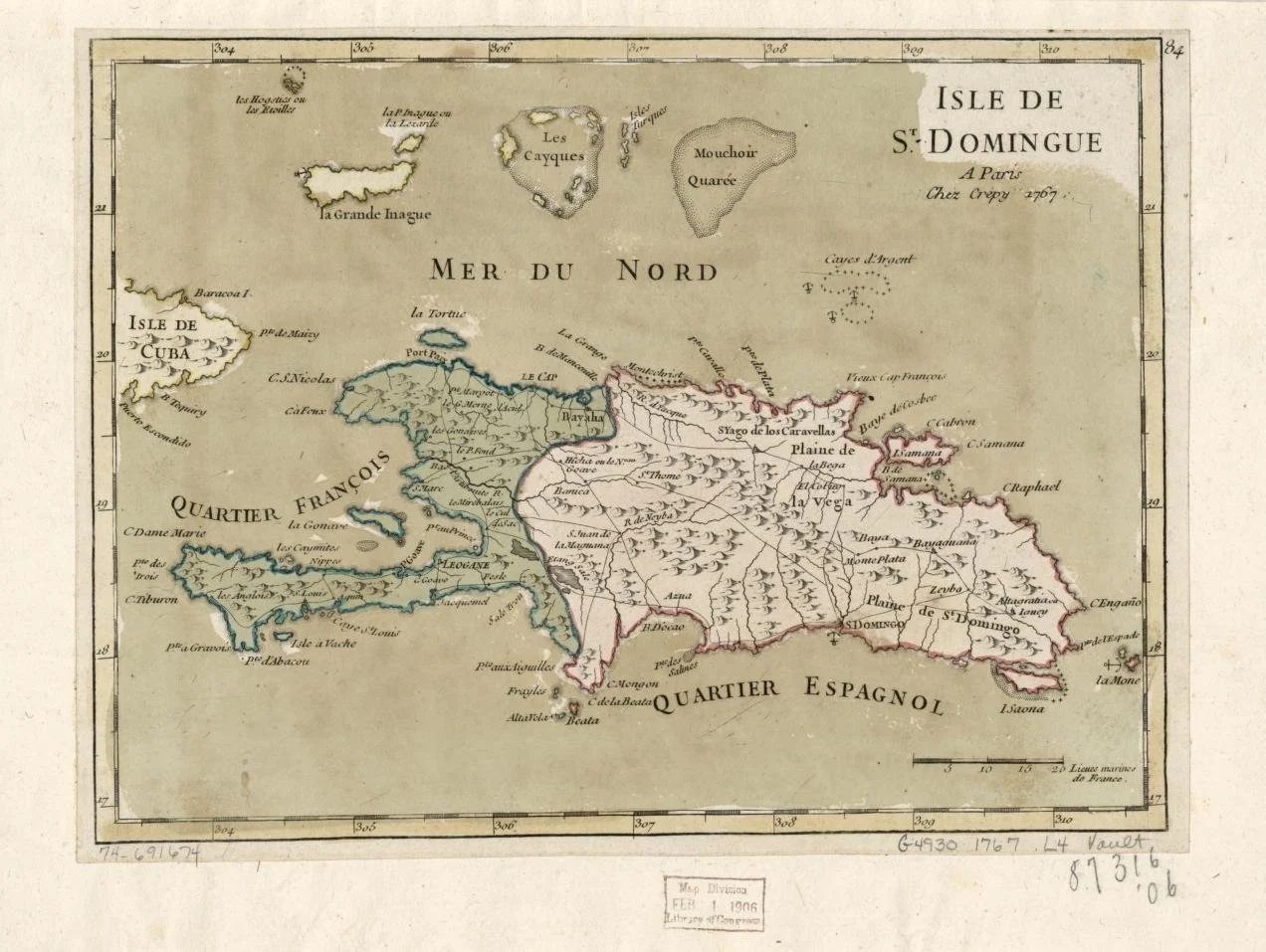
Isle de St. Domingue
by Le Rouge, Georges-Louis, published in Paris 1767 by Chez Crepy
The first references to Jack’s presence in Maine are from around 1802 in the town of Warren–an early resident of a soon-to-be thriving community of color in what became Peterborough. The Annals of Warren by Cyrus Eaton (1851) pegs him as hailing from New London and running a hattery along with Holbrook Martin (a white man from Concord, MA) and Isaac Brakely (a “colored man” from Poughkeepsie, NY). Eaton writes that Jack “was celebrated as a violinist, and took a bass viol to meeting, the first musical instrument except a pitch pipe ever used in public worship here.”
But what happened during the first 23 years of Jack’s life? How did Jack get to Maine–and Prospect, in particular? And how does one find out?
A chapter referencing Jack in the 1907 book, An Old River Town, written by Ada Douglas Littlefield (not a relation) contains some clues. Her source materials, housed at the Maine Historical Society’s Brown Research Library contain even more—including a collection of letters from people in Prospect, Frankfort, and Winterport responding to questions in letters Ada sent to them.
“I can’t tell you how he got here.” (letter to Ada Douglas Littlefield from G.W. DeSilver)
“He lived at San Domingo—when a boy he ran away from there and enlisted in some wars as a drummer boy…before living in Winterport he lived in Prospect. He used to live near or with Captain Chute.” (letter to Ada Douglas Littlefield from Nan Merrill, 1904)
“Jack was in the English Army. Major in army there. Lived at Cape Verde. Heard Captain Shute talk about it. He brought him over. He put him in hoghead.” (letter to Ada Douglas Littlefield from Captain Crocker)
“Came to Prospect [illegible] Capt. Benj Shute from San Domingo. Ran away from San Domingo – compelled to go in army drafted – to stay 7 years. Stayed 3 yrs. Au Manowar, had violin in drum. In water several hrs to Barbadoes” (notes by Ada Douglas Littlefield from a letter or conversation with Libbeus Cummings, a student of Jack’s who went on to have a long career as a fiddler)
From these letters, and with some historical context, a version of Jack’s life that feels at least slightly less apocryphal than the version found in Ada’s book emerges. Grateful as we are to Ada, who truly persevered against some great odds to write and publish this book, the evidence she had at hand does not present a consistent story, though the anecdotes are very colorful and not necessarily untrue. By all accounts, Jack was a man of legend, whether or not he actually rode around on a white horse, as Ada writes in her book, or could play in his sleep.
Given Jack’s race (multiracial), he could have been part of the gens de couleur libres (free Black and mixed race) in Haiti–i.e., still heavily restricted by the French colonial authorities but not enslaved. This too, is uncertain.
It’s not clear from the letters Ada received or her notes who Jack was conscripted by—if he ran away from forced military service by Haitian military forces or the French, and that he escaped from them and joined the British army or, if he was serving in the British military and only completed a portion of that service, too. Perhaps he really did run away from one of these forces with a fiddle[3] in a hogshead, swimming for three hours until a man-o-war picked him up in Barbados, as one person told Ada. A Black drummer named John Douglass was transferred to the British 4th West Indian Regiment in 1796, but we have yet to verify that this is the same person.
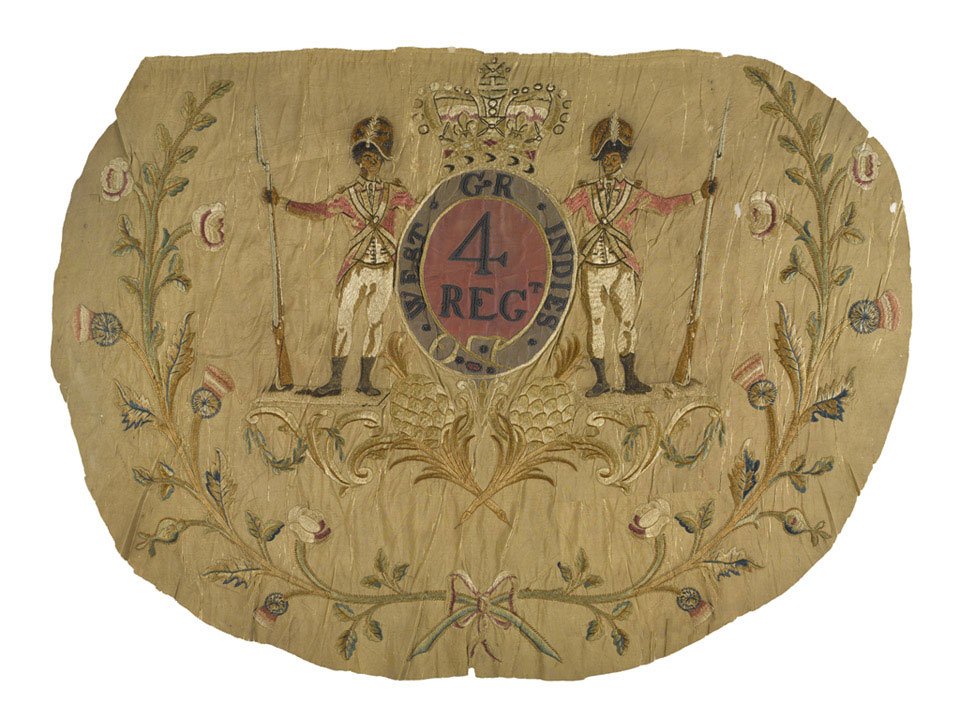
Regimental Colour of the 4th West India Regiment circa 1795-1804
Courtesy of the National Army Museum in London
Additionally, as Haitian-American musician and fellow Interco(a)stal colleague Jennifer Rachele notes, “John Douglass is not a very Haitian-sounding name.”—it’s likely Jack would have changed his name when he left St. Domingo.
Somewhere along the way–perhaps in the waters off Bermuda, perhaps in Cape Verde, perhaps in St. Domingo itself, Shute connected with a vessel that brought him to New England. Perhaps a Captain Shute of Prospect (there were several) delivered him first to New London, and he then made his way up to Warren/Peterborough. Then Camden. Then Bucksport. Eventually, Jack bought a farm and home from Giles Scott, in an area called “Poverty Shore” in Prospect Ferry, Maine, a peninsula along the Penobscot River, across from Bucksport.[4] The house looked out onto the river, which between the shipyards,[5] logging, and granite industry would have been a bustling maritime highway at that point in time.
By 1810, we find Jack listed in the census as living in his own residence in Prospect Ferry, with four other people (among them his wife, Sarah [Sally], and their daughter Belinda). According to the 1810 town evaluation records, they had 99 acres of unimproved land, eight acres of pasture, and eight cattle.
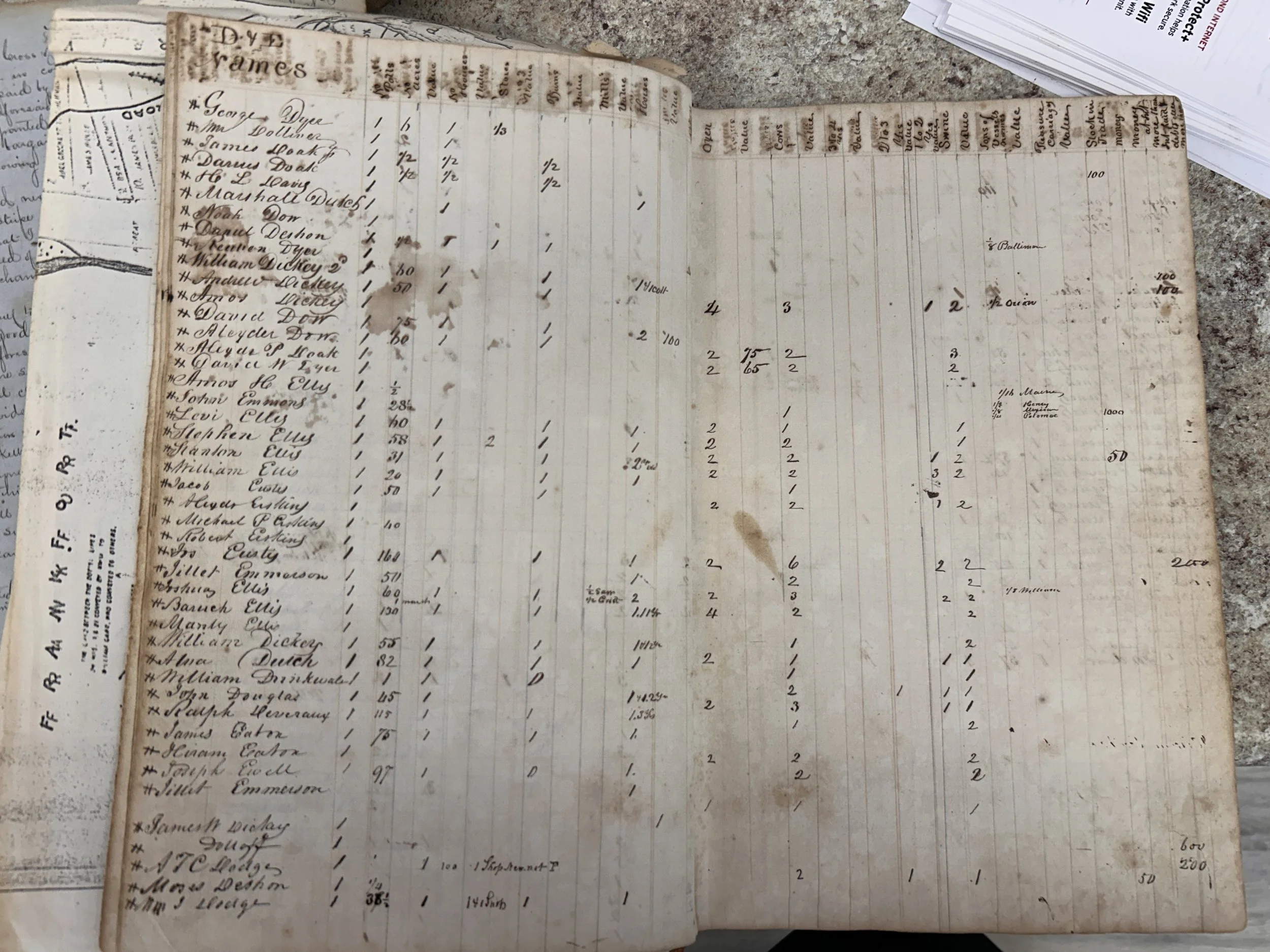
1838 Valuation Records for Prospect, Maine
This 1838 evaluation book featuring John Douglass was found up in the eaves of a town's fire dept. It's now safely tucked in at their historical society.
The next thirty years of Jack’s life were occupied by homesteading, becoming a father of at least five children, (three of whom died in their 20s), becoming a mason[6], the death of his wife, Sarah (the mother of his children) in 1837, marrying Elizabeth Brakely (daughter of his former business partner in the hattery) who died within a few years of their union, and marrying again (Mary Olney). His homes were also homes to other people of color who came to the area–at times he had up to three additional people living in his homes, likely some of the young Cape Verdeans who came to the area with Captain Benjamin Shute.
While Jack’s “occupation” isn’t officially listed in government documents until the 1850 census, the throughline through these immense joys and losses may have been his music, which he became extraordinarily well-known for. One of his students–Libbeus Cummings, said that Jack could read three bars ahead.
In 1838, Bangor accountant and shopkeeper John Martin kept a prolific 650-page illustrated journal in which Jack is mentioned:
To Show my ear for music I was in the Bar and a company from the Marsh on the March stoped in front of the house in the road hearing different companies music I was on the west side of the house the company on the east. I heard some exelent music on Tenore Drum I said to some one that is the best Drumming I ever heard whereupon I went to the door and, Jack Douglas was beating a tenore drum (he as has been known for years was the best musician on several instruments in the State and taught music on Bugle clarinet fife violin Tromboon Drum…
Numerous newspaper articles (mostly posthumous) similarly praise Jack:
“one of the greatest musicians in his day.” Sun Journal, Lewiston, ME, Jan 30, 1892
“Mr. D. was a great musician and played to many dances with that violin. He composed many pieces of music, one piece especially that shows his skill in composing, that being Douglass Favorite.” – Bangor Weekly Commercial, June 8, 1894
“Major Douglass was considered in those times to be the foremost musician of the vicinity and was in great demand in Belfast by the dancing public.” – Sun Journal, Lewiston, ME, March 8, 1913
“Major Jack Douglass the first teacher of instrumental music in all Down East and the everywhere known ‘fiddler of olden time’ now near ninety years of age had a benefit given him recently in Belfast and himself presides in the orchestra of the assembly.” – Bangor Weekly Courier, March 25, 1851
“The drum was beat in ancient style by that famous Antiquarian Musician, Jack Douglass, to whose music the mothers and grandmothers and great grandmothers of all Penobscot born, have tripped in the merry dance.” – Bangor Whig and Courier, August 25, 1847
“There was a Grand Ball at Pierce’s Hall on the evening of March 4th—Inauguration Day. The prominent feature was the veteran Major Jack Douglass, who made music on the occasion for the grandchildren of those who nearly half a century before tripped on “the light, fantastic to,” to the sound of his fiddle.” – Republican Journal, Feb. 18, 1875
Jack was among the first music teachers in Waldo County, if not the first. He played up and down the coast, at dances, parties, bees, and celebrations, sometimes playing on the Steamship Tarratine, often traveling between 20-30 miles to play for people’s weddings.
While most accounts point to Jacks’ talents as a musician being greatly appreciated and respected, there’s also this article, written in The Bangor Daily News in 1905, by someone who grew up in Prospect:
We can remember having had him pointed out to us when we were very young as a most wicked man, and a person who had sold his soul to Satan for the gift of music.
The same article goes on to acknowledge his unusual musical abilities, writing, “He could sit bolstered up in his chair and continue to play his fiddle long after he had fallen asleep–never missing a note.”
In addition to “Douglass’ Favorite,” other tunes Jack is said to have perhaps authored are “Beautiful Pennies” and “Hole in the Floor” along with a handful of waltzes that are supposedly in Howe’s New Violin Without a Master (1847, by Elias Howe). Whether or not Jack is truly the author of these songs, life with holes in the floor was not unknown to him. Venerated as he was, one unwavering trail Jack left was court records of people claiming debts from him left and right, up until his death. The 99 or so acres in Prospect he started off with were slowly parceled off and sold. By 1842, he still had 50 acres. In 1843, he went to live with his wife, Mary Olney, in Winterport (then still part of Frankfort) on his friend Billy Mansfield’s farm, selling his homestead in Prospect to a Cape Verdean family—the DeSilvers[7]—who had come over to Maine via Captain Benjamin Shute as youths.
When the DeSilvers built an addition on the house in 1859, they invited Jack to come and play for the housewarming and dance, which we know from a letter to Ada Douglas Littlefield penned by Miguel/Michael’s son, George. It was at this celebration where Jack likely last played “Douglass’ Favorite.”
George writes:
My father bought the place he lived on, and Jack moved to Winterport from here, where he lived for a long time. Father built a new part on the old house and was going to have what they called an old-fashioned housewarming and got the old man to come down to play for the dance. He came, and was taken sick and died at our house, and was buried in the Ferry Cemetery just below our house…
Jack’s wife Sarah is buried at the Ferry Cemetery, right on the southwest corner. Perhaps there was less forest around the cemetery then—this is likely—but if Jack is buried there he’s right on the edge, tucked in next to Sarah, even though his wife Mary was still alive.
Mary outlived Jack by 38 years, working at various houses in Winterport to provide for herself. One newspaper article from 1892 states that the masons of Steuben would be providing a home for her but that seems to have been short-lived, as two years later, she was living on the town farm in Winterport, where she spent the last three years of her life. According to yet another letter to Ada, Mary was reportedly buried in Ellingwood Cemetery as there were no burial grounds at the town farm. Mary’s grave, too, is unmarked, and the Winterport town sexton has no records mentioning her.
Jack had at least five children, possibly more. His daughter Belinda married Thomas Brown–Bangor’s first Black doctor. His daughter Lucy married Bartholomew Monteiro–another Cape Verdean who came to the Prospect area as a youth on ships captained by Benjamin Shute. Jack’s son, John Jr., worked as a stevedore in Portland.
The last time “Douglass’ Favorite” was played was last week, at a lively contra dance in Surry, Maine, not far from where Jack once lived.
Of this tune, music scholar and historian Paul Wells–who wrote The Maine Musical Compendium–noted to me via email:
To my mind and ears there's very little to distinguish it from the general run of Yankee reels...that is, I can't perceive anything African about it…It was accepted into the general New England repertoire alongside countless other stylistically similar tunes.
I’m not a music theorist and can’t say how stylistically similar or distinct “Douglass’ Favorite” may be from other reels of that era. On paper we have the notes Jack left behind. What we don’t have is a recording of how it sounded when Jack himself played it, nor any reflections on how it sounded from any of his Black contemporaries. As enigmatic as Jack himself remains, he was as undeniably distinct as can be.
Sometimes when “Douglass’ Favorite” is played by contemporary musicians such as the Pine Tree Flyers, it’s accompanied by a word about the fabled man who wrote it and the significance of this nineteenth-century Black fiddler in midcoast Maine.[8] Sometimes Alex has an opportunity to share the idiosyncratic history of this man. And sometimes, there’s nothing but the music.
Footnotes
[1] In 1860, the town of Winterport broke off from Frankfort, meaning that while technically, Jack lived in Frankfort, he never lived within the bounds of what is considered Frankfort.
[2] For what it’s worth, neither of us are professional researchers or historians. Alex is a 66-year-old retired geologist and I am a 44 year-old freelance writer who had never set anything but a wayward foot in the archives before digging into this research.
[3] Jack likely learned to play the fiddle in St. Domingo. In the late 1700s, the city of Le Cap (now Cap-Haitien) in St. Domingo was famous for its classical music and opera, including orchestras prominently made up of Black fiddlers. In addition, lest we forget, there is a long history of fiddling across the African continent that continues to this day.
[4] This land was purchased in 1808 from Giles Scott—son of a free “mulatto” woman and a white man. Giles was sent to Maine from Jamaica “for his education.” Jack married Sarah, who was possibly Giles’ daughter. In the deed, Jack is referred to as a hatter from “Buckstown” (Bucksport).
[5] According to research by Kate McMahon, at least three vessels used to transport captives through the illicit slave trade were built in what was then Prospect during the 1850s, the last decade of Jack’s life.
[6] In 1814, Jack became a member of the Machias Mason Lodge. In 1819, he transferred his membership to the Orland lodge (the lodge closest to Prospect).
[7] An 1894 article from the Bangor Daily News reports, “Another noted place in town [Prospect] is a farm on what is known as Poverty Shore. This farm ever since the oldest inhabitants can remember has been in the possession of colored people and is noted for being the home of the famous colored musician, Jack Douglass…”
[8] Jack was (and is) far from the only Black fiddler in Maine. Check out fellow Interco(a)stal artist Stephen Oliver’s work on Gambo (a fiddler who lived along the Presumpscot River), Lancaster Hodges of Brownfield, Isaac Davis of Cape Neddick, and Thomas Bassett of Kennebunk.
Immense gratitude to Alex Mann who started researching Jack Douglass over 20 years ago, Atlantic Black Box, Emeline Dehn, Meadow Dibble, the Pine Tree Flyers, Chrissy Fowler, Tina Gagnon, Lois Gianni, Arline Lamarche, Ada Douglas Littlefield, the Penobscot Marine Museum, Stephen Oliver, Megan Pinette, the Town of Prospect, Jennifer Rachele, Bucksport Historical Society, Frankfort Historical Society, Belfast Historical Society, Maine Historical Society, Prospect Historical Society, Winterport Historical Society, Stockton Springs Historical Society, Bonnie Veinote, Paul Wells, and Thomas Zeigler.
Additional Resources
Black Fiddlers - documentary film by Eduardo Montes-Bradley
Thomas Bassett - a Black fiddler who lived in the Ridge Community in Kennebunk Maine, who passed away in 1838
Hoedowns Reels and Frolics by Phil Jamison
Fiddling in West Africa: Touching the Spirit in Fulbe, Hausa, and Dagbamba Cultures by Jacqueline Cogdell DjeDje
Maine Musical Compendium by Paul Wells
A note from Michele and Alex:
Reader, we still have questions about Jack. Maybe you do, too.
Do Jack’s fiddles still exist? If so, where might they be?
How did Jack get to Maine? Might there be a mention of him in a ship’s log?
What were the conditions of Jack’s departure from St. Domingo?
Where in St. Domingo was he born?
What mentions are there of Jack in the British military archives at Kew?
Jack’s student, Libbeus “Lib” Cummings of Prospect studied daguerreotype photography in the 1850s—might a daguerreotype of Jack exist?
Who and where might his descendants be?
What might it take to make a memorial honoring Jack at his resting place in Prospect, as well as for his partner, Mary Olney, in Winterport?
If you’d like to connect, collaborate, and/or support this ongoing independent research and tending, please reach out.
About the Author

Michele Christle is a writer and community researcher whose work explores culture, ecology, history, and place. Her writing has appeared in publications including The Kenyon Review, Down East, and Cultural Survival Quarterly, and she has worked with organizations such as Maine Sea Grant, Maine Audubon, StoryCorps and Atlantic Black Box’s WHERE. The recipient of a LEF/CIFF Fellowship and residencies at Hewnoaks and Shannaghe, Michele is currently working on a writing and documentary project about eels, and writes a newsletter called Tinker on the Marsh, documenting her research and explorations in and around the tidal marsh where she lives. Learn more at michelechristle.com.