The Passamaquoddy & The American Revolution
Treaty of Watertown (July 19, 1776)
With the Revolutionary War underway, Continental leaders sought Indigenous alliances to secure the northern frontier against British forces and their Native allies. Drawing on longstanding Wabanaki grievances against British expansion, members of the Massachusetts Bay Council, on behalf of the Continental Congress, approached leaders from several nations in what is now Maine and the Canadian Maritimes.
The Treaty of Watertown was the first formal treaty—and first international agreement—of the United States after the Declaration of Independence on July 4, 1776. Concluded in Watertown, Massachusetts, between the Passamaquoddy, Mi’kmaq, and Maliseet nations, it pledged Wabanaki military support against the British in exchange for recognition as independent allies, along with promises of mutual respect, clothing, provisions, and ammunition.
Passamaquoddy warriors served as scouts, guides, and fighters in the challenging coastal and riverine terrain, playing a key role in securing Maine’s eastern frontier. Without their support, parts of eastern and northern Maine might well have ended up within Canadian provinces. The U.S., however, failed to uphold its commitments; expansion soon violated Wabanaki sovereignty, and promised supplies were never delivered.
The Revolutionary War’s Cost to the Passamaquoddy
Under the treaty, Wabanaki communities were to “supply and furnish 600 strong men … for service in the Continental Army.” A Passamaquoddy war song, Polansuwe Susehp Neptan, shared by Francis Joseph Neptune and preserved at the Library of Congress, suggests that roughly 200 of these men were Passamaquoddy—and many died in battle.
Beyond the loss of life, the war accelerated settler encroachment. After the Treaty of Paris (1783), ancestral Passamaquoddy lands became a resettlement area for displaced Loyalists. Along the St. Croix River, 200-acre parcels were taken from the Wabanaki and awarded to Revolutionary War veterans, while Britain enacted similar seizures across the river. Hunting and fishing grounds were diminished, and timber extraction, farming, and mill construction disrupted ecosystems. Over time, the Passamaquoddy were treated as trespassers in their own homeland.
This erasure of Passamaquoddy contributions to the Revolution foreshadowed a pattern repeated in later American wars.
“Then wars came, the Spanish-American War, World War I came, and the Passamaquoddy sent young men to battle, even though they could not vote or be considered US citizens. The percentage of Tribal men who fought in these wars was higher than most other towns and cities in the state. These soldiers returned to their communities as heroes, only to be treated as outcasts by members of the surrounding communities.”
George Washington Appeals to the Passamaquoddy - 1776
Writing to Passamaquoddy tribal leaders from the banks of the Delaware River on the eve of his famous risky crossing, George Washington appealed to the Chiefs for help. Morale among Washington’s troops was extremely low, following a series of crushing defeats. The support of Indigenous allies would prove decisive in securing American independence.
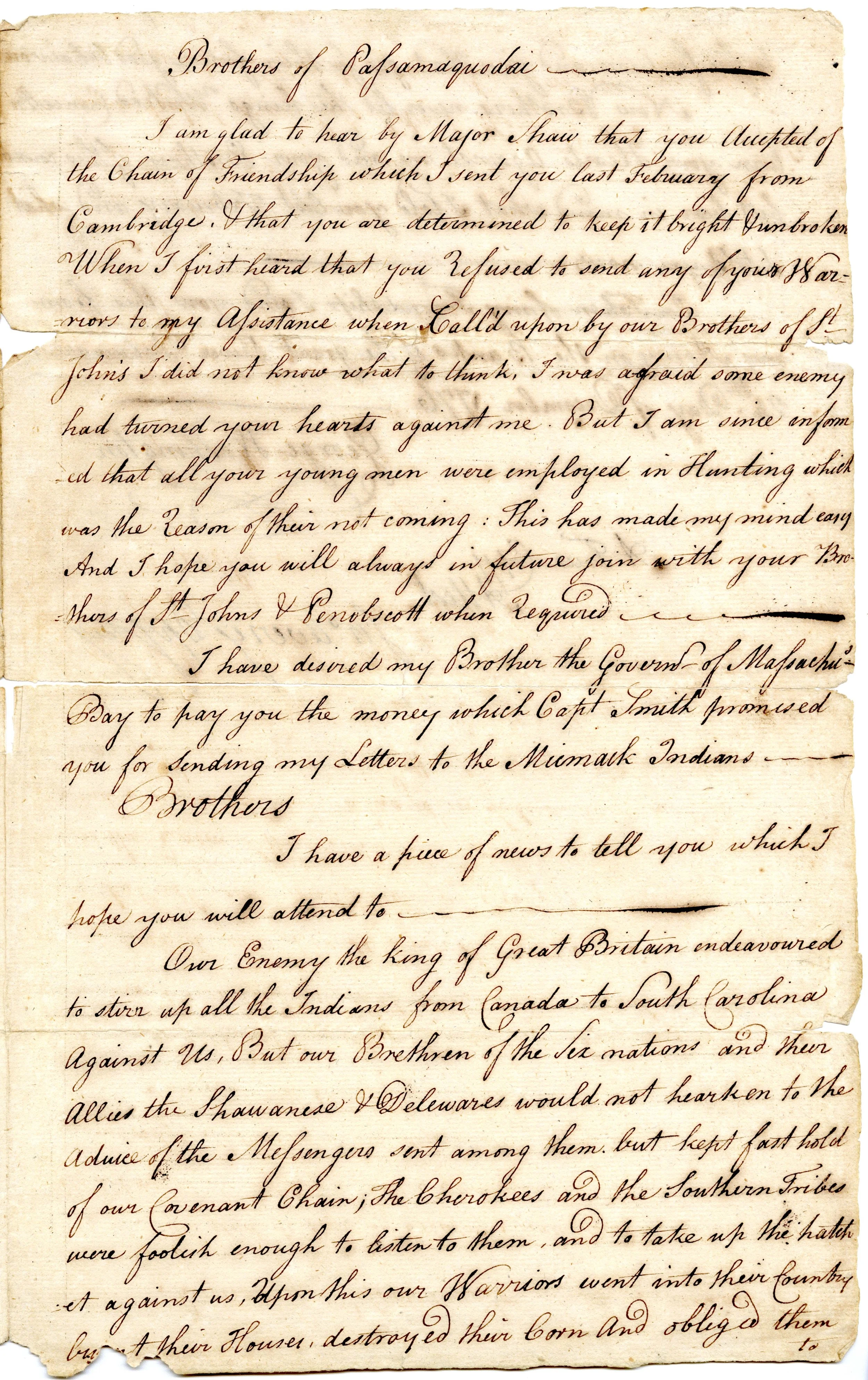
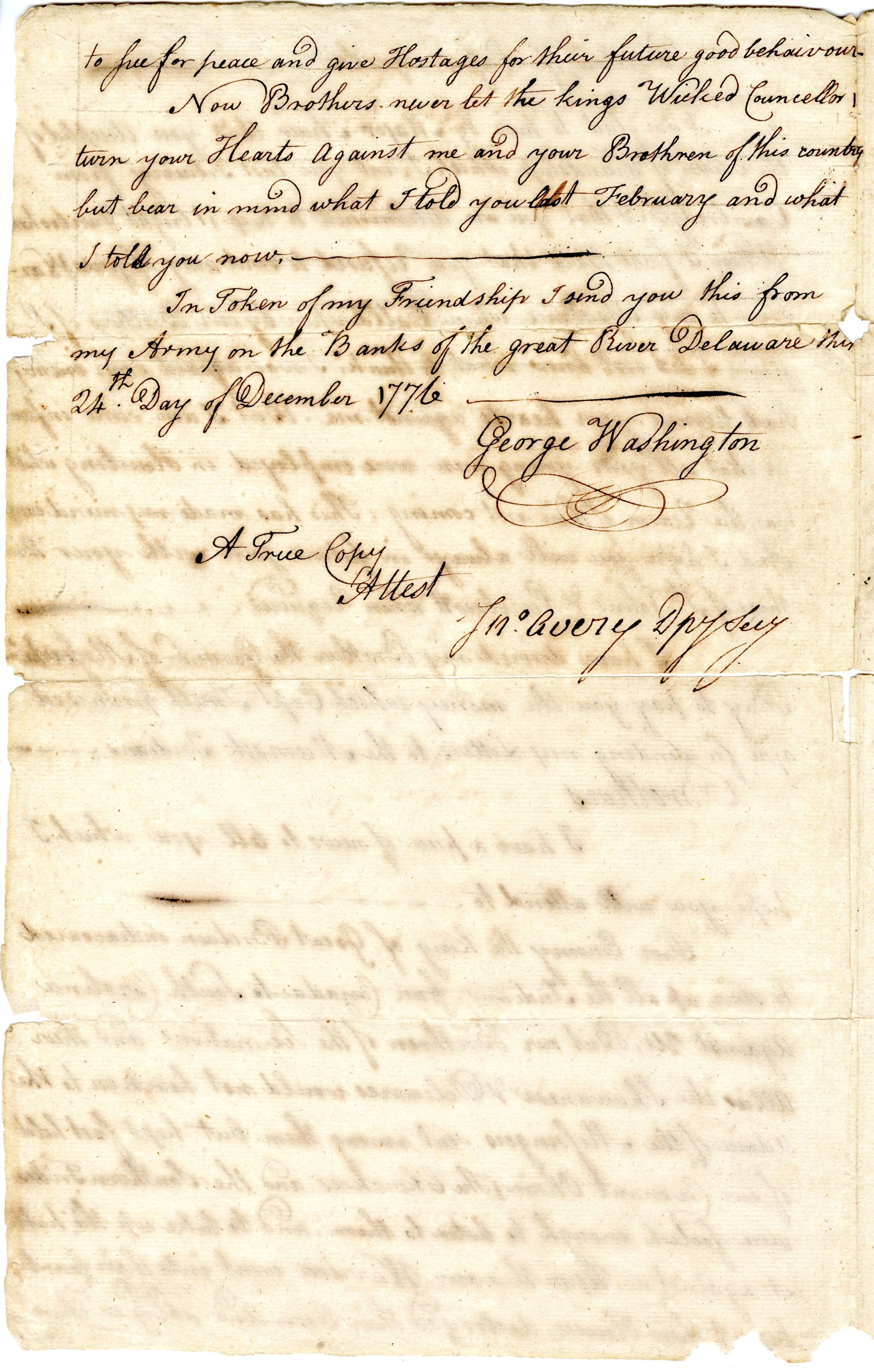
Collection: George and Martha Washington letters | MS-SC2956 | ArchivesSpace Public Interface
(Text from letter above)
Brothers of Passamaquodia
I am glad to hear by Major Shaw, that You Accepted of the Chain of Freindship which I sent you last February from Cambridge, & that you are determined to keep it bright and unbroken. When I first heard that you refused to send any of your Warriours to my Assistance when called upon by our Brothers of St Johns I did not know what to think; I was Afraid that some Enemy had turned your Hearts Against Me. But I am since informed that all your young Men were employed in Hunting, which was the reason of their not coming; This has Made my Mind easy, and I hope you will allways in future join with your Brothers of St Johns & Penobscott when required.
I have desired My Brother the Governr of Massachusetts Bay to pay you the Money which Capt. Smith promised you for Sending My Letters to the Micmack Indians.
Brothers—I have a peice of News to tell you which I hope you will Attend to. Our Enemy the King of Great Britain endeavoured to Stir up all the Indians from Canada to South Carolina Against Us, But our Bretheren of the Six Nations and their Allies the Shawanese and Delewares would not hearken to the Advice of the Messengers sent among them but kept fast hold of our Ancient Covenant Chain; The Now Brothers never lett the Kings Wicked Councellors turn your Hearts Against Me and your Bretheren of this Country, but bear in Mind what I told you last February and what I tell you now. In token of my Freindship I send you this from my Army on the Banks of the great River Delaware this 24th Day of December 1776.
George Washington
More context for this song and recording located here.
Additional Resources
This research was compiled as part of the Mihqitahatom: The “I Remember” Walk at Motahkomikuk/Indian Township, which took place on August 17, 2025. For more research related to this area, click on the tags below. To download a hi-res version of the posters below for educational use, please contact where@atlanticblackbox.com.
This walk was a collaboration between the Passamaquoddy Tribe at Motahkomikuk (Indian Township), First Light, and the Walks for Historical & Ecological Recovery (WHERE), a series convened by Atlantic Black Box, following the actions and determination of the community and leadership from elders.
