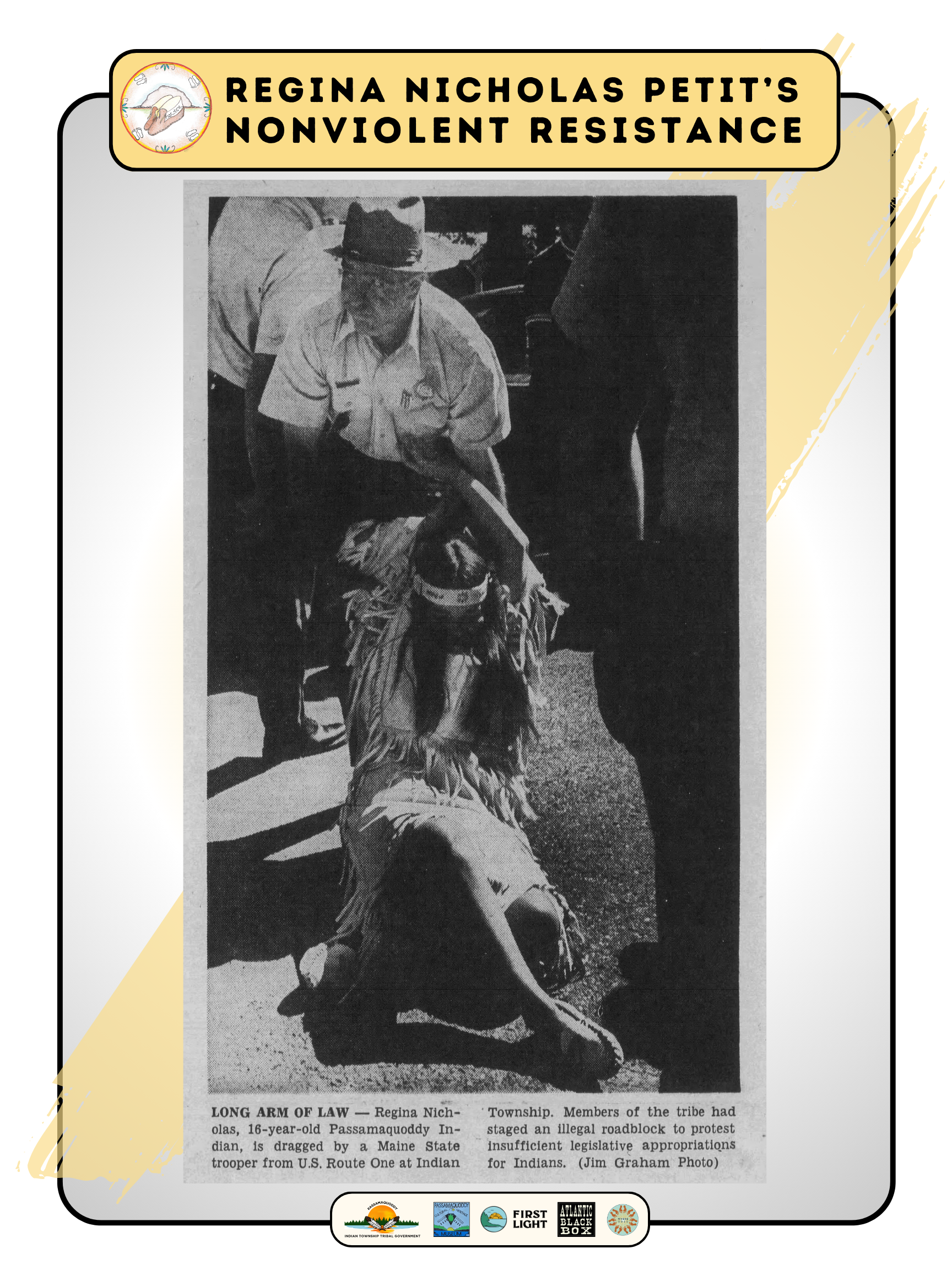
The Roadblock at Forestry Corner
The buildings at Forestry Corner, located at the crossroads of Route 1 and Grand Lake Stream Road, are remnants of state infrastructure that now belong to the Passamaquoddy tribe. As the site of nonviolent protests and courageous acts of resistance in the 1960s and 70s, this intersection is charged with symbolic power and has become a place of community memory.
“Not even one cent do we ever get for that long strip of land, one mile wide by eight miles long, used as payment to build a road through Indian Township. ”
Chief Allen Sockabasin and attorney David Crosby, as the State Police block the forest building door
Roadblock
By 1968, the Passamaquoddy at Motahkomikuk were deeply frustrated with how the State of Maine administered tribal funds and services and regularly failed to meet the community’s basic needs. After state agencies ceased supplying the milk, food, and medicine allotments tribal members relied on—which were meant to be paid for from tribal trust accounts—residents rose up and responded by erecting a roadblock at Forestry Corner and establishing a tollbooth to raise the money to purchase the supplies. Motorists were charged $1 per vehicle. Before long, the State Police were on the scene. But within an hour officials had capitulated and restored the allocations.
The roadblock fits into a broader pattern of actions that took place in 1968–1969, when Passamaquoddy protestors used their bodies to stop non-Native contractors and block loggers illegally operating on reservation lands. These protests produced arrests, criminal charges in some cases, and growing legal and political pressure that fed into the larger land-claims litigation and eventual settlement movement.
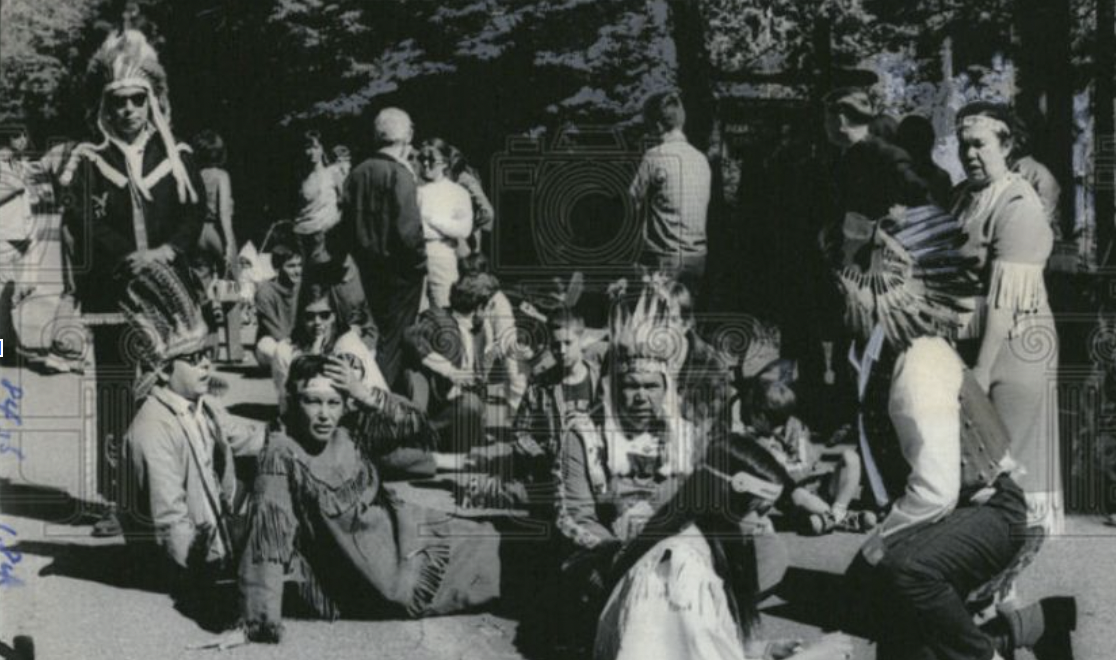
Occupation of the Forestry Building
It was during this period that the State of Maine permitted Georgia Pacific Lumber Company to aggressively cut standing timber on the Motahkomikuk reservation, an operation managed through the State Forestry Office housed at this location.
Passamaquoddy Chief John Stevens protested these actions, stating, “They are using bulldozers and scraping the land barren. There won’t be anything growing there in 200 years if we let them continue their present tactics” (Woodard 2014).
Tribal members entered the Forestry Building.
“We told them we never authorized placement of that Forestry building,” former Passamaquoddy Vice Chief Darrell Newell recalls. “Things reached a boiling point. Other tribes came to our assistance, and we all came together. We were inspired by Martin Luther King, by his peaceful resistance movement.”
They then asked the foresters to leave the building, which they did.
July 8, 1969
According to Professor Micah A. Pawling, on July 4, 1968, a week after tribal leaders asked the company to remove their harvesting equipment from their lands, 40 Passamaquoddy citizens sat in front of the logging skitters and trucks to protest the cutting of tribal timber.
Again, the State Police arrived and broke up the gathering. Eventually the Governor of Maine and the Chief reached an understanding.
Several days later, Georgia-Pacific agreed to the tribal demands to hire “all-Indian crews” and to gradually turn over cutting practices to the Passamaquoddy within 10 to 15 years.
In 1969, Maine enacted Chapter 217, “An Act to Improve the Management of the Indian Township Forest Resources and Passamaquoddy Trust Funds” (effective Oct. 1, 1969), showing Augusta’s heightened focus on the Township’s forests and finances during this same period.
This site later served as the tribal Forestry Building to manage the tribal forest. Today it serves as the Child Welfare Building and Public Works Building.
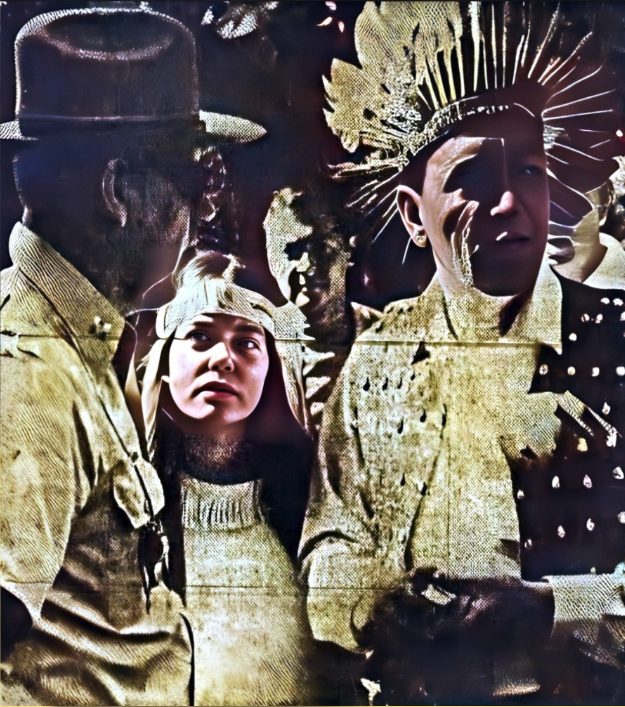
Chief John Stevens and Regina Nicholas Petit talking with a state trooper
Further Resources
Unsettled (Portland Press Herald special project, 2014) Investigative series quoting Tribal leaders describing how milk deliveries and medical payments were cut and how trust funds were being effectively controlled by state agencies.
“Wabanaki Forests: Identity, Cultural Connections, and a Call for New Collaborations.” by Micah A. Pawling, Maine Policy Review, vol. 34, no. 1, 2025, pp. 22–27, documents the July 4, 1968 forestry roadblock sit-ins and direct actions blocking skidders & logging trucks.
This research was compiled as part of the Mihqitahatom: The “I Remember” Walk at Motahkomikuk/Indian Township, which took place on August 17, 2025. For more research related to this area, click on the tags below. To download a hi-res version of the posters below for educational use, please contact where@atlanticblackbox.com.
This walk was a collaboration between the Passamaquoddy Tribe at Motahkomikuk (Indian Township), First Light, and the Walks for Historical & Ecological Recovery (WHERE), a series convened by Atlantic Black Box, following the actions and determination of the community and leadership from elders.