Recognizing Pompey’s Service
Contributed by Barbara Desmarais
Writer and local historian, author of Cemeteries of Brunswick blog
The third and last captain at Fort George was Capt. Benjamin Larrabee, whose “Negro servant” was named Pompey. Four documents provide cursory details about Pompey’s life in Brunswick from 1730 to 1749.
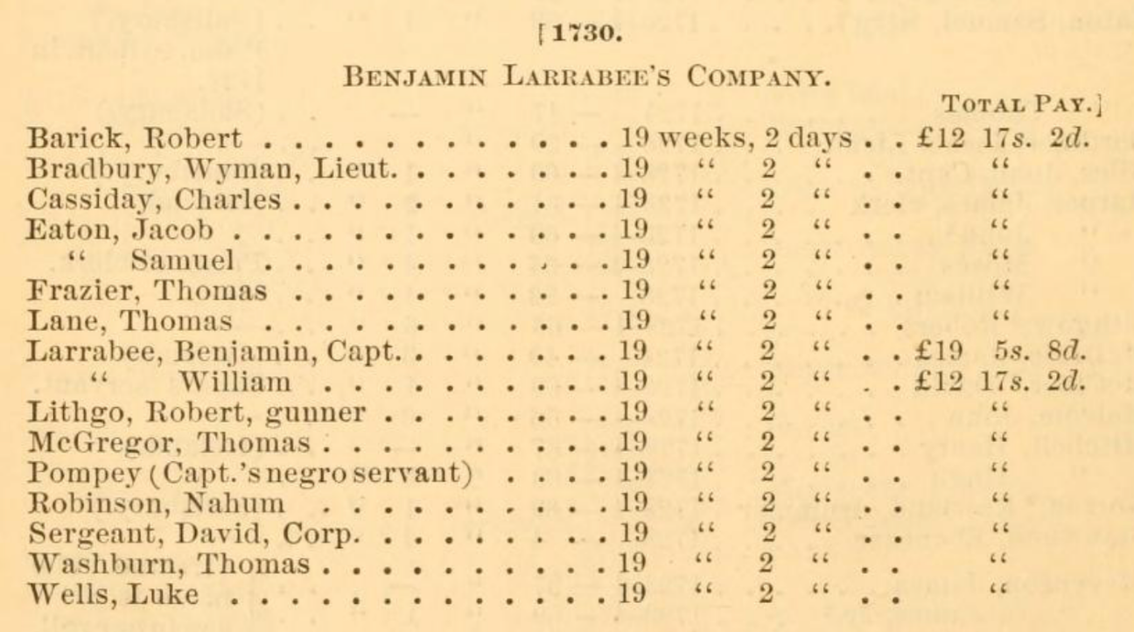
Two documents list the members of Capt. Larrabee’s military company, first in 1730 and then from 1738 through 1745. In both, Pompey’s position is the captain’s “Negro servant.” Since he was paid the same rate as the other soldiers and not called “Negro boy,” it seems probable he was at least fifteen years old in 1730.
The entry “Captain’s Negro servant” doesn’t tell us if Pompey was a free man of color, a soldier simply assigned to aid the captain, or enslaved. By 1641, British colonials in Massachusetts had passed laws clearly defining a “servant of color,” be they “Negro” or “Indian,” as a slave. Some enslaved persons were treated as indentured servants with the opportunity to gain their freedom, though many were enslaved as “property” to be traded or sold.
As a soldier, Pompey lived at Fort George, perhaps with the Larrabees in their large house within the fort walls. When Fort George closed, he would have moved with the Larrabee family to their new home at New Meadows, across the river from Georgetown (Bath).

Pompey’s given name hints at enslavement. Most colonials in Maine bore Hebrew biblical names ranging from the common Joseph and Mary to the unusual Hezekiah or Mehitable. Enslaved persons, though, were sometimes given classical names of Greek or Roman origin. Since the “original” Pompey was the ancient Roman general, Pompey the Great, it wouldn’t be hard to imagine Capt. Larrabee naming his “servant” after the long-ago military officer.
“Pompy, a negrow belonging to Benjamin Larrabee, Esq., of Brunswick and Silvey a negro belonging to Mr. Mikel Malcolm of G., int. Mar. 12, 1747-48.”
By 1748, Pompey would have been thirty-three or older. Had he been allowed to keep his military wages? If so, did he have to buy his own uniforms, weapons, and food? Was he saving up to buy his freedom? Pompey’s third appearance in the archive occurs in the record of Georgetown Marriages.
The record of Pompey and Silvey’s intentions to marry reveals that both were of African descent and both were enslaved. Georgetown marriage records of the time are notoriously lacking; no marriage was listed for the couple or for dozens of other intendees.
What actually happened?
Capt. Larrabee died May 9th that same year. He left no will or testament that would clarify Pompey’s status at the time of Larrabee’s death. It would be up to the general court to determine the disposition of Larrabee’s land and goods.
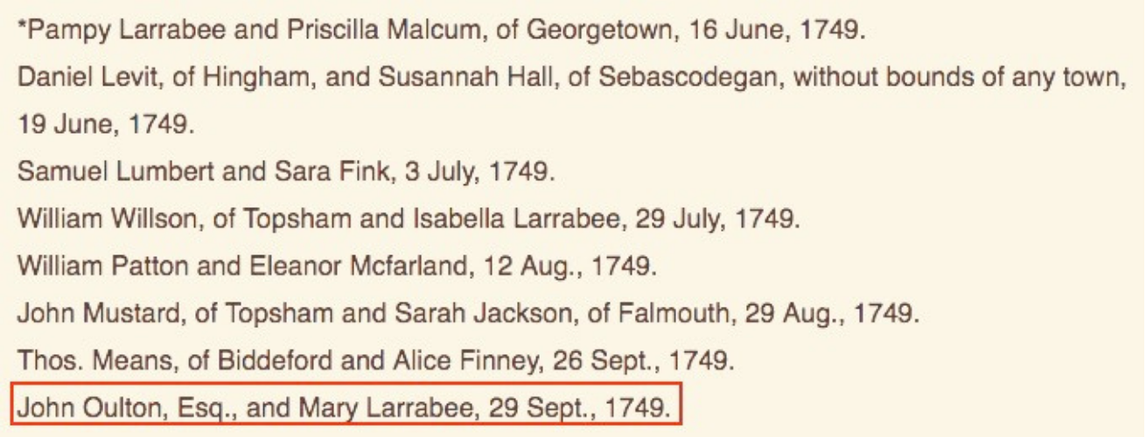
The final document is also a marriage intention, this one in Brunswick on June 16, 1749. It listed intentions between Pompey “Larrabee” and “Priscilla Malculm of Georgetown.” Priscilla and Silvey may have been the same person. The Malcolm/Malculm surname fits, as does the bride’s Georgetown residence.
Once again, there’s no record of marriage between Pompey and Priscilla. Still, there was a marriage that year that may have been life-changing for Pompey. On Sept. 29th, Capt. Larrabee’s widow, Mary, wed John Oulton. Anything Mary owned immediately became Oulton’s to do with as he pleased.
Perhaps including Pompey.
This research was compiled as part of the Pejepscot Portage Walk, which took place in Brunswick on October 6, 2024. For more information about this walk, clickhere.
For more research related to this area, click on the tags below. To download a hi-res version of the posters below for educational use, please contact where@atlanticblackbox.com.
This walk was a collaboration between the Pejepscot Portage Mapping Project and Atlantic Black Box.